Merlot and Bondola
Grape Varieties
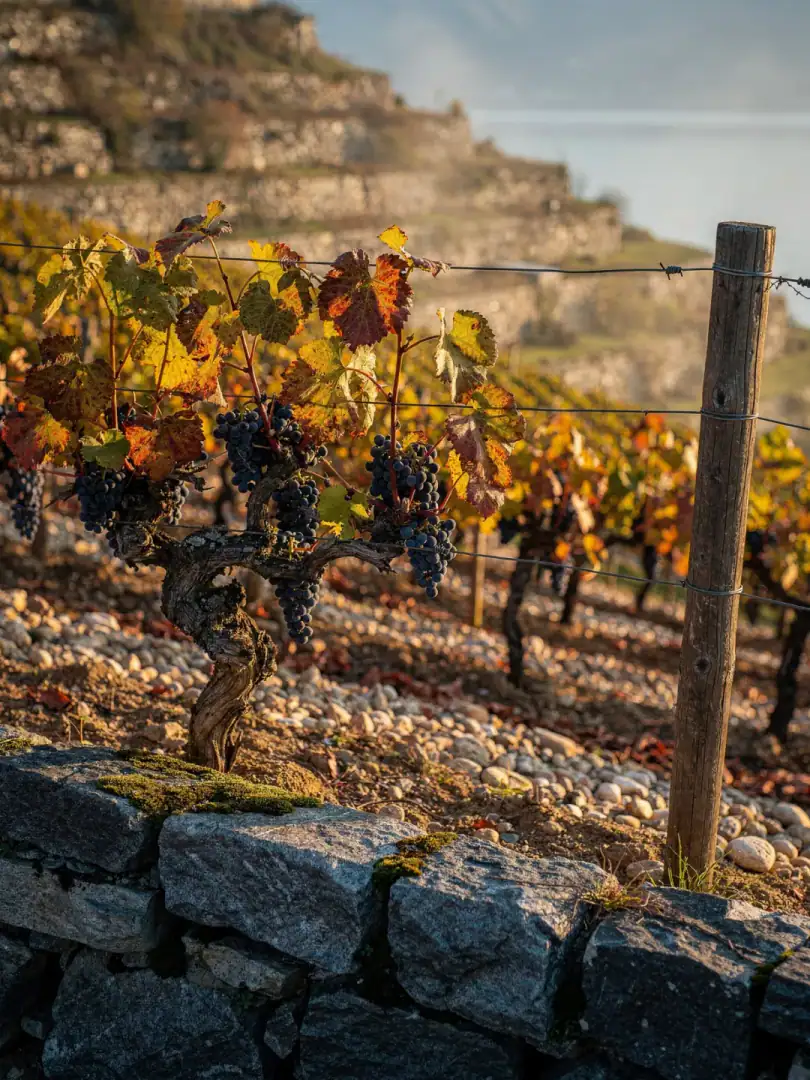
A single grape variety now carries almost the whole of Ticino winemaking: Merlot. It arrived from Bordeaux only in 1904 and within a few decades pushed nearly everything else aside. Today it covers a good three-quarters of the vineyard area. No other Swiss wine region depends so heavily on one single variety. That says something about both courage and risk.
In the glass, Ticino Merlot shows lighter than its French model, since the humid, warm climate and the thin, stony soils don't hold back the sugar, but they do rein in the heavy, expansive body that Merlot often takes on along the right bank of Bordeaux. The result is a wine of ripe plum, a touch of cherry, and a velvety tannin that's rarely hard, that furry grip in the mouth that comes from the grape skins. Between Sopraceneri and Sottoceneri, length is the main distinguishing feature: leaner and tighter in the cooler north, denser and darker in the warmer south.
Before Merlot, Bondola ruled here, an old native variety with thin skin and pale color, barely more robust than a rosé, but juicy and easy to drink. After the Merlot boom its area shrank to under two percent, together with the related Bondoletta. A handful of winemakers still grow it, mostly in the Sopraceneri. They pour it young in the Grotto, just as people did two hundred years ago.
Merlot is, on top of that, the only variety anywhere that gets bottled in the same canton both as a full-bodied red and as a pale Merlot bianco. For the Bianco it's pressed with no skin contact whatsoever. Alongside it, small amounts of Cabernet Franc, Cabernet Sauvignon and the new crossing Gamaret ripen for blends, and among the whites, Sauvignon Blanc, Chardonnay and Semillon, though a DOC Merlot may only be blended with wine from Italian-speaking Switzerland itself, never with grapes from outside the canton. Varietal wine still accounts for the great bulk of the harvest: pure Merlot.