Opoka & Terraces
Soils
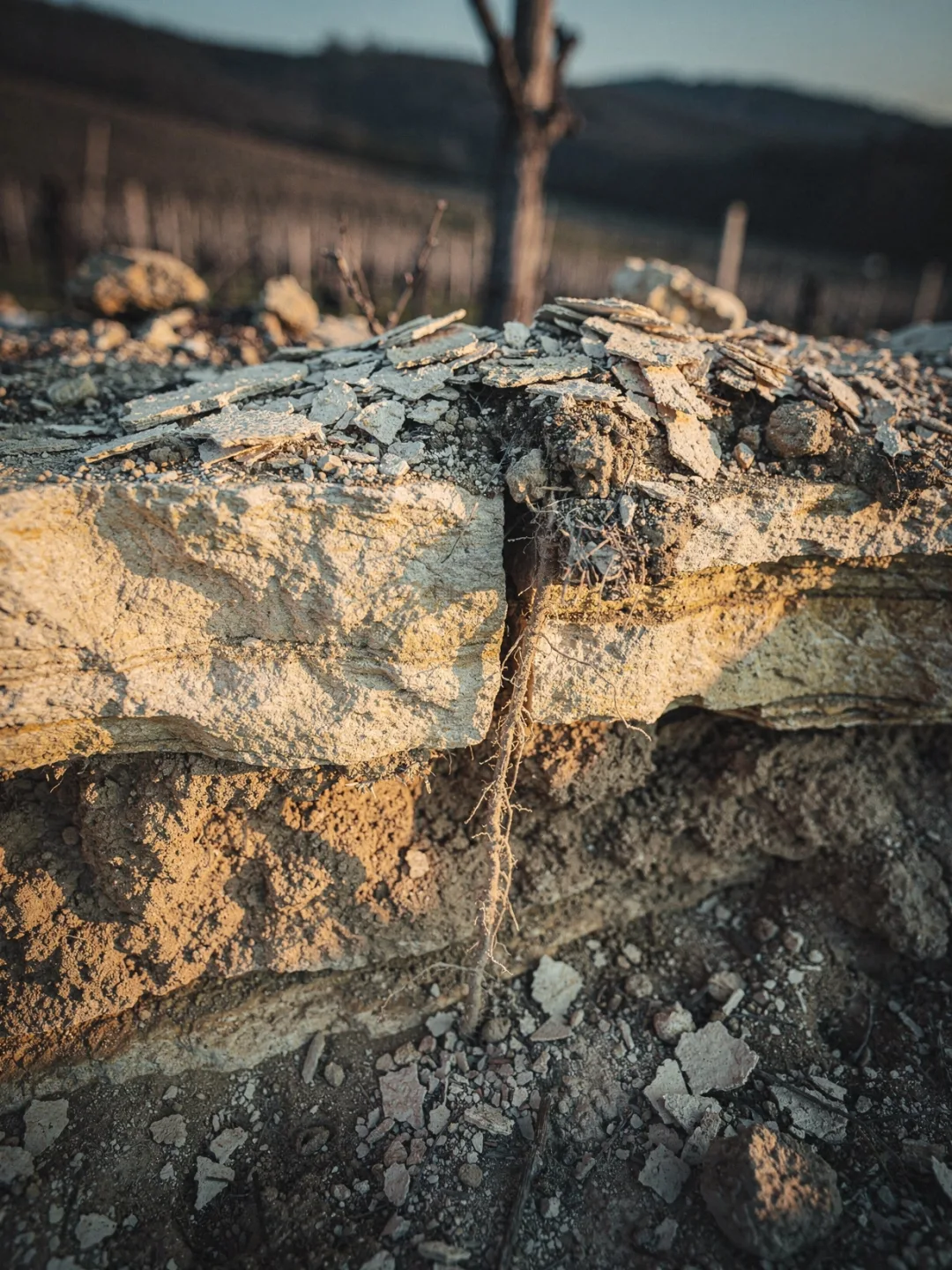
Anyone who digs a spade into the slope at Jeruzalem hill hits soft, pale stone after just a few strokes. This is opoka, a mixture of marl and fine sandstone that formed roughly eighteen million years ago at the bottom of the Pannonian Sea. You can crumble it between your fingers.
This very softness makes opoka both a problem and a blessing. Water and air pass through easily, so the vine roots drive deep, often several meters, in search of moisture and the few nutrients the stone can offer. But in heavy rain, the same stone swells and becomes unstable, and entire stretches of slope have slid in the past.
In the Haloze, the story is written a little differently. There the opoka dates from the Miocene, an epoch over five million years ago, and is in places threaded with hard, calcareous sandstone. The slopes there are also steeper than in the Ljutomersko-Ormoške gorice, where loose sand, gravel, clay and marl alternate. Both soils yield white wines with similarly lean acidity; only the fullness on the palate differs.
A persistent misconception lingers here too. People often say the wine tastes mineral because the root draws minerals from the rock and passes them on. That's not quite right. Rock supplies only trace amounts of dissolved ions, far too little for any palate to detect. What actually matters is the indirect effect on water balance and warmth, which the pale stone stores during the day and releases again at night.
Terraces are the human answer to this restless ground. They break the slope into flat steps, hold the rain on the surface longer, and slow the erosion that would otherwise wash a piece of vineyard down the hill every autumn on a bare opoka slope.
A thin, dark layer of decomposed leaves and grasses, almost always left standing between the vine rows to hold the slope in place.
The root: Fine roots capture the rain here as soon as it falls, and after just a few dry days they're the first to go thirsty.