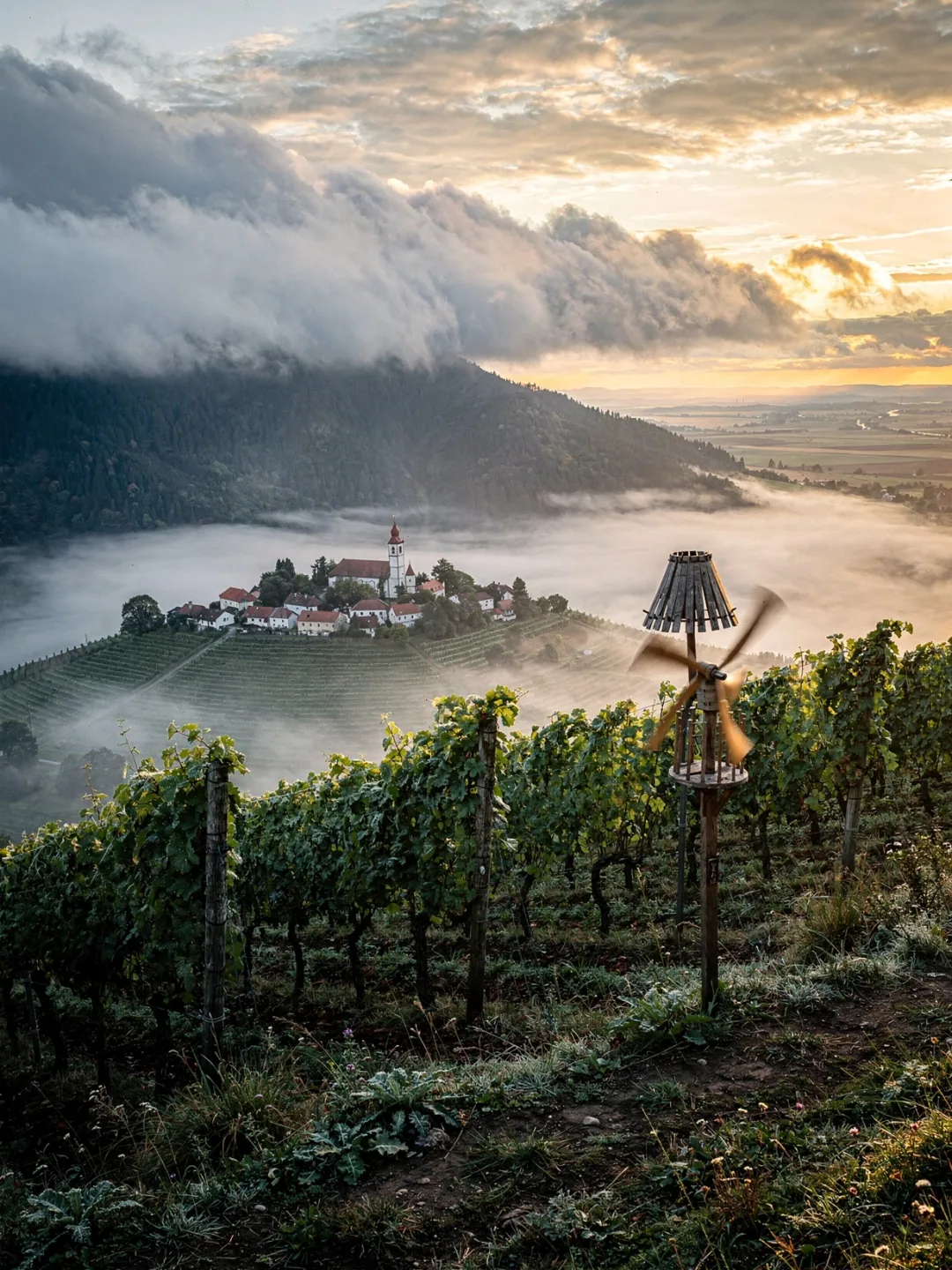
Pohorje Meets Pannonia
Climate
Two weather worlds collide here. To the west stands Pohorje, to the east the Pannonian Plain opens up, and Štajerska Slovenija lies exactly in between. The mountains rise to 1,543 meters at Črni vrh, holding back cool, damp air. To the east, meanwhile, the land is open all the way to Hungary, bringing in dry, continental warmth.
This contrast creates a climate best described as moderately cool, even though the summers are anything but mild. Daytime temperatures in September often climb above thirty degrees Celsius. At night, the Pannonian air quickly cools. It is precisely this difference between day and night that keeps the acidity fresh in Sauvignon and Šipon, even as the sugar in the berries keeps rising.
Without this shift, the wines would taste flat. That's why the best sites usually lie on sunny south-facing slopes, above the cold air layer that settles in the valleys at night. Once the berries start to sweeten, the Klopotec comes into play, a wooden windmill mounted on a tall pole. It rattles loudly to keep starlings and blackbirds away from the grapes. Up there, the risk of spring frost is lower, and the grapes ripen more evenly than down at the foot of the slope, where cold air and fog tend to pool. That's exactly what makes all the difference in the end.
Around a thousand millimeters of rain fall each year. That's also the risk. Because the soft opoka drains water poorly, it swells after heavy rain and becomes slippery. Entire slopes have slid as a result, which is why a grass cover is almost always left standing between the vine rows to hold the soil in place.
Climate change has already shifted the calendar. What used to begin in late September has, in recent years, started as early as August in parts of Podravje, roughly a week earlier than usual. Winegrowers are now deliberately harvesting earlier to preserve acidity before the heat burns it off.