Albariza, Barros, Arenas
Soils
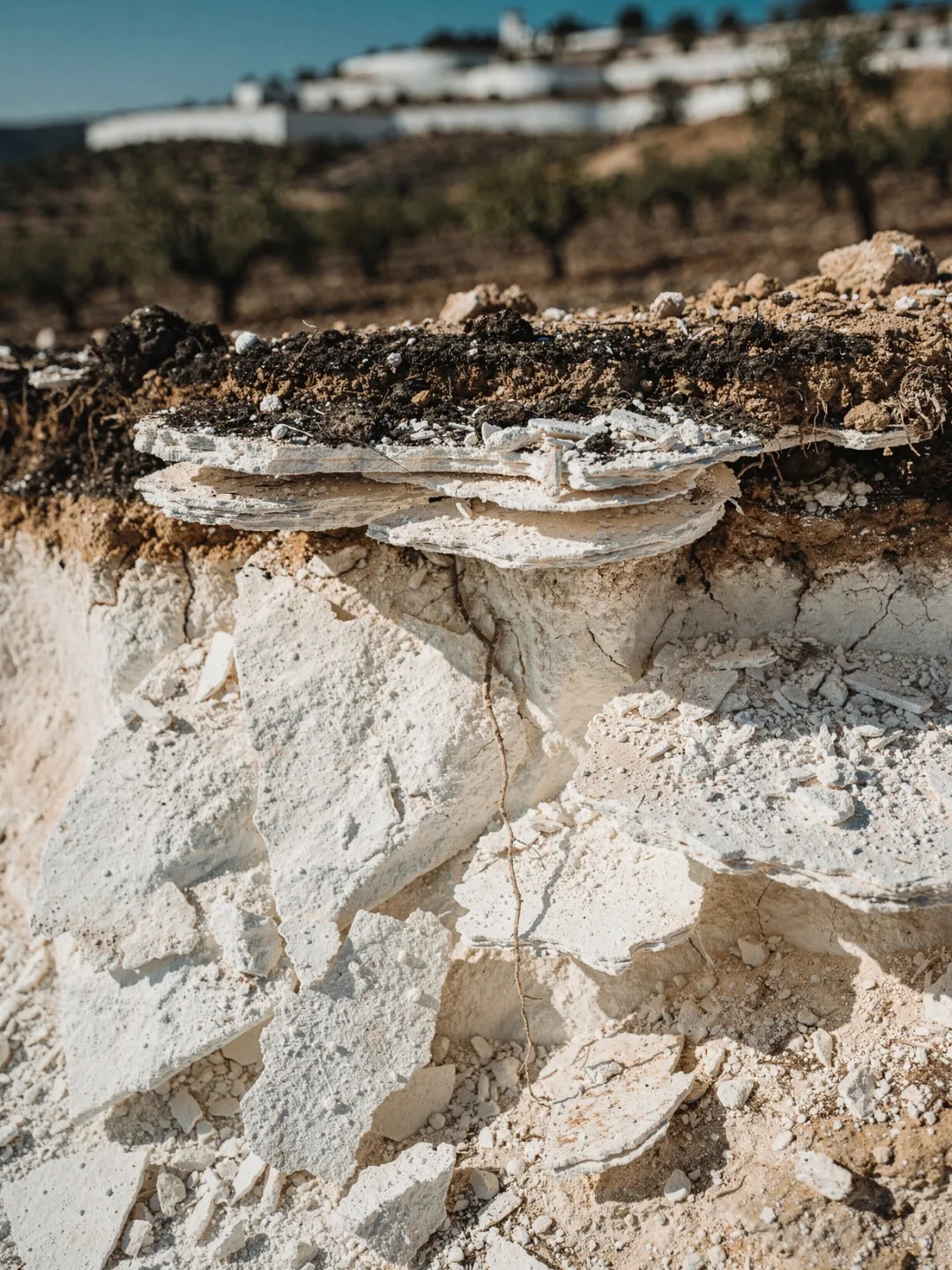
Dig a hole in a vineyard near Macharnudo in summer, and you'll quickly hit brilliantly bright earth: Albariza. It's a marl deposit from a former sea, rich in calcium carbonate, clay and silica, and covers around two-thirds of all vineyards in the Marco de Jerez.
What makes this soil special is how it behaves with water. In winter it soaks up rain like a sponge. In summer its surface compacts into a crust that holds the water stored beneath instead of letting it evaporate. Depending on the lime content, growers distinguish several Albariza types. The hard Tajón reaches around eighty percent lime, the looser Tosca at least sixty, and the crumbly Lentejuela only around fifty.
Not every vineyard in the Marco de Jerez sits on Albariza. In lower-lying areas there's Barros, a darker, iron- and humus-rich clay with at most thirty percent lime. It does store water, but it cracks open in summer and produces coarser, less refined wines. Closer to the coast, around Chipiona and Trebujena, lies Arenas, a sandy, reddish soil with almost no lime — here almost exclusively Moscatel grows.
One misconception persists stubbornly: that a wine tastes "mineral" because the vine absorbs minerals from the limestone and passes them on into the glass. That's not really how it works. What enters through the root are dissolved ions in quantities no palate on earth could actually taste. Albariza works indirectly instead — through the water it stores, and through the bright surface that reflects sunlight back onto the low-trained vines.
As early as the nineteenth century, the bodegas were already distinguishing individual sites with their own names, so-called Pagos: Macharnudo, Añina, Carrascal, Balbaína. All lie on Albariza, and yet a Fino from each of these Pagos tastes different. Proof that even within the same soil type, every hill keeps its own signature.
A thin, dark layer with little organic material. In an Albariza vineyard, rarely more than a hand's width deep.
The root: This is where the fine roots sit. They take up whatever the rain has just brought — and are the first to dry out.