Monastrell & Cencibel
Grape Varieties
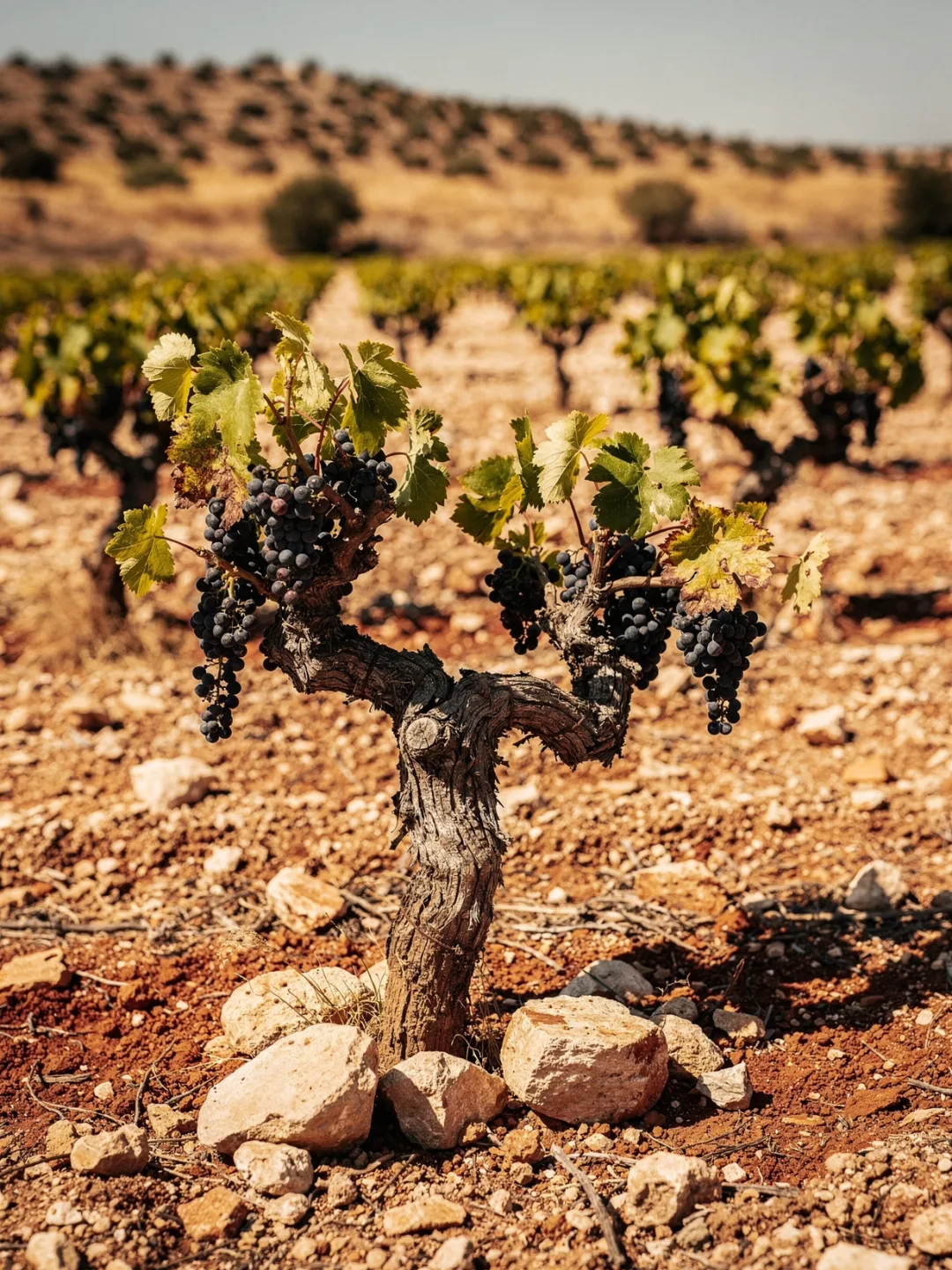
A single grape variety carries almost the entire harvest here. Monastrell covers about seventy percent of the vineyard area in DOP Jumilla. The berries are small and round, dark and thick-skinned, on wood that withstands drought, late frost, and forty degrees in the shade without complaint. It's exactly this thick skin that makes the difference. It delivers color and tannin in abundance, while the flesh itself stays pale and soft, contributing hardly any flavor of its own.
Things get confusing with the name of the second variety. Cencibel sounds like a grape in its own right. In fact, it's simply the name under which Tempranillo grows here in the southeast — the same grape as in the north, just under a different name, ripening noticeably earlier in the hotter climate. Add to this Garnacha, Garnacha Tintorera, Cabernet Sauvignon, Merlot, Syrah, and Petit Verdot. All are permitted under the Denominación's regulations, but none comes even close to Monastrell in terms of planted area.
Some of these vines still grow on their own roots. Over a thousand hectares in Jumilla were never grafted onto American rootstock. It's the largest contiguous area of ungrafted vines in all of Europe, almost entirely Monastrell dating from before 1989. Anyone processing at least eighty-five percent of such grapes, using vines at least thirty years old, may write "Viña Vieja" on the label. This must be verified through the vineyard registry, not merely claimed.
The most famous of these plots belongs to Casa Castillo. Its Pie Franco grows on a south-facing slope of limestone and scree, planted in the 1940s by the grandfather of the current generation. For the 2020 vintage, critic Luis Gutiérrez awarded a perfect one hundred points in the Wine Advocate, the first time in the region's history. An ungrafted vineyard in the middle of the Spanish provinces, older than the Denominación itself, had achieved the highest score a wine critic can possibly give.