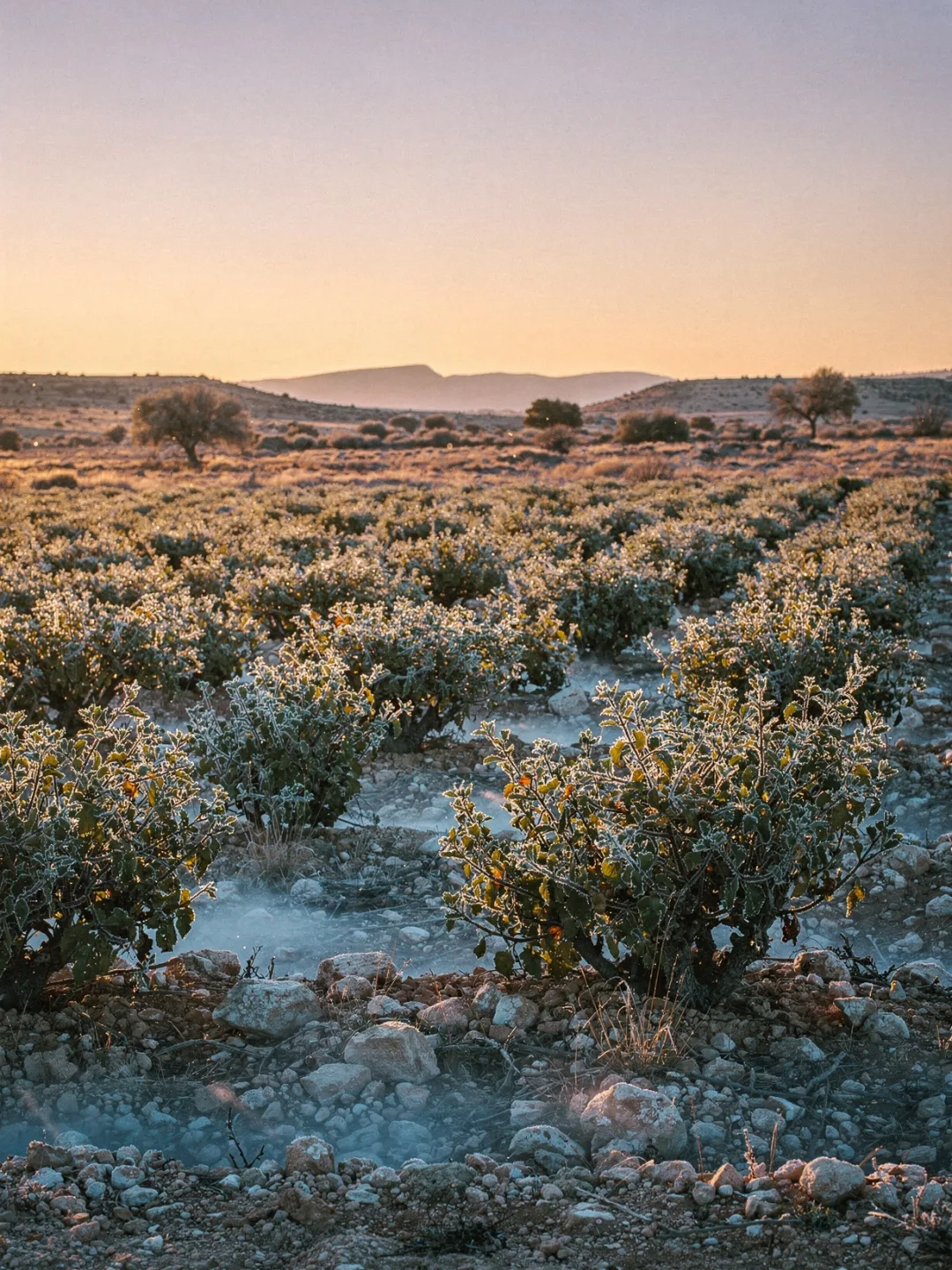
Continental despite proximity to the sea
Climate
The sea isn't far away. Yet you'd never taste it. Jumilla belongs to the so-called Altiplano Levantino, a high plateau in southeastern Spain. Its climate behaves as though no water were nearby at all: continental, dry, with sharp contrasts between day and season. On average, only around three hundred liters of rain per square meter fall each year, spread across just twenty days, concentrated mainly in autumn with a second, smaller peak in April. Between these: nothing.
What's lacking in water is made up for by the temperature range. In summer, the thermometer regularly climbs above forty degrees Celsius, while in winter it can drop to nearly minus ten on some nights, and frost between November and March is simply normal. On rare occasions, it even reaches into October. For the Monastrell vine, this means constant stress between two extremes, and it's precisely this stress that compresses berries small and concentrates aromas more densely than in milder locations.
One would expect elevation to matter a great deal here, as it does almost everywhere in winegrowing. The vineyards sit between 320 and 900 meters. Yet between the lowest and highest sites, the annual average temperature difference is only around two degrees — remarkably little for such a range. What really cools the nights isn't altitude but the dry, clear air, through which warmth escapes upward unimpeded the moment the sun disappears. In the mornings, a heavy dew then settles over the leaves, often the only moisture supply between two rain showers.
With over three thousand hours of sunshine a year, plus high evaporation, fungal diseases have little chance under these conditions. That's why a large share of estates here farm organically without having to change much for it. In the summer of 2026, harvest in the DOP began earlier than ever recorded. A heat wave drove sugar levels up faster than estates could round up pickers.