Picón & Malpaís
Soils
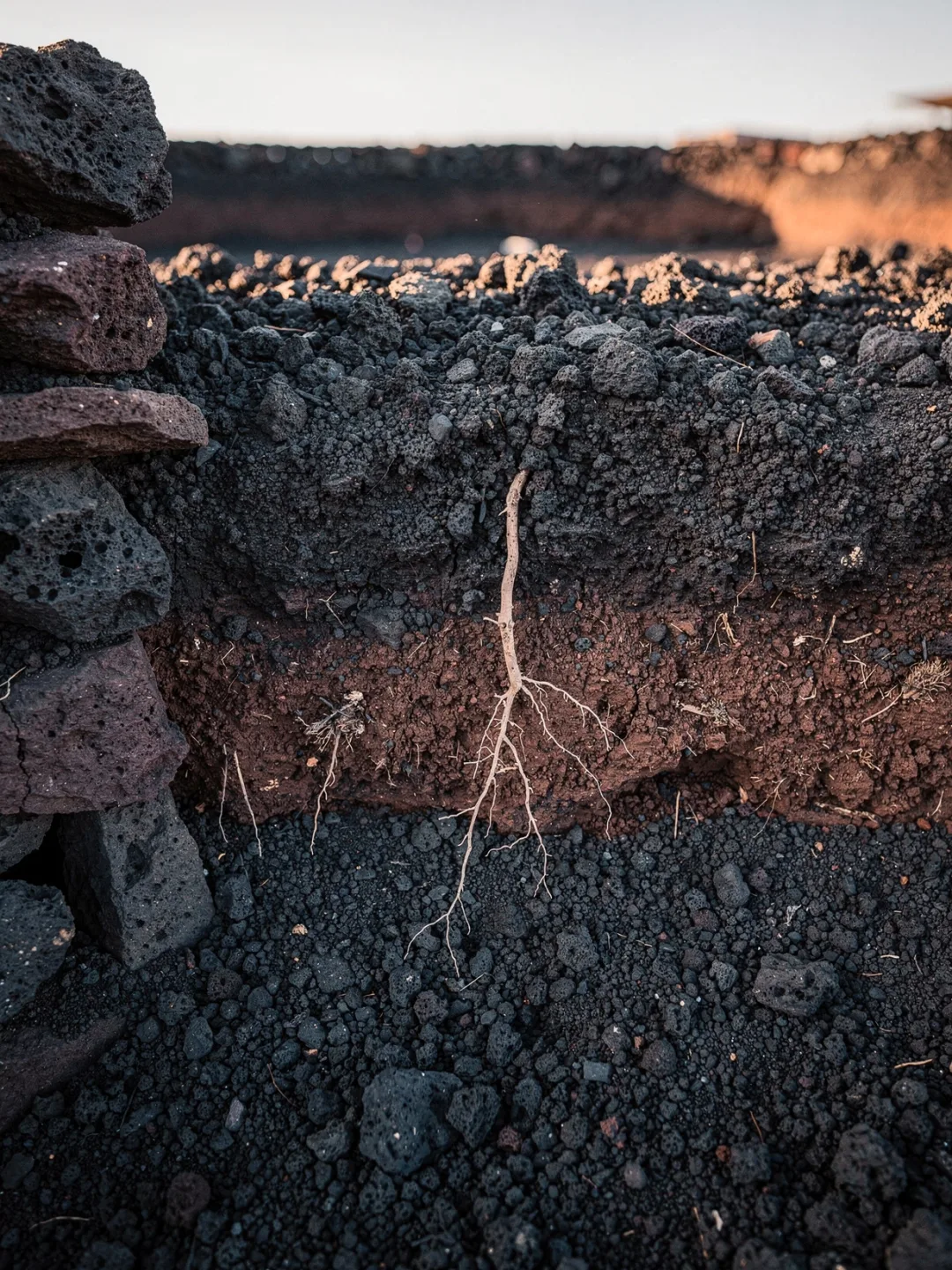
Dig a hole in a vineyard in the La Geria landscape on Lanzarote, and at first you'll dig through nothing but black gravel. This is picón, granular lava that rained down over the island during the eruption, small as coffee beans and riddled with tiny pores. Only after more than two meters do you finally hit real soil.
This soil dates back to before 1730. Over six years, until 1736, more than a hundred volcanic vents opened in what is now Timanfaya National Park, burying nearly a third of the island under lava and ash, including its most fertile farmland. Rather than abandon their farms, the farmers dug funnel-shaped pits by hand through the new layer of ash down to the old soil beneath. Often this meant digging two to three meters deep, and into each pit went a single vine.
Around the rim of each pit, they built a semicircular wall of loose stones, called a zoco, always positioned on the side the Alisios blow from. Without it, the wind would simply blow the loose picón straight back out of the hole. With it, the depression stays calm enough that almost nothing stirs inside it except the vine itself.
Protection isn't picón's only job. During the day it stores heat, releasing it slowly again at night. Its countless tiny pores also capture the nightly dew and channel it, drop by drop, down to where the roots wait. The island sees barely 150 millimeters of rain a year. This moisture from the dew is often the only thing a vine here can truly count on.
Not every Canary island requires this much effort. On Tenerife and La Palma, a thinner veil of ash over the rock is often enough. There it's called malpaís, named after the old lava flow beneath it, and the roots manage without any pit at all. Still, every one of these soils shares the same underlying principle: young, mineral, low in humus, and for that very reason too meager to support large berries. What results are small, thick-skinned grapes, and it's in the skin that color and tannin reside.
Loose black volcanic ash from the eruption of 1730 to 1736, small as coffee beans and full of tiny pores. Almost devoid of nutrients, but cool and moist.
The root: The young root pushes through here almost through emptiness. It finds little to grip, but loses almost no water along the way.