Wind, clouds, altitude
Climate
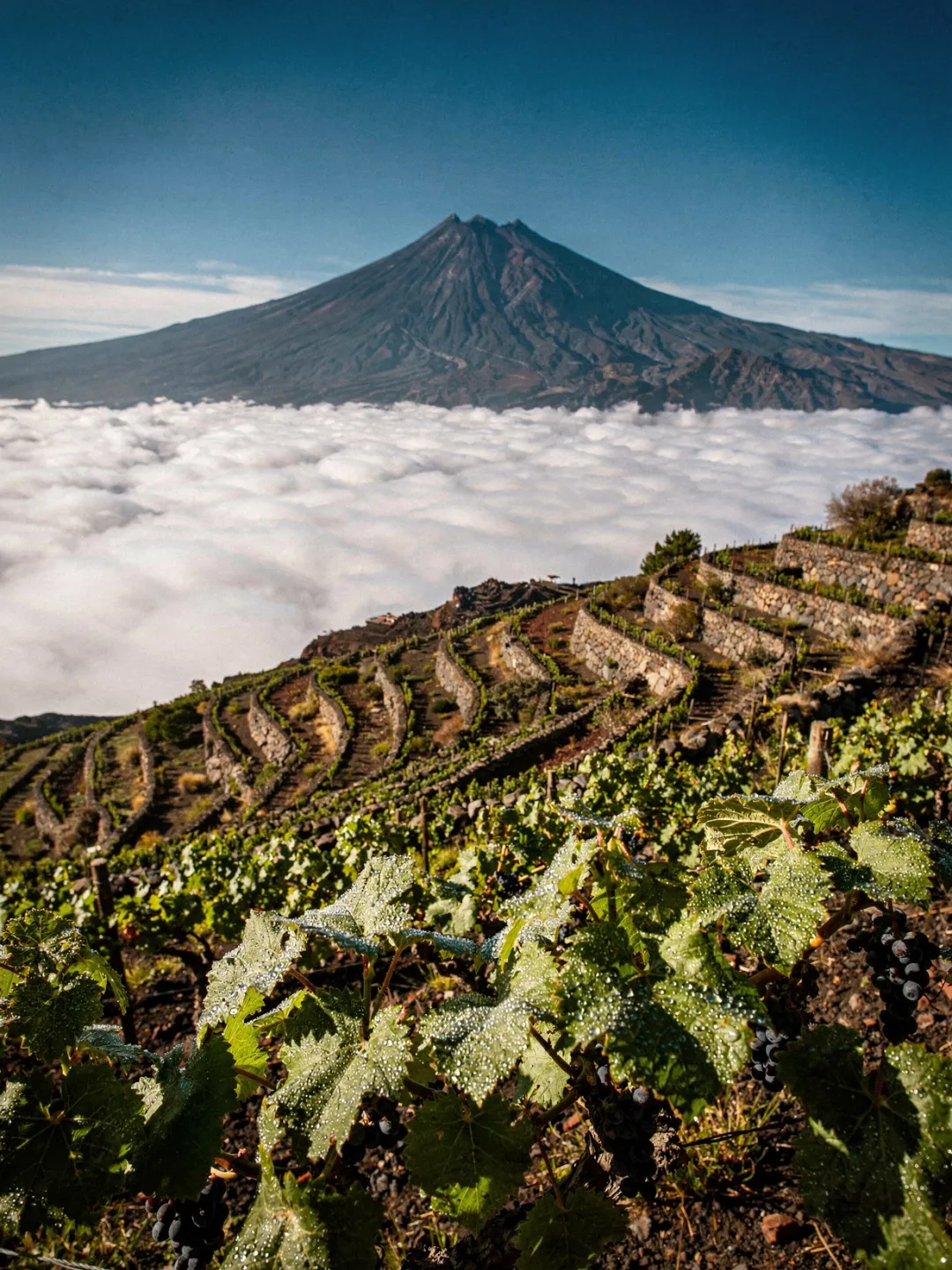
A single mountain is enough to split the climate of the Canary Islands in two. On Tenerife, the trade winds — the Alisios — blow from the northeast and hit the Teide, where they bank up into a layer of cloud locals call panza de burro, the donkey's belly. Beneath it, conditions stay humid and green. Behind it, on the south side, there's only sun and drought.
Above this cloud layer, it's usually sunny, and it's exactly there, between about 1,100 and just over 1,600 meters in elevation, near Vilaflor, that some of the highest vineyards in Europe are found. They sit even higher than Switzerland's Visperterminen, which until recently was considered the continent's highest vineyard. The clouds themselves are called mar de nubes, sea of clouds: from above, you look out over an unbroken white expanse, as if gazing at the open sea.
Just how stark the difference is becomes clear from the rainfall. Tacoronte-Acentejo, in the humid north of Tenerife, receives plenty of precipitation from the Alisios, along with fog and dew throughout the year. Lanzarote, by contrast, catches almost no clouds at all. In some years, rainfall there stays under one hundred millimeters for the entire year.
What still keeps the wine fresh is the swing between day and night. At 1,100 meters, temperatures drop noticeably after dark, even when the sun blazes during the day. This coolness slows the breakdown of acid in the ripening berry, which would otherwise vanish quickly under relentless heat. Over remarkably short distances, soil type, wind direction and cloud height can all change within just a few kilometers, compounded by elevation differences of a thousand meters or more on one and the same island. Two vineyards on the same island can therefore sometimes taste like two entirely different worlds.