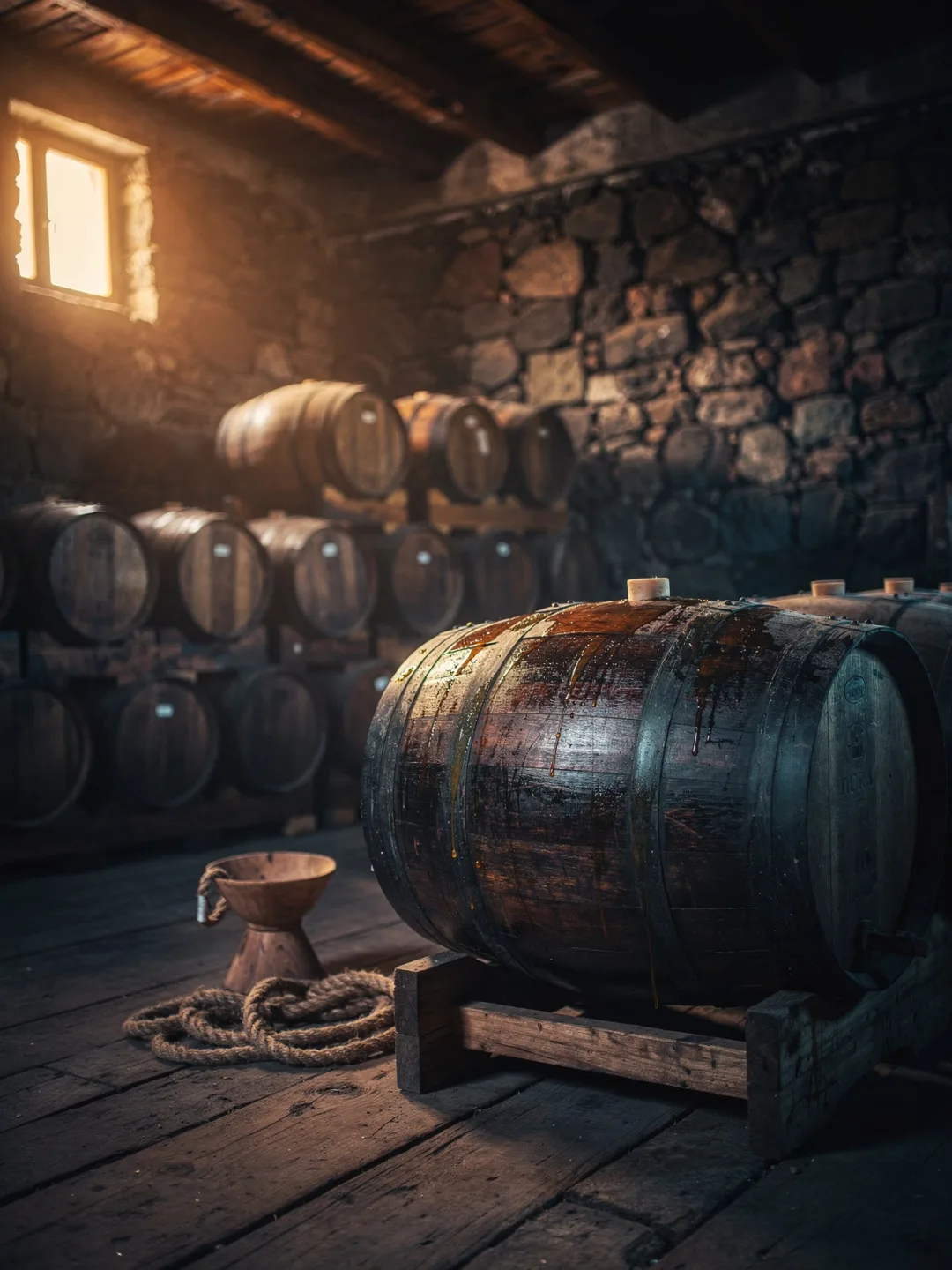
Hoyos and resin barrels
Production
The vineyard itself does most of the work, long before anything happens in the cellar. In the La Geria landscape on Lanzarote, each vine stands alone in its own earthen pit, spaced well apart, without wire or stake. No trellis, no wires. The vine grows freely along the ground like a shrub, since there's simply nothing here for it to climb.
In the Valle de La Orotava on Tenerife, winemakers solved the same problem differently, and had already done so by the sixteenth century. They braid several years' worth of shoots into a long plait, the cordón trenzado. It hangs sixty to eighty centimeters above the ground on wooden forks, so that in winter, when the vines were bare, farmers got their fields back for potatoes or grain, without having to uproot the vines. Since May 2026, the technique has officially been recognized as intangible cultural heritage.
After that, what follows in the cellar is the same everywhere: red wine ferments on the skins, white wine without them. For Listán Negro, skin contact usually lasts only a short time, often no more than a week. The variety brings little color and tannin to begin with, and too much time on the skins only makes the wine harsh, not more structured.
There's one special case found only in the northwest of La Palma, in the municipalities of Garafía, Puntagorda and Tijarafe: vino de tea, a wine unlike any other. Historically, oak was scarce there, but old, resin-rich Canary pines were not. So winemakers built their barrels, called pipas, from the resinous heartwood of these trees. In them, the wine takes on an intense scent of resin and smoke reminiscent of Greek retsina — you either love it or you can't stand it.
For sweet Malvasía, the grapes are often left to wither in the sun for days before pressing. This very idea already lay behind the export wine shipped to England back in the sixteenth century. When the English market collapsed centuries later, many producers turned instead to lighter field blends of several grape varieties, known as vidueños. Some of the simpler Canary wines made today still trace back to exactly that hardship.