Listán & Co.
Grape Varieties
More than a hundred different grape varieties grow in the Canary Islands — a number few people expect. The Instituto Canario de Investigaciones Agrarias has genetically identified around one hundred thirty-five of them, more than anywhere else in Europe on such a small area. Many are remnants of a diversity that vanished on the mainland long ago, lost to phylloxera and mass-market taste. Find an old vine here, and you often find a piece of wine history that exists nowhere else.
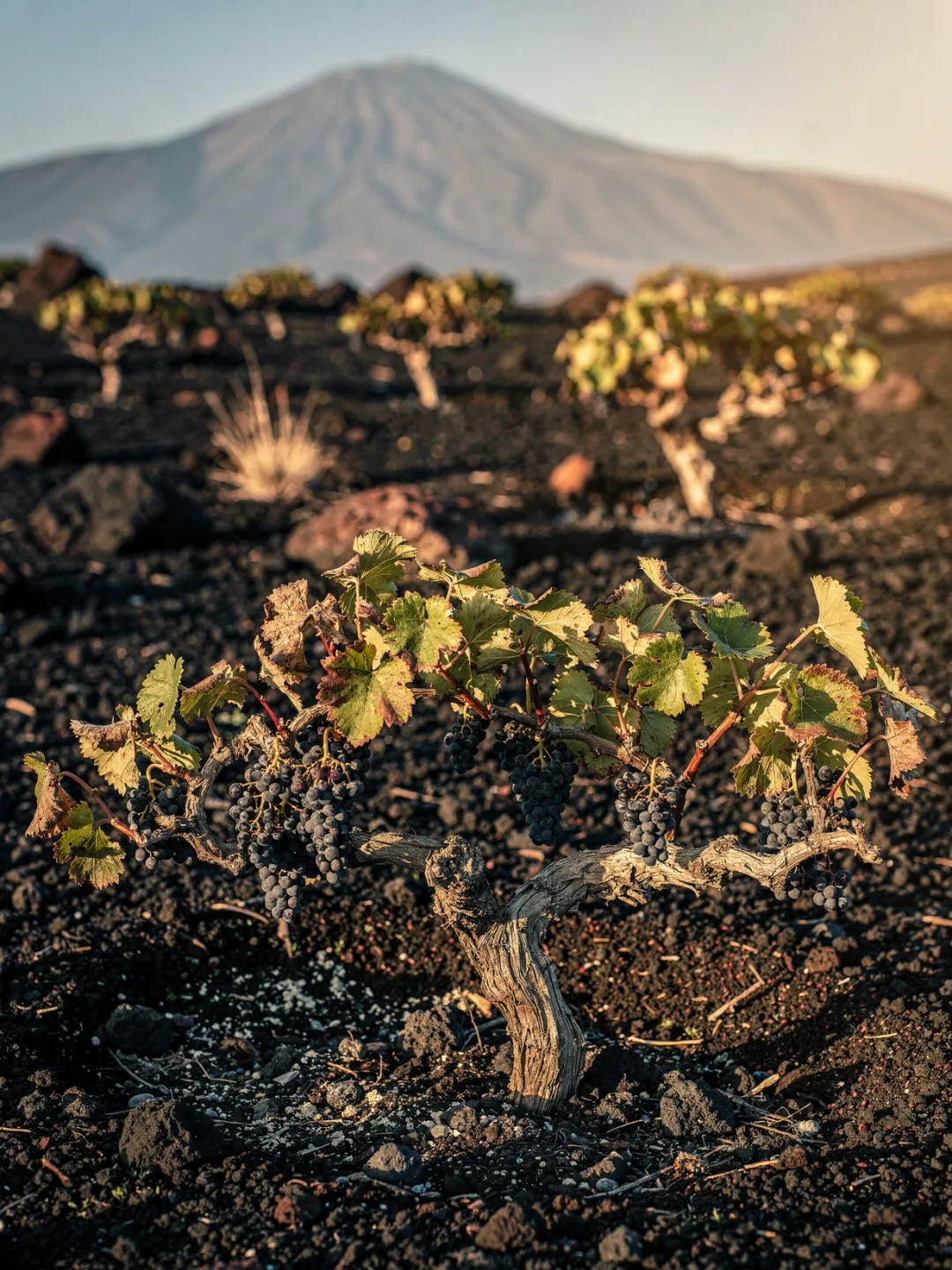
The most widely planted is Listán Negro, the most important red variety across the entire archipelago. It grows vigorously and yields pale, light-bodied red wines with little tannin, plenty of acidity, and a salty undertone that winemakers attribute to the proximity of the sea. On Tenerife, it is by far the most common red variety.
Among white varieties, Listán Blanco leads the way — the same grape known in Jerez, in Andalusia, as Palomino Fino, where it's used to make sherry. In the Canary Islands, it yields dry, fresh white wines, entirely without the oxidative character typical of sherry production. On Lanzarote, a different variety dominates: Malvasía Volcánica. It's aromatic, ranging from bone-dry to lusciously sweet, with a scent of ripe white fruit and a smoky, mineral note drawn from the volcanic soil.
Then there's a long list of lesser-known names. Negramoll, genetically identical to the Andalusian Mollar Negro, produces soft, fruity red wine and also grows on Madeira, where it's called Tinta Negra. Vijariego Negro and Vijariego Blanco contribute mostly acidity and freshness, Marmajuelo carries scents of apricot and passion fruit, and Gual is the same grape known on Madeira as Bual — three names, all borne by a single vine. Baboso Negro survives mostly in small, old plots. Moscatel de Alejandría, often fortified with alcohol, yields the sweetest wines on the islands. Hardly any of these varieties can be found anywhere outside the Canaries.