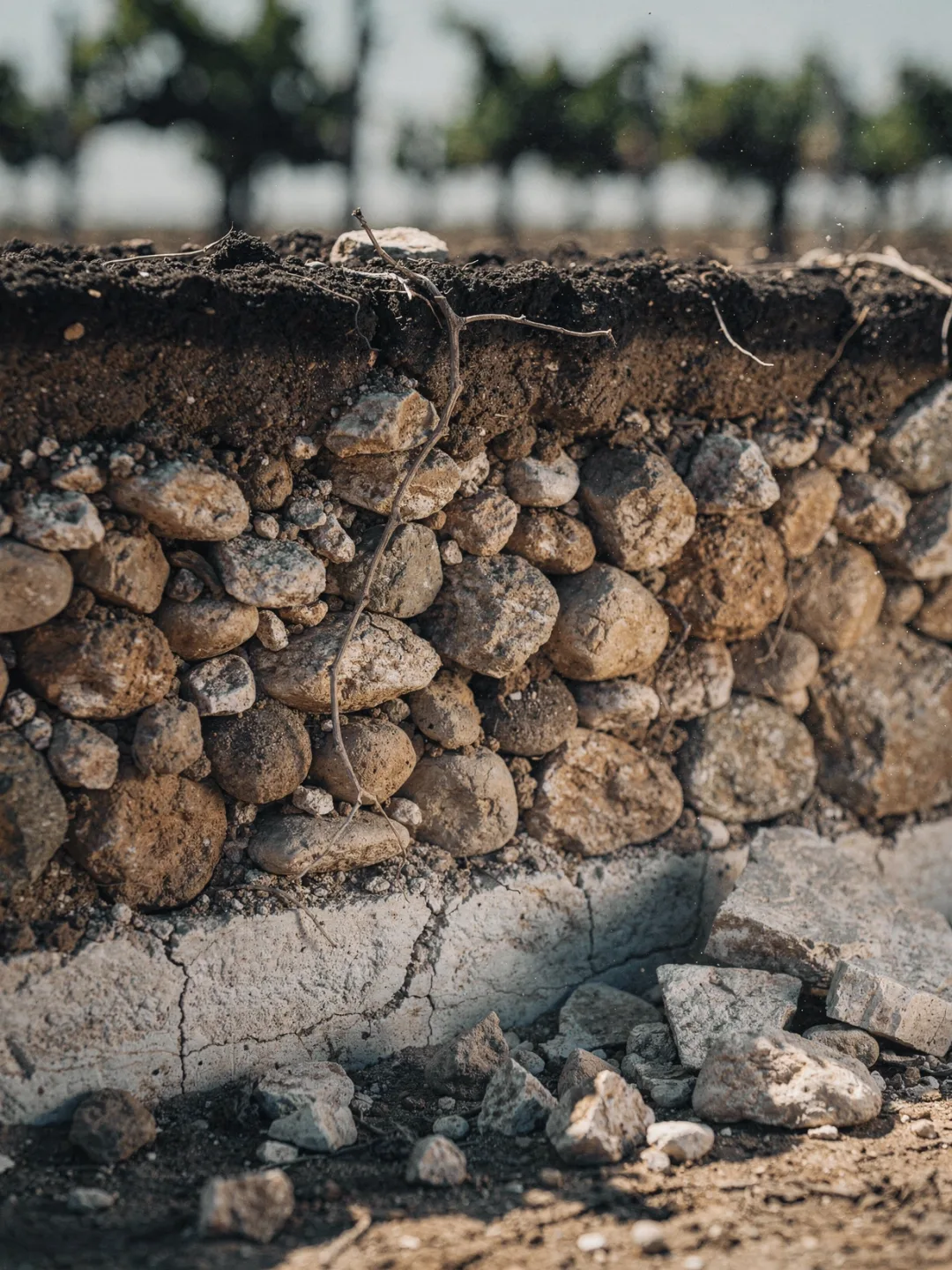
Cascajo & Limestone Crust
Soils
Dig a hole in a vineyard near Olite. After just a few shovelfuls, you hit dark, stony earth, and beneath that it turns round: rounded limestone pebbles, from fist-sized to little-finger-thick, packed tight like an ancient riverbed. That's no coincidence. It once was one.
Over hundreds of thousands of years, the Ebro, Arga, and Aragón rivers pushed gravel down from the Pyrenees and the Iberian mountain range. They deposited it in terraces, step by step, as the rivers carved themselves ever deeper. What remained is cascajo: loose, round gravel that water passes through almost unimpeded. This soil holds almost no nutrients.
That's exactly what forces the vine to dig deep. It drives down two, three meters, sometimes more, searching for moisture between the stones, and this effort curbs yield. The result is smaller berries with a higher skin-to-juice ratio. Color and tannin sit in the skin, and that's what gives a Tempranillo from Ribera Baja its density.
Further north, in Tierra Estella, the soil tells a different story. There, the vineyards sit atop a Triassic salt diapir, compressed gypsum and multicolored clay left behind more than two hundred million years ago by an evaporating inland sea. The soils above are clayey, deep, and rich in gypsum. They yield wines with high acidity and a pronounced mineral character, as the DOP's official specifications put it.
Right at the bottom, beneath the gravel of the Ribera, a third layer often waits. It's called costra caliza, a pale, hard limestone crust, cemented from the same limestone that coats the pebbles above, and it holds water like a reservoir the roots can tap into during the dry days of August. The claim, often made in marketing brochures, that the wine actually tastes like the stone isn't quite accurate – roots don't absorb stone, only dissolved minerals in tiny amounts. What really matters is the roundabout effect through water, warmth, and the forced depth of the root.
Dark, stony surface layer with scattered limestone pieces, poor in organic matter. In a vineyard near Olite, rarely more than a hand's width deep.
The root: This is where the fine roots sit. They grab whatever the scarce rain brings — and are the first to dry out.