From Tirage to Disgorgement
Production
Before Cava reaches the glass, it has fermented twice. The first fermentation turns the juice of Macabeu, Xarel·lo, and Parellada into a still, tart base wine. It's dry, sharp, hardly enjoyable on its own. This lean wine is exactly the prerequisite for everything that follows.
Then comes the tirage: yeast and a bit of sugar are added. The wine is bottled into the very bottle that will later stand on the table, and sealed with a crown cap. A second fermentation begins in the bottle, this time with no escape route for the resulting carbon dioxide — it stays dissolved in the wine and later becomes the bubbles.
The yeast dies off after fermentation. It settles as a fine sediment, and the wine rests on it for months. A basic Cava needs at least nine months for this, a Reserva at least eighteen, a Gran Reserva as much as thirty. Corpinnat goes even further, requiring its members a minimum of eighteen months for every single bottle, with no exceptions allowed below that.
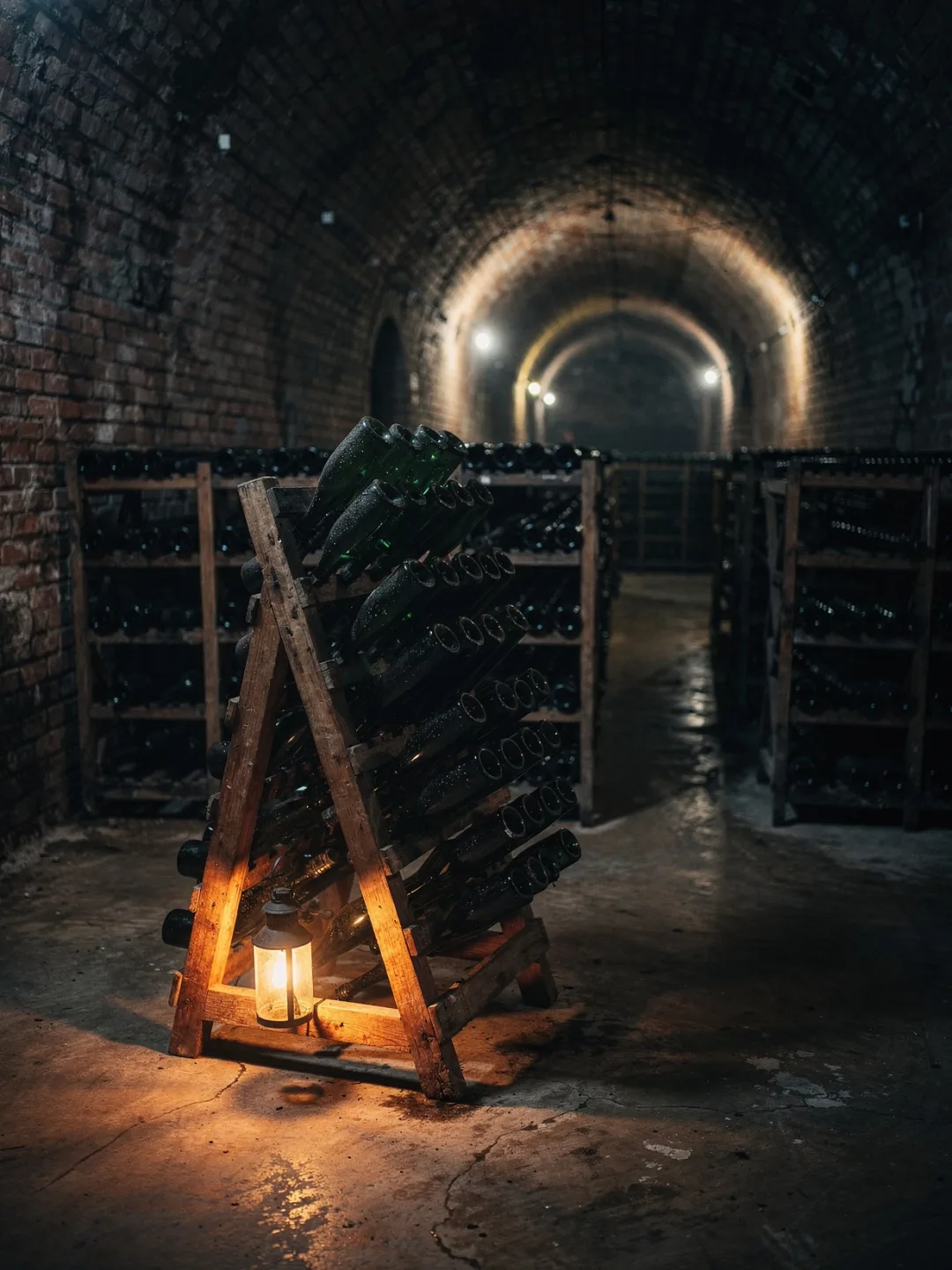
To get rid of the yeast again, the bottle is turned. This is called remuage, or riddling. Traditionally, it's placed at an angle in a wooden rack, the pupitre. It's turned by hand a little each day, until the yeast collects in the neck of the bottle. Starting in the 1970s, machines took over this task in many places — so-called gyropalettes, called girasol in Spain. The method was invented in France, but Codorníu from Sant Sadurní d'Anoia was among the first major producers to adopt it.
At the end comes dégorgement: the neck of the bottle is briefly frozen, the ice plug containing the yeast shoots out when the bottle is opened, and a final addition fills the small gap — the dosage. Whether this becomes a Brut Nature with no added sugar at all or a sweeter style depends entirely on this final addition — at most Corpinnat houses, it's deliberately kept very low.