From Pineau to Haro
Region & History
In 1858, a nobleman named Camilo Hurtado de Amézaga received a commission from the provincial government of Álava. Having lived in Bordeaux since his youth, he was tasked with finding an oenologist who could teach the winemakers of Rioja Alavesa the techniques of the Médoc. He hired Jean Pineau, the cellar master of Château Lanessan, and had nine thousand cuttings of Cabernet Sauvignon, Merlot, Malbec, and Pinot Noir shipped over. In 1862, his estate, since known as Marqués de Riscal, bottled what are now the oldest documented bottles from the entire region. Three years later, that same wine became the first non-French wine ever to win a medal of honor at the Bordeaux World's Fair.
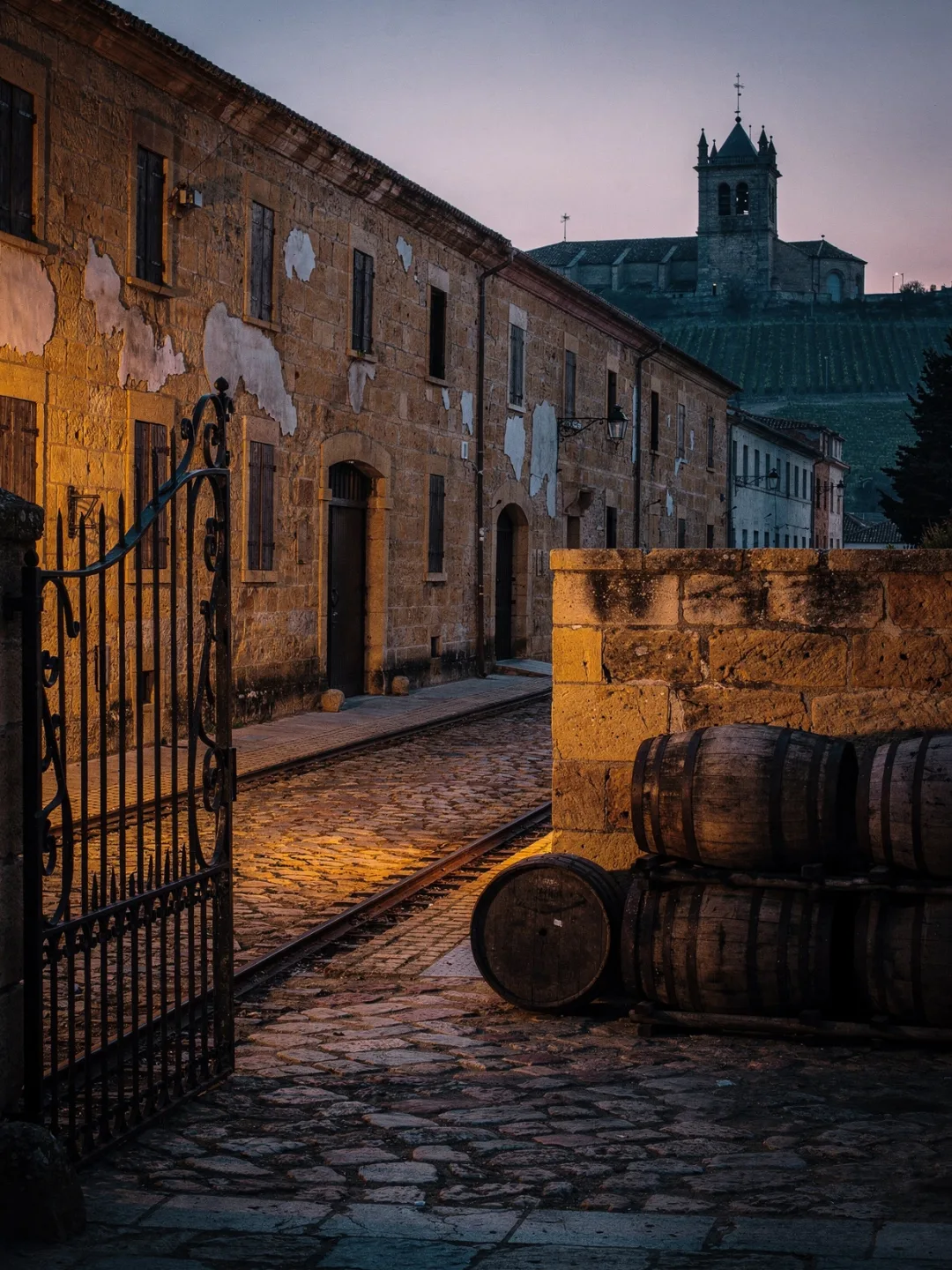
What Pineau brought was, above all, an idea: small oak barrels instead of large clay vessels. That idea arrived just as a crisis was beginning in France. Starting in 1863, powdery mildew and, soon after, phylloxera devastated the vineyards around Bordeaux, and French merchants went looking for a substitute. They found it on the Ebro, shortly after the Bilbao–Tudela railway line reached a new station in Haro on August 30, 1863. Around that station, an entire district of warehouses and wineries sprang up within thirty years — still known today as the Barrio de la Estación: López de Heredia was founded there in 1877, the Compañía Vinícola del Norte de España in 1879, and Bodegas Bilbaínas in 1901.
Rioja's own phylloxera outbreak came late, but hit hard. On June 12, 1899, a commission confirmed an infestation near Sajazarra, just a few kilometers from Haro. Victor Manso de Zúñiga, who ran the oenological station of Haro, urged winemakers to graft their native varieties — Tempranillo, Graciano, Mazuelo — onto American rootstocks. Many simply couldn't afford to replant, and some vineyards lay fallow for years.
To protect the region's origin, producers had already agreed on a shared quality seal back in 1560, and in 1787 the Real Junta de Cosecheros became the first formal institution set up to safeguard it. In 1925, this evolved into Spain's first Denominación de Origen, and a year later, by royal decree of October 22, 1926, it gained its Consejo Regulador. Since 1991, Rioja has held the rank of Denominación de Origen Calificada, the first region in Spain to do so. Since 2018, the eastern zone once known as “Baja” has officially been called Rioja Oriental.
Not every memory of Rioja needs a label. Every year on June 29, the feast day of Saint Peter, the people of Haro march to the cliffs of Bilibio. There, they douse each other in liters of red wine — the Batalla del Vino. Tradition traces its roots back to a medieval pilgrimage, though the custom has only been documented as a full-blown wine battle since the late nineteenth century.