Tempranillo & Co.
Grape Varieties
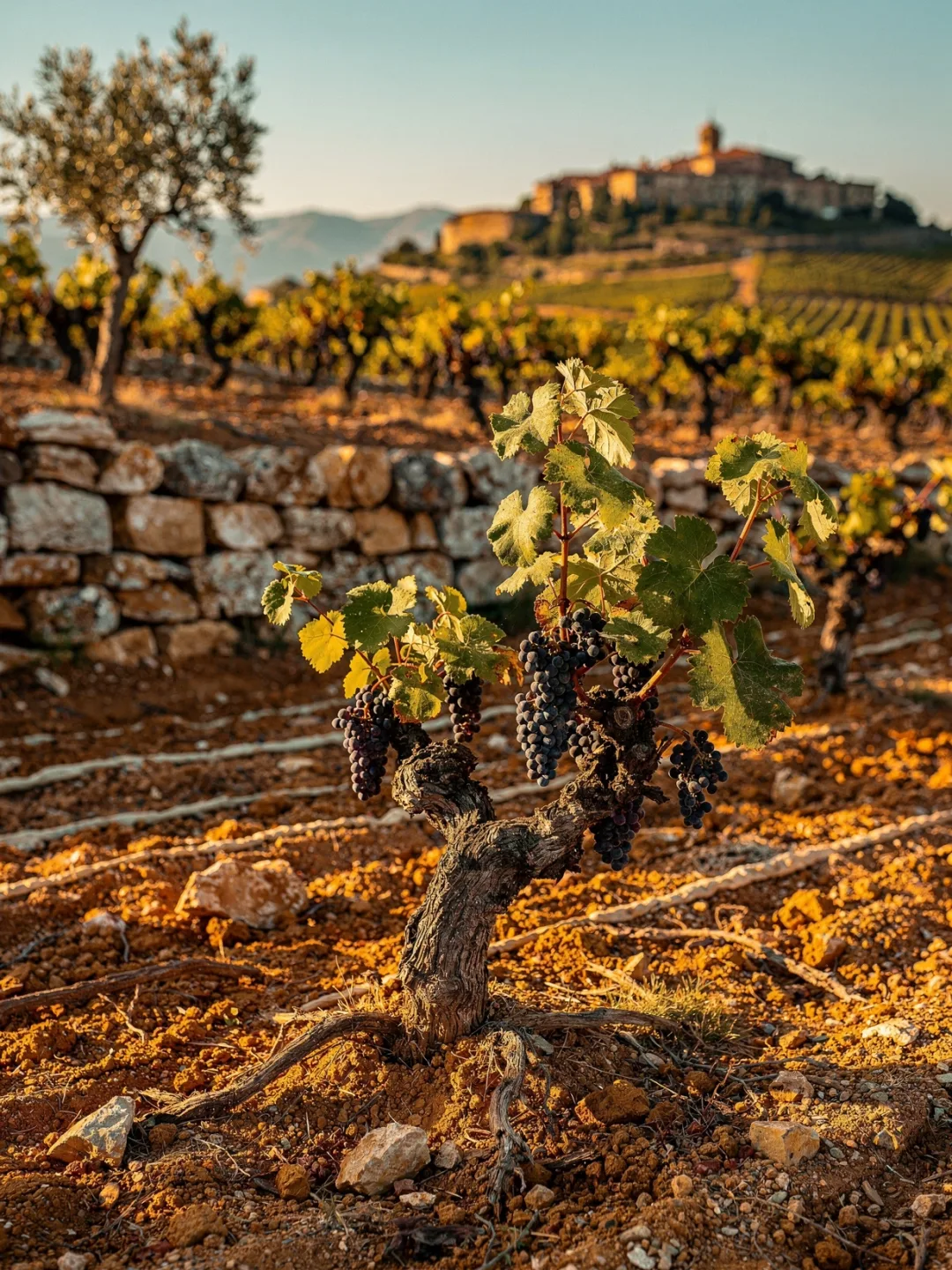
One grape carries nearly everything here. Tempranillo covers a good eighty percent of the roughly sixty-six thousand hectares under vine in the DOCa. Its name comes from temprano, meaning early, since it ripens ahead of almost every other Spanish variety. Where it's planted matters more to the final wine than anything that happens later in the cellar.
Four other red varieties are permitted, though all are far less common. Garnacha brings warmth and fruit sweetness, especially in the hotter Rioja Oriental. Graciano contributes acidity, color, and a distinctive spicy aroma, but demands plenty of sun and low yields. Mazuelo, known elsewhere as Cariñena, adds firm tannin. Maturana Tinta, despite its old name, was only officially reauthorized in 2007 — it had nearly vanished before being rediscovered in a handful of surviving plots.
Among the white varieties, Viura, also called Macabeo, has dominated since the 1970s, prized for its bright citrus notes and its ability to hold onto acidity in the heat. Eight more white varieties appear on the Consejo Regulador's list alongside it: Malvasía, Garnacha Blanca, Tempranillo Blanco, Maturana Blanca, and Turruntés. Following a relaxation of the rules in the 2000s, Chardonnay, Sauvignon Blanc, and Verdejo were added too. That brings the total to fourteen permitted varieties — five red and nine white.
Rioja Alavesa, the smallest of the three subzones, is widely seen as the heartland of pure-varietal Tempranillo: small parcels, cooler sites, taut wines. In Rioja Oriental, by contrast, warmer and drier, Garnacha plays a bigger role, delivering more fruit and more alcohol than its northern counterparts.
What looks today like a purely Tempranillo region was once a testing ground for Bordeaux varieties. Cabernet Sauvignon, Merlot, Malbec, and Pinot Noir arrived in 1858 with Jean Pineau, not as blending partners but as the main experiment. In the end, though, it was the native grape that endured. Foreign varieties survive today only in a handful of historic plots, never at scale.