Verdejo & Cenicienta
Grape Varieties
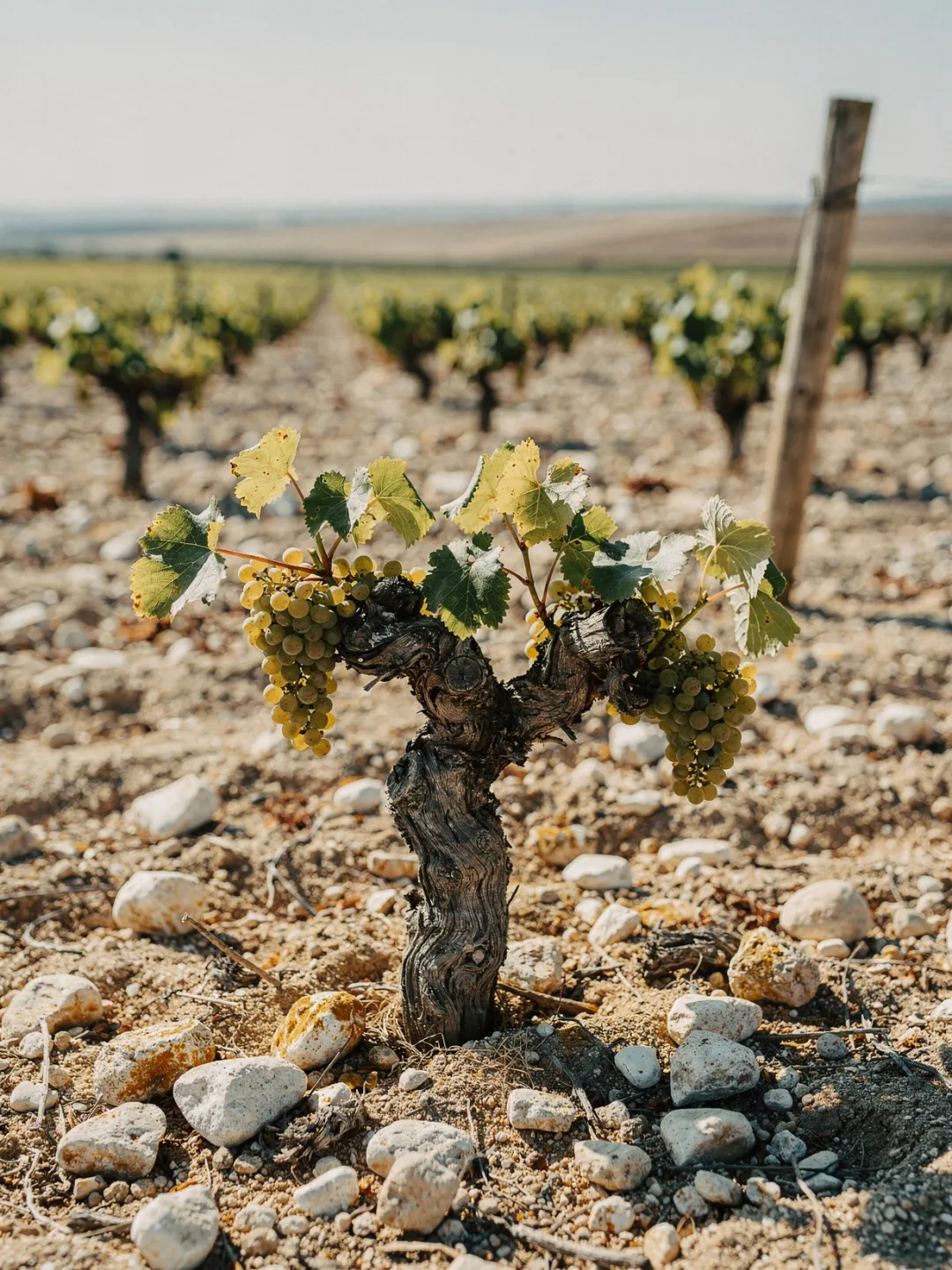
One grape carries almost the entire region. It's called Verdejo, after the greenish color of its skin. One tradition links it to Moorish settlers who came to this valley along the Duero during the reconquest under King Alfonso the Sixth, long before anyone here thought of wine as an export good. This isn't fully documented. Even so, the vine has long been considered native, and it shapes practically every wine made here.
Traditionally, Verdejo grew as a low bush without wire trellising, called vaso in Spanish, planted far apart so that each individual plant could still get enough of the scarce water in this dry soil. Today many younger plantings stand on wire. That allows for higher yields. Even so, new plantings have required at least eleven thousand one hundred vines per hectare since 2019. A wine simply labeled Rueda must consist of at least seventy-five percent of the main varieties. If Verdejo stands alone on the label, at least eighty-five percent of it must come from this one grape.
Alongside Verdejo, Sauvignon Blanc, Viura, Chardonnay and Viognier now also count among the main varieties. All four were only classified as such in reforms of recent years, most recently Chardonnay and Viognier in 2024. Riesling, Gewürztraminer and two Muscat varieties are permitted as secondary varieties. Palomino Fino may still be harvested. However, new plantings of the old base for the oxidative wines are no longer permitted anywhere; it is slowly dying out of the vineyard, even though the wine made from it lives on.
Among the red grapes, Tempranillo dominates. Cabernet Sauvignon, Merlot, Garnacha Tinta, Syrah and, since 2024, Bruñal complement it. More interesting is a find from La Seca. Winemaker Javier Sanz discovered an old, almost forgotten vine there in a historic parcel and had it studied closely for years before he could be certain what he had actually found. He named it Cenicienta, because the undersides of the leaves shimmer ash-gray. Approved since 2024, it is the first recognized native red variety of the region altogether.