Granite & Alluvium
Soils
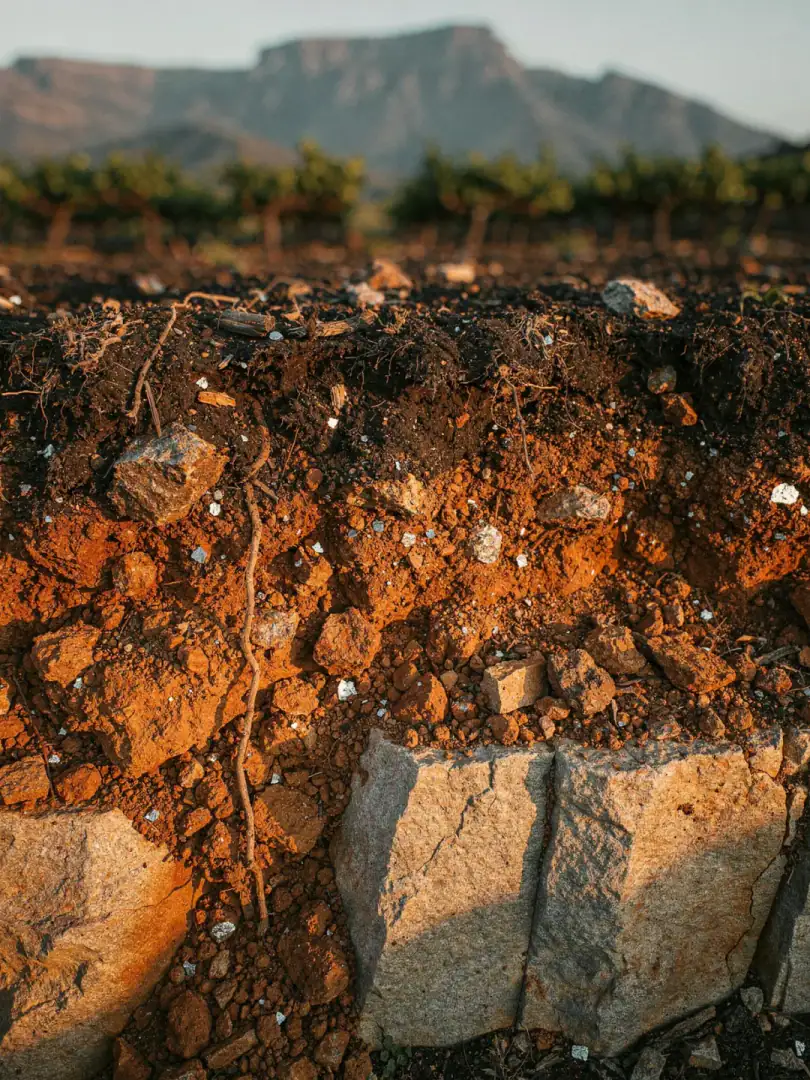
Dig a hole on a slope above Franschhoek, and you'll break through the first layer quickly. Beneath it comes reddish-orange, crumbly grus, weathered Cape granite, the same formation found beneath Stellenbosch and Paarl. This isn't a thin layer. It often runs several meters deep before firmer rock follows. Higher up on the steep slopes toward the Groot Drakenstein range, the soil grows thinner and stonier, with pale sandstone occasionally emerging between the granite, the same Table Mountain sandstone that forms the peaks.
Down on the flat valley floor, along the river, the story looks different. There, the Berg River has deposited sand, silt, and some clay over millennia, more fertile than the granite, but also holding more water. Vines initially favor this valley soil. They grow quickly and bear heavily there, but that rarely benefits concentrated wines.
This is exactly where the difference lies. On the slope, the situation reverses: weathered granite drains water well but retains enough at depth to survive dry weeks. The vine root has to work for it, pushing between the weathered crystals rather than spreading comfortably through loose valley soil. This very effort curbs yield and shrinks the berry.
Smaller berries mean more skin relative to juice, and the skin holds color, tannin, and much of a wine's aromatic character. That's why the granite hillside sites are considered the true source of Franschhoek's finest Semillons and Cabernets. The soil shapes the root, not the other way around.
One misconception persists stubbornly: the granite itself doesn't show up in the glass as a flavor. What arrives is an indirect effect, through water balance, heat retention, and the depth to which a root is forced, not a mineral that travels straight from the stone into the berry.
Dark, sandy topsoil over the grus, in Franschhoek's hillside sites usually only a hand's breadth deep.
The root: This is where the fine roots sit. They absorb every rainfall immediately and dry out just as quickly.