Huguenots & Oliphantshoek
Region & History
In 1688, a ship carrying nearly three hundred French passengers landed at the Cape. They were Huguenots, Protestants for whom France had become unsafe ever since King Louis XIV revoked the Edict of Nantes three years earlier, an edict that had protected them for decades. Anyone unwilling to convert to Catholicism had to leave the country. The Dutch East India Company welcomed the refugees gladly, since many of them brought winemaking knowledge that the young Cape colony sorely lacked.
Cape Governor Simon van der Stel assigned them a valley east of Stellenbosch, which the first settlers had named Oliphantshoek after the elephants grazing there. On October 18, 1694, nine farms in the valley were granted to Huguenot families. One went to Pierre Jourdan, who named it after his French hometown of Cabrières, barely altered to this day: Cabrière. Van der Stel deliberately mixed the French settlers in among the Dutch burghers. His reasoning was blunt: adopt the language and customs, blend into the colony.
That was no accident. Within two generations, hardly anyone in Oliphantshoek still spoke French, yet the name kept evolving: first de France Hoek, then le Coin Français, and finally simply Franschhoek. In Dutch, this means the French corner. In 1825, the Franschhoek Pass was built over the mountains to the south, the first professionally engineered mountain pass in the whole country, featuring South Africa's oldest still-used stone arch bridge. It still holds today. Only then was the enclosed valley truly connected to the outside world.
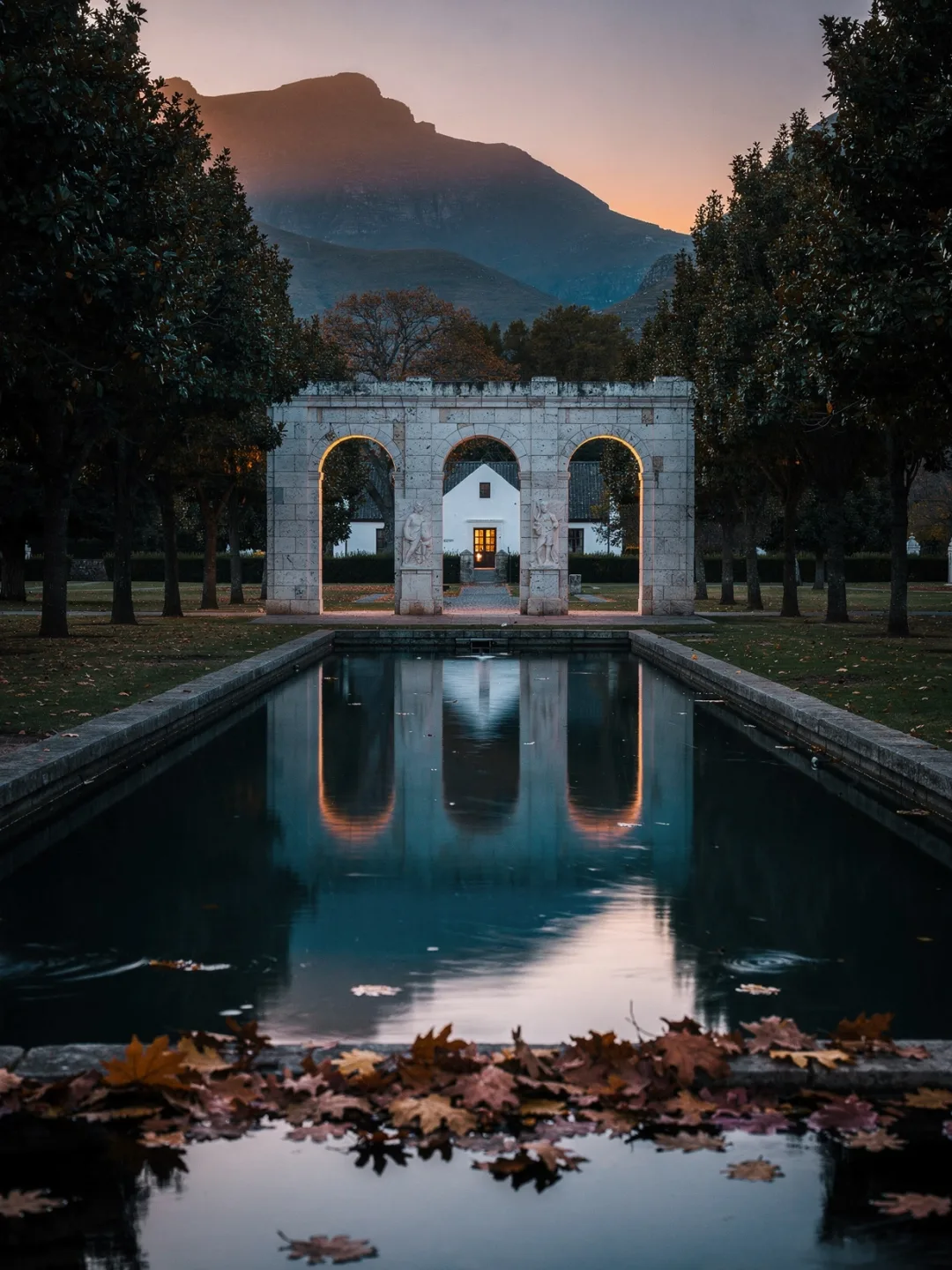
A century after the landing, a monument finally honored the founders. The Huguenot Monument was completed in 1945 from Paarl granite and inaugurated on April 18, 1948, its three arches symbolizing the Holy Trinity. In front stands a female figure holding a Bible and a broken chain. A museum beside it followed in 1957.
In terms of wine law, however, Franschhoek long remained in the shadows: for decades, the valley was merely a ward of the much larger Paarl. Only in 2010 did the Wine and Spirit Board, which oversees South Africa's Wine of Origin system, recognize Franschhoek as an independent district. Three centuries after the flight, a refuge had become its own address.