Semillon & Cabernet
Grape Varieties
Drive through Franschhoek today, and you might think you've entered Cabernet and Shiraz country. Around twelve hundred and fifty hectares in total are planted with vines, and more than half of that now carries red grapes. Cabernet Sauvignon leads with just under one hundred ninety hectares, Shiraz follows close behind, with Merlot and some Cabernet Franc rounding things out. But anyone who reads only these figures misses what's truly special about the valley.
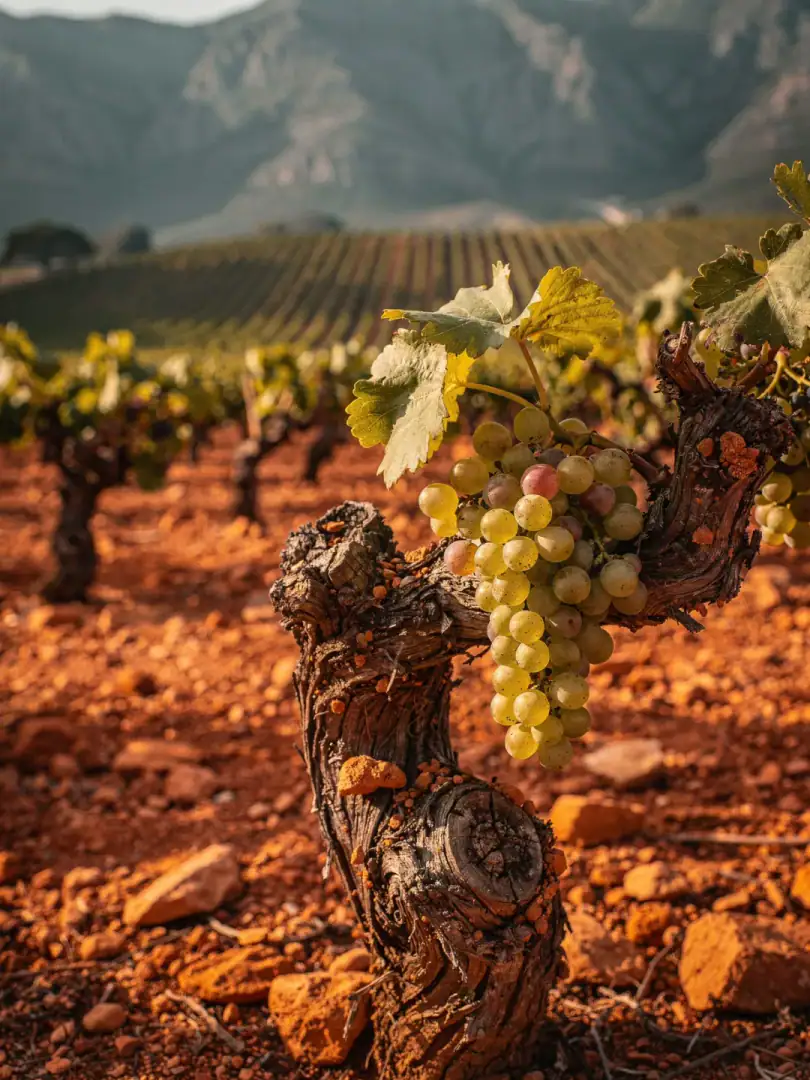
That would be Semillon. The variety already grew in the Huguenots' first vineyards and is considered today the valley's true specialty, even though it now trails behind the red varieties in acreage. Franschhoek is regarded as the unofficial center of South Africa's old Semillon vines. In the Eikehof vineyard, vines planted since 1902 are recognized as the country's oldest recorded white wine block. Nearby La Colline was planted in 1936. Nationwide, ten vineyards qualify as centenarian, four of them in Franschhoek, three of those Semillon.
Over generations, a genetic quirk crept into these old vines. Among the green berries grow grey-pink berries on the very same plant, a spontaneous mutation called Semillon Gris. No one bred it deliberately; it simply emerged over the decades and is now deliberately harvested alongside the rest.
Among the white wines, there's also plenty of Chardonnay, at just under one hundred eighty-two hectares the second-largest white variety after Sauvignon Blanc, and both varieties serve Franschhoek in a second role too. Some of the grapes aren't vinified into still wine at all, but into Cap Classique, South Africa's traditionally bottle-fermented sparkling wine. That requires mainly Chardonnay and Pinot Noir, the same varieties grown in Champagne. At the Cabrière estate, named after the Huguenot Pierre Jourdan, both have been grown specifically for this purpose since the 1980s. Chenin Blanc and Viognier round out the white picture, usually as blending partners, rarely as standalone wines.
Among the reds, Shiraz remains the most distinctive voice. In Franschhoek it often tastes spicier and darker than in the hotter sites further inland, with fruit that leans more toward blackberry than cherry. Cabernet Sauvignon and Merlot, by contrast, produce classic Bordeaux-style blends, powerful, tannic, built for extended aging.