Pinot & Chardonnay
Grape Varieties
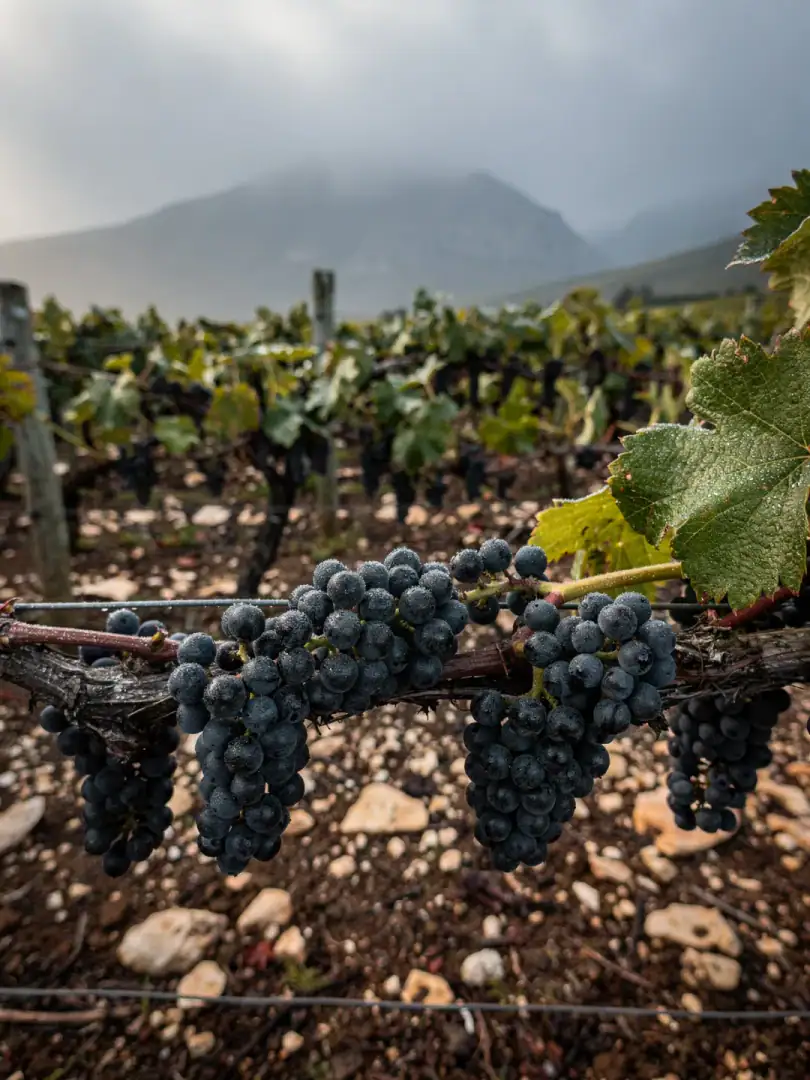
Three international varieties rule this valley, which is unusual for South Africa. Elsewhere in the country, Chenin Blanc has always dominated. Here, though, it's Pinot Noir, Chardonnay, and Sauvignon Blanc that deliver the best results on the cool slopes around Hermanus. Pinot Noir is a temperamental, thin-skinned variety that needs cold nights, or it loses its freshness within a matter of days.
In the glass, Pinot Noir from the Hemel-en-Aarde Valley shows pale and translucent. The nose brings sour cherry, cranberry, and pomegranate, along with an earthy, almost mossy undertone. Sometimes a subtle smoky note appears from the French oak in which the wine is aged. This combination of lightness and depth is, for many critics, the calling card of the whole of Walker Bay.
Chardonnay hardly plays second fiddle. Critics have taken to calling the valley a paradise for this grape. Anyone who tries a bottle quickly understands why: candied citrus peel, ripe fig, and a salty, oyster-shell-like finish. It carries the closeness to the Atlantic straight into the glass. Sauvignon Blanc often grows just a few kilometers from the sea and tastes the part: green fig, grapefruit, and a distinct salinity that winemakers themselves call the coast's signature.
Further inland, in the warmer wards of Bot River and Sunday's Glen, the lineup changes completely. There, Chenin Blanc, Shiraz, and even Grenache ripen reliably, while in the cool Hemel-en-Aarde they'd often stay green and unfinished. Pinotage, South Africa's own grape variety, also finds a second home here.
Pinotage was created in 1925 in Stellenbosch. Professor Abraham Izak Perold crossed Pinot Noir with Cinsaut, a grape then still known in South Africa as Hermitage — hence the name. In 1994, Anthony Hamilton Russell, the founder's son, wanted to prove that this often-underrated variety could taste serious and age-worthy, and so founded the second label, Southern Right.