What Grows Together
Regional Classics
An old saying claims that what grows together belongs together. This isn't mystical wisdom but the result of centuries in which a region's cuisine and wine adapted to one another, often without any deliberate plan.
Why this rule of thumb often holds true
Climate and soil shape both local cuisine and local wine in similar ways, since both arise from the same ingredients: the same sun, the same rain, the same soil. Cooler, wetter regions tend to produce lighter, acid-driven wines, and the local cuisine there often favors freshness over heavy roasted flavors as well. In hot, dry regions, bolder, more alcoholic wines grow, while the cuisine relies on intense spices and plenty of oil, which in turn calls for exactly these wine styles.
Over generations, cooks and winemakers have also learned from one another, often quite incidentally at the same dinner table. A dish that clashed with the local wine gradually got adjusted, just as a wine that didn't suit the local cuisine was planted less often over time. The result is a kind of slow, unplanned fine-tuning that has corrected itself over decades.
Examples from various countries
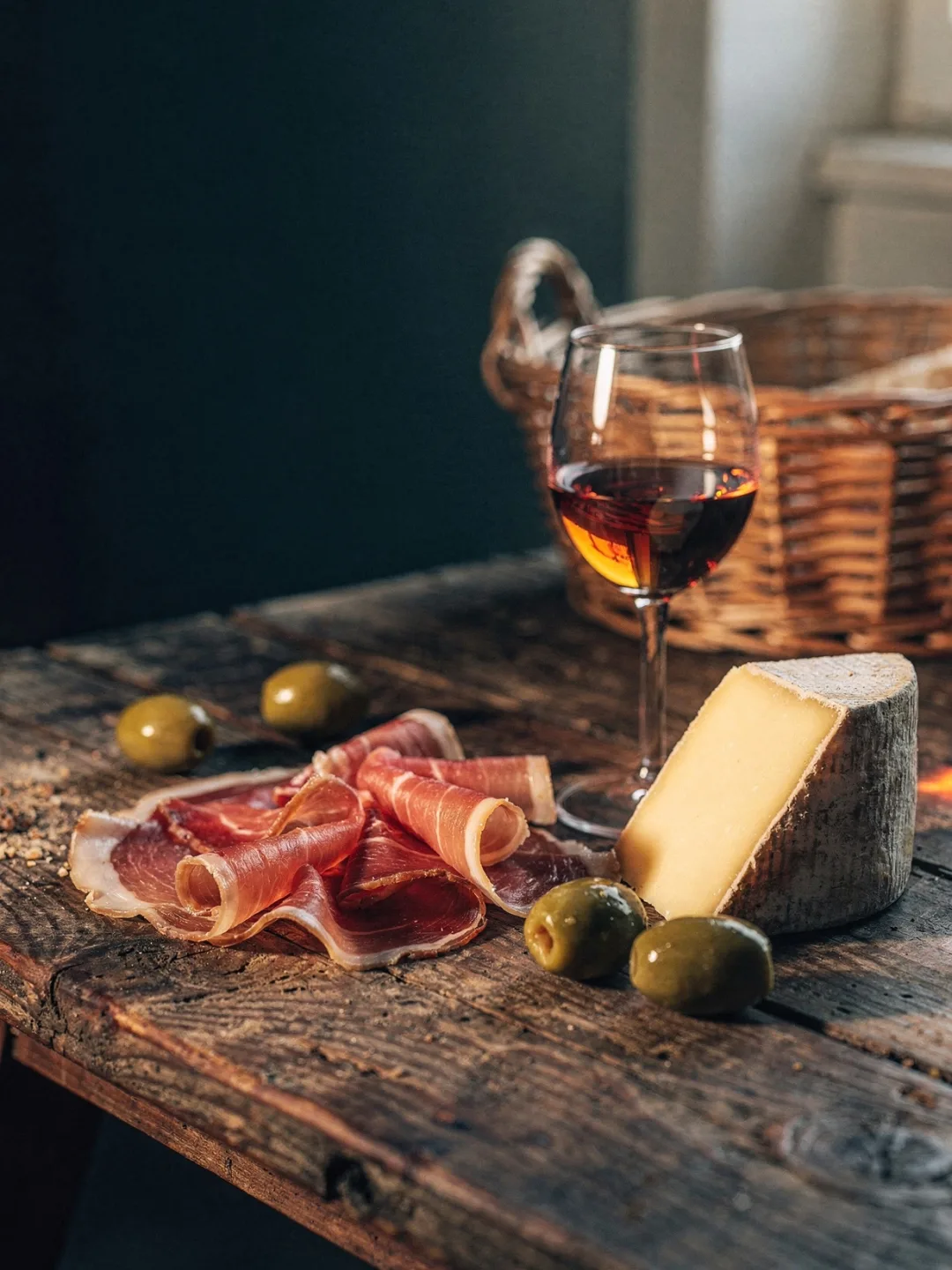
In the Loire Valley, goat cheese traditionally meets Sauvignon Blanc from the same region, and the pairing works so well because both share the same mineral, grassy freshness. Along Galicia's Atlantic coast, a crisp Albariño accompanies seafood drawn from the same cold waters as the grapes from the nearby coastal vineyards. In Andalusia, dry Sherry meets ham and olives, because both developed over centuries in the same dry, salty landscape.
The same pattern shows up outside Europe too: in temperate wine regions with good grilling weather, such as parts of Australia or Argentina, a bold red wine culture developed alongside a strong grilling culture built around beef. None of these pairings were designed on a drawing board; they grew together over a long time until they fit one another.
The limits of the rule
Charming as this saying sounds, it isn't a law of nature but an observation with plenty of exceptions. Some famous regional cuisines only emerged after the local wine had long since disappeared, and some wine regions export nearly their entire production without any matching cuisine even existing locally. Taking the rule too literally also means missing out on many excellent pairings across borders that, by taste alone, still fit together perfectly.
It's more useful to treat the rule as a starting point rather than an endpoint: with an unfamiliar regional dish, reaching first for the local wine is worthwhile, since the odds of success are high. If the pairing still doesn't convince, the principles from earlier stops on this journey help just as reliably, regardless of where the food and wine come from.
What this means for everyday life
Home cooks don't need to study a map to benefit from this rule. Simply reaching for a wine from roughly the same climate zone as the dish, say a wine from a warmer region with a Mediterranean sauce rich in olive oil and tomato, usually points you in the right direction almost automatically. This rough guideline doesn't replace any of the earlier rules, but it complements them nicely, especially when there's no time for lengthy deliberation.
In the end, regional pairing remains a useful first instinct, not the final word. It offers a good starting point for any choice, while the individual rules about acidity, tannin, sweetness, and spice handle the fine-tuning whenever the first impression doesn't quite convince.
The rule, briefly summarized
What grows together often belongs together. That's the whole saying. It holds as a rule of thumb, not as a law. Climate shapes cuisine and wine in similar ways. Cool regions produce light cuisine and light wine. Warm regions produce bold cuisine and bold wine.
In everyday life, a rough glance at the map is enough. A wine from a warmer region almost always pairs with rich, oily cuisine from warmer regions. A wine from a cooler region almost always pairs with fresh cuisine from cooler regions. This rough matching doesn't replace fine-tuned rules, but it helps when shopping quickly.
In the end, your own taste matters more than the map. A rule that nobody enjoys is useless to anyone. Even knowing the regional rule of thumb, you're always free to break it whenever another wine simply fits better.