Sweeter Than Sweet
Dessert and Chocolate
With desserts, one rule applies more strictly than anywhere else: the wine must be sweeter than the dish, no exceptions. Break it, and even the finest sweet wine will taste thin and sour next to the wrong dessert.
The sweetness rule in detail
Sugar on the tongue changes how all other flavors are perceived, and acidity is among the most sensitive to this. A wine that tastes pleasantly fruity and sweet on its own suddenly seems bland or even sour after a spoonful of caramel dessert, because within seconds the brain adjusts to the dessert's higher sweetness level. Ignore this rule, and you'll end up serving a technically fine wine that still disappoints next to the dessert.
As a rough guide, comparing residual sugar levels helps: a dessert wine with noticeable but moderate sweetness pairs well with light desserts like fruit salad or sorbet, while very sweet creations like caramel, toffee, or rich cream cakes call for a considerably more concentrated, often lusciously sweet wine. Plenty of room lies between these two extremes, room best judged by feel rather than calculated precisely.
Chocolate as a special case
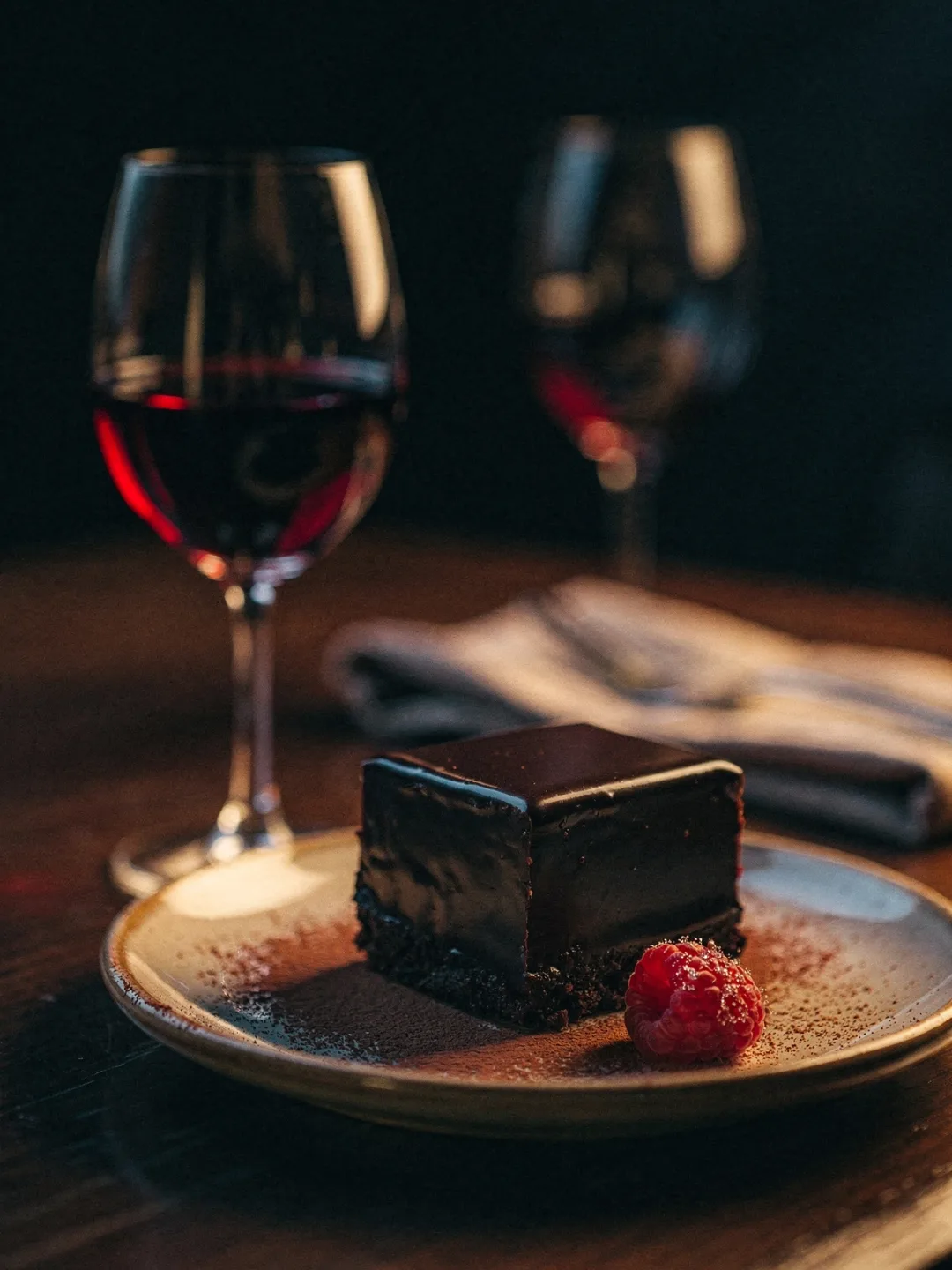
Dark chocolate brings its own bitterness alongside its sweetness, stemming from the roasted notes of the cocoa, and this bitterness clashes particularly unfortunately with tannin, since both forms of bitterness add up in the mouth instead of neutralizing each other. A dry red wine with dark chocolate therefore almost always tastes sharper and more bitter than either ingredient does on its own.
Exceptions prove the rule: a very sweet, robust Port brings enough sweetness of its own to carry the chocolate's bitterness rather than being overwhelmed by it, and its dark fruit and roasted notes complement the cocoa nicely. Milk and white chocolate, by contrast, are considerably milder and more approachable, tolerating even lighter sweet wines or aromatic sparkling wines with a touch of sweetness.
Fruit and fresh desserts
Fruity desserts like fruit tarts, sorbet, or a simple fruit salad call less for pure sweetness than for freshness, since the fruit's own acidity would otherwise clash with the wine. A light, aromatic Moscato or a sparkling wine with a touch of residual sugar often works better here than a heavy, high-alcohol sweet wine, which would overwhelm the dessert's delicate fruit.
Citrus fruits like lemon or grapefruit present a particular challenge, since their acidity is very intense and needs an equally intense but considerably sweeter counterpart. A lemon tart next to only a mildly sweet wine often makes the wine seem to disappear entirely, while a concentrated sweet wine with plenty of its own acidity can hold its ground here.
When no wine fits at all
Some desserts successfully resist any wine pairing, chief among them very sour, very cold, or very minty creations, where temperature or freshness numbs any delicate wine aromatics in the mouth. A lemon sorbet fresh from the freezer or a strongly menthol-flavored dessert can make even concentrated sweet wines seem flat and lifeless, because for a moment the tongue barely registers anything else.
In such cases, it's more honest to skip the wine altogether rather than offer a forced pairing that won't convince anyone anyway. A coffee, or simply water in between, does the dessert more favors than a wine that gets instantly overwhelmed by the dish's cold or acidity.
Dessert wine, briefly summarized
The wine must be sweeter than the dessert. This one rule holds almost without exception. Chocolate additionally needs sweetness to counter its own bitterness. Fruit needs freshness above all, not pure sweetness. Very cold or very sour desserts defeat almost any wine.
Anyone buying just one bottle for dessert should reach for a medium-sweet, sparkling wine with good acidity. It pairs with fruit tarts as well as light creams, failing only with very dark chocolate or very cold sorbet.
One last tip: when in doubt, reach for a sweeter wine rather than a drier one. Too much sweetness in the glass barely gets noticed with dessert. Too little sweetness, on the other hand, stands out immediately and unpleasantly.
Sweeter than the dessert, always. Cold beats every wine. Chocolate needs sweet wine. Fruit needs freshness. That's really all you need to remember.