Grape or place
Grape variety or origin
"Chardonnay" or "Chablis"? Both words can describe the same wine, one names the grape, the other only the place. Which path a label chooses reveals more about its origin than about its taste.
Two ways to name the same wine
Two traditions have taken hold worldwide for labelling wine. One, often called the "New World" approach, simply names the grape variety. If a bottle from California or Australia says "Chardonnay", you instantly know which grape is inside. The other, typical of many European appellation wines, names the place instead: a Chablis from Burgundy is named after its village, even though practically every bottle of it is made from the same grape, Chardonnay.
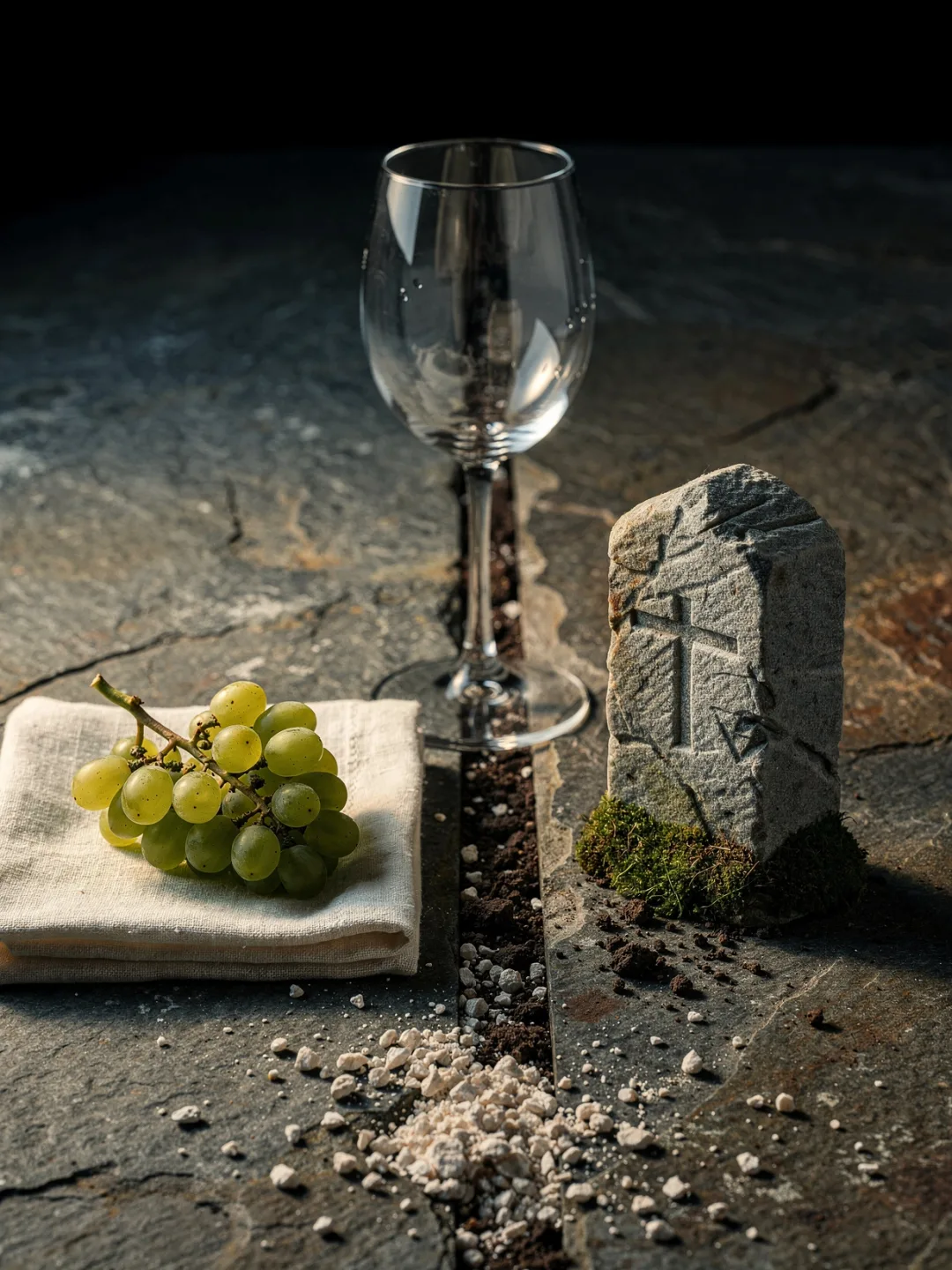
The reason for this difference lies in history. Old winegrowing regions established their rules long before globally marketed grape variety names even existed. They tied the name to the site, not to the plant. A farmer in medieval Burgundy thought in terms of parcels, not variety catalogues. Newer wine countries, without such centuries-old rulebooks, opted for the grape variety instead, because it's instantly understandable internationally. Both systems ultimately describe the same wine, just from two completely different angles. One looks at the plant, the other at the soil it grows in.
How much grape a name really requires
If a single grape variety is named on the label, EU law requires the wine to be made from at least 85 percent of that exact grape. The remaining 15 percent may come from other varieties, often for fine-tuning colour, acidity or aroma. A wine sold as "Merlot" can therefore quite legitimately contain a dash of Cabernet Franc or Petit Verdot. This doesn't have to appear on the label. For the taste, this small proportion often makes the crucial difference, without ever calling the name on the bottle into question.
If, on the other hand, two or more grape varieties are named together, such as "Cabernet Sauvignon Merlot", a stricter rule applies. These varieties together must make up exactly 100 percent of the wine. In addition, the law requires them to be listed in descending order of their proportion. The variety named first is therefore always the one present in the greatest amount. Reading the order on the label is thus reading a rough quantity indicator too, even if no exact percentages are given alongside.
Why some labels leave out the grape variety
In many classic European appellation regions, naming the grape variety isn't forbidden, it's simply unnecessary, because the appellation's own rules already fix it. A Chianti must, by regulation, be predominantly Sangiovese; a Sancerre is almost always Sauvignon Blanc. Anyone who knows the place name automatically knows the grape too, via the regulation, without it ever needing to be printed separately.
Some appellations even explicitly forbid stating the variety, because they want to emphasise their own designation of origin more strongly than the botany behind it. For inexperienced buyers from countries with a varietal culture, this can seem impractical at first, almost like a puzzle. But once you've learned the key associations, such as that Bordeaux mostly means Cabernet Sauvignon and Merlot, or Rioja almost always means Tempranillo, you can read a label without a grape variety and still understand it fully. Nobody needs to memorise these associations by heart; a quick look in a reference guide is usually enough.
When a blend doesn't carry a single name at all
Some wines are made from so many different grapes that no single variety reaches the 85 percent mark. Here, producers often turn to their own invented name for the blend, a kind of brand name for that one particular mixture. Such names say nothing about the origin of the grapes; instead they function like a recipe that can be reassembled differently each year.
In this case, the designation of origin becomes the most important anchor of trust, since the grape variety is no longer available as a point of orientation. The blend's name can also change from year to year. A buyer who knows neither the grape variety nor a familiar place name can still hold onto the protected designation of origin. It at least guarantees that certain growing rules were followed, even if the exact grape mix remains the cellar master's secret.