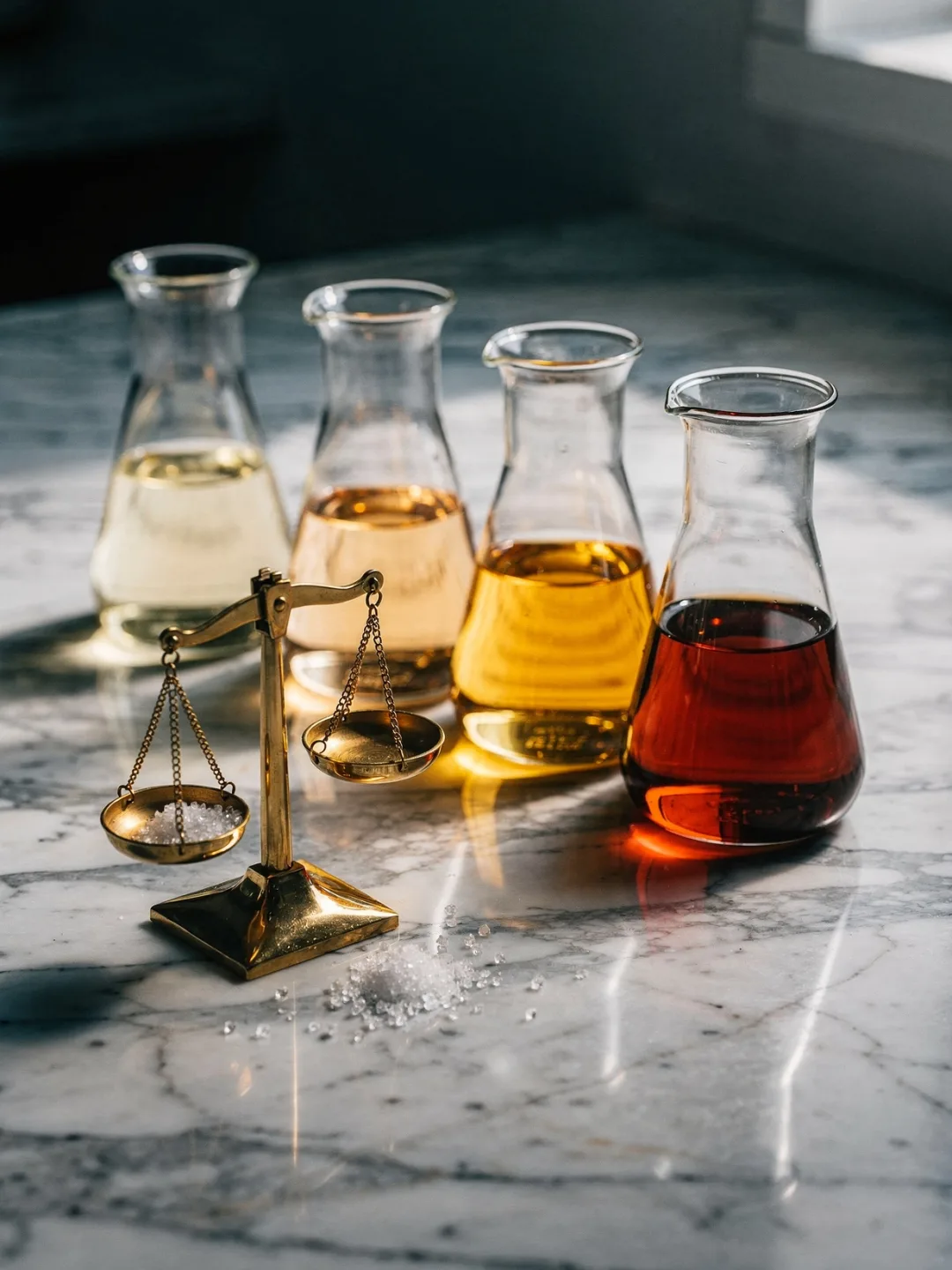
Dry to lusciously sweet
Levels of sweetness: dry to lusciously sweet
Trocken, halbtrocken, lieblich, süß: four words. Behind them lies a fixed number in grams of sugar per liter, not a matter of pure taste. Anyone who knows the thresholds already has a rough idea of what to expect before even reaching for the bottle.
Four tiers, measured by a single number
EU law measures sweetness by residual sugar, the sugar left in the wine after fermentation, measured in grams per liter. A wine may call itself dry if this value is no more than 4 grams per liter. Off-dry begins after that and extends up to 12 grams. Medium-sweet follows, up to a maximum of 45 grams, with everything above that classed as sweet. These four tiers are defined uniformly across the entire EU, regardless of whether the wine comes from Germany, Hungary, or Greece. A label from Athens and one from the Rheingau therefore mean exactly the same sugar range when they use the same word.
In practice, this scale can seem surprisingly coarse. Between 13 and 44 grams of residual sugar lies a huge difference in taste, yet the law recognizes only a single word for it: medium-sweet. That's why many producers voluntarily add the exact figure to the back label as well, often as a small number next to the words "residual sugar". Some wineries even print a small dial-style scale on the label, similar to a fuel gauge. So anyone who really wants to know exactly how sweet a bottle tastes will rarely find the answer on the front, but often on the back.
Why acidity shifts the boundary
The simple four-gram threshold for dry doesn't apply without exception. The law allows up to 9 grams of residual sugar per liter if the wine's total acidity is no more than 2 grams lower than the sugar level. Behind this lies an observation about taste: high acidity makes sweetness seem weaker on the tongue. A wine with high acidity and slightly more residual sugar can therefore still taste dry.
The same logic applies one tier up: off-dry wines may contain up to 18 instead of 12 grams of residual sugar, provided the acidity keeps pace accordingly. Riesling benefits from this rule especially often, because the variety naturally brings a lot of acidity with it. That's exactly why some Riesling labeled officially as "off-dry" can taste remarkably crisp and barely sweet in the glass. A low-acid wine with the same sugar levels, by contrast, tastes noticeably sweeter.
Lusciously sweet: a style, not a legal term
Unlike trocken, halbtrocken, lieblich, and süß, "edelsüß" (lusciously sweet) isn't an officially defined category with a fixed sugar threshold. Instead, the word describes a style. It refers to wines whose high natural sweetness comes not from simply stopping fermentation early, but from grapes that have shriveled significantly or frozen. Beerenauslese, Trockenbeerenauslese, and Eiswein from Germany belong to this group, as do Sauternes from Bordeaux and Tokaji from Hungary.
The difference lies in the path to sweetness, not in the label word itself: in many of these wines, the berry shrinks due to the fungus Botrytis cinerea, also called noble rot, concentrating sugar and aromas into a tiny space. A simple sweet wine, on the other hand, can be sweet simply because fermentation was stopped early. Both end up in the same legal category of "sweet," but they often taste fundamentally different. Noble rot also brings its own aromas of honey, apricot, and saffron.
How to guess the sweetness level without reading the fine print
A rough but useful trick: the lower the alcohol content at a similar grape ripeness, the more likely more residual sugar was left in the wine. Less sugar was then fermented into alcohol. A Riesling with 8% alcohol by volume is almost always sweeter than the same Riesling at 13% from comparable grapes. This rule of thumb doesn't work equally well for every grape variety, but it does provide a useful first orientation when in doubt.
It's safer to look at specific words: "Trocken" (dry) and "feinherb" point to low sweetness. Feinherb is a term commonly used in Germany, though not legally defined, for the drier side of off-dry. If there's no sweetness word at all, it often helps to look at the Prädikat: Kabinett and Spätlese can be either, while Beerenauslese and Trockenbeerenauslese are practically never dry.