The Cradle of Wine
First Traces in the Caucasus
The oldest traces of wine aren't found in France or Italy, but in the Caucasus. Archaeologists discovered pottery shards in Georgia that came into contact with fermented grape juice some 8,000 years ago. Long before Rome or the Pharaohs existed, wine was already being made here.
Pottery Shards from Georgia
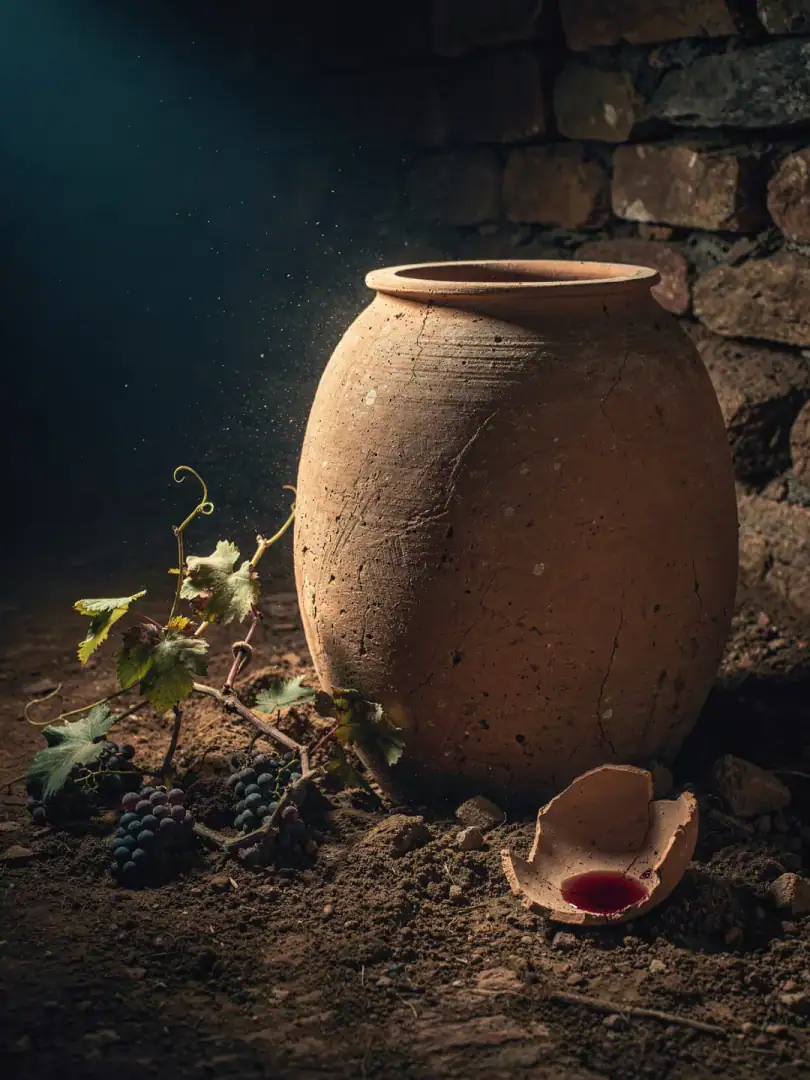
In 2017, an international team from seven countries published a study on two villages south of Tbilisi, Gadachrili Gora and Shulaveris Gora. Fragments of large clay vessels were found there, buried since the early Neolithic period. Scientists chemically analyzed the residues and found tartrate, or tartaric acid, in strikingly high amounts. This acid occurs almost exclusively in the fruit of the grapevine. The find is therefore considered proof of genuine wine, not just some fermented fruit juice.
The age of the shards pushed back the known history of wine by six hundred to a thousand years, since finds from Iran had previously been considered humanity's oldest known evidence. Dating placed the Georgian vessels at roughly 6000 to 5800 BC. The oldest chemical evidence of wine to date thus comes from the southern Caucasus, not from one of the countries most people associate with winemaking today.
Why the Vine First Grew Here
The Caucasus lies at a climatic seam, where humid winds from the Black Sea met warmer air from the interior. It was precisely there that the wild ancestor of today's grapevine grew on its own, without any human involvement, unnoticed for thousands of years. Botanists call this subspecies Vitis vinifera sylvestris. People likely gathered its grapes long before they cultivated the plant deliberately. Such wild vine forests still exist in the Caucasus today, along riverbanks and in shaded gorges.
The shift from gathering to cultivating can't be pinned to a single year. Farmers probably observed over many generations which vines bore sweeter or larger grapes, and deliberately replanted their seeds. In this way, a wild plant slowly became a cultivated one. At the end of this long process stood a simple vessel: a clay pot full of grape juice that began fermenting on its own.
The Qvevri: Clay Instead of Barrel
Georgians fermented and aged their wine in large, egg-shaped clay vessels called qvevri. They buried them up to the rim in the ground and filled them with pressed grapes, including skins, stems, and seeds. Underground, the temperature stayed remarkably steady for months, allowing fermentation to proceed gently. After several months, the vessel was opened again. What emerged was a robust, often amber-colored wine.
This method is no mere archaeological footnote, but a living practice. UNESCO added traditional Georgian qvevri winemaking to its list of Intangible Cultural Heritage in December 2013. Families still pass down the knowledge today, from one generation to the next, often during shared autumn harvest festivals where entire villages pitch in. Some farms own qvevri buried by their great-grandparents, tended for over a hundred years. Anyone drinking Georgian qvevri wine is drinking wine made by a method barely changed in eight thousand years.
A Heritage That Returns
For centuries, the qvevri method remained almost exclusively a Georgian affair, barely known beyond the country's borders. Only in the last twenty years have winemakers worldwide rediscovered the principle: grape juice fermenting together with the skins, without cultured yeasts or much technology. The result often resembles what's sold today as orange wine. Modern winemakers rarely use real clay vessels for this, usually working instead with open vats or concrete eggs.
So at the start of this journey stands no winery and no country in today's sense, but a valley south of Tbilisi. From there, viticulture spread across millennia, south into the Middle East and west to the Mediterranean, until it eventually even reached the Rhine. Every following stop on this journey builds on this one discovery that nobody expected when the archaeologists began to dig.