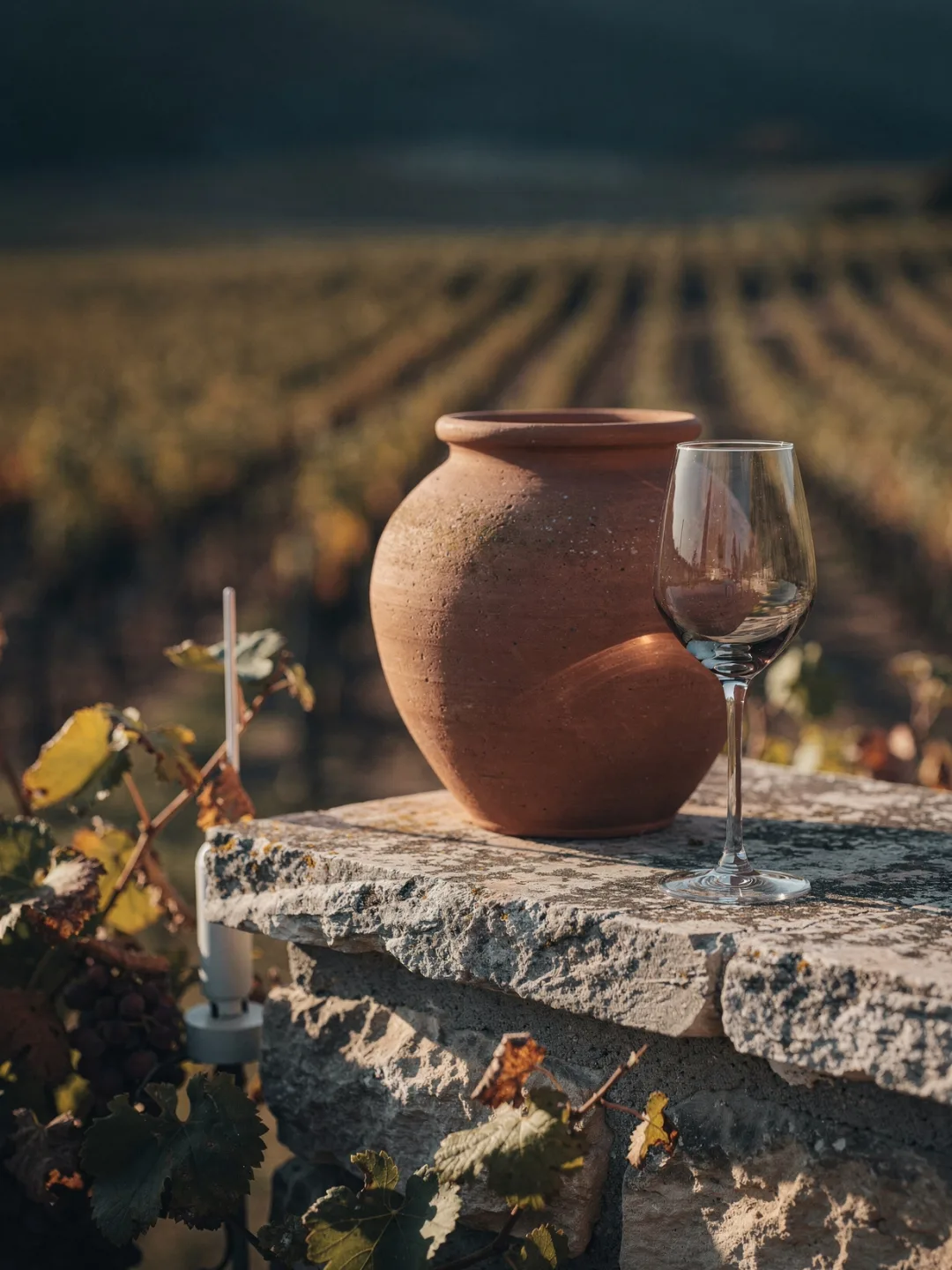
Climate meets tradition
Wine today
Ten thousand years after the first clay vessels in the Caucasus, winemaking once again stands on the brink of upheaval. This time, it's driven by neither war nor pest. It's a warmer climate and a growing number of winemakers deliberately returning to simpler, older methods.
Harvests that start earlier and earlier
Winemakers worldwide now pick their grapes, on average, significantly earlier than just a few decades ago. In the Burgundian town of Beaune, the harvest between 1988 and 2018 began, on average, around thirteen days earlier than in the decades before. Similar shifts are visible in wine regions around the globe, from Germany to Australia.
Warmer summers make grapes ripen faster. That may sound like an advantage at first, but in practice it creates new problems: higher sugar content means more alcohol in the finished wine. The acidity that keeps a wine fresh and lively breaks down faster with quicker ripening. Winemakers are responding. They're seeking out higher-altitude or cooler sites, trying late-ripening varieties, or repositioning their vine canopies to provide more shade for the grapes. Some are also experimenting with grape varieties from warmer countries of origin, which their own climate will likely resemble in twenty or thirty years. It's a kind of forward-looking bet on their own future. Others are betting on traditional, nearly forgotten local varieties that have always coped better with heat and drought than today's widespread international standard varieties.
New regions, old regions under pressure
Areas once considered too cool for serious winemaking are now gaining importance. These include Southern England, which now produces remarkably good sparkling wine, and parts of Scandinavia, where winemakers have only recently begun planting vines at all. At the same time, traditional, warm wine regions in southern Europe are coming under pressure, increasingly simply lacking the cool conditions needed for fresh, balanced wines.
This shift is also reshaping economic maps in the long term. Some centuries-old wine regions must reinvent themselves, while other, previously insignificant stretches of land are catching the eye of winemakers and investors for the first time ever. Agricultural land that was considered completely unsuitable for viticulture just twenty years ago is now being planted, on a trial basis, with the first rows of vines. Investors from established but increasingly pressured regions often finance this.
The return to natural wine
Alongside climate change, a movement has been growing for some years now that looks in exactly the opposite direction: natural wine. It's made with as little technical intervention as possible, without added cultured yeasts, and with little to no sulfur as a preservative. The grapes are often grown organically or biodynamically, harvested by hand, and fermented with wild yeasts native to the estate, rather than purchased cultures.
Some of these winemakers, consciously or not, are drawing on exactly the method with which this journey began. Grape juice ferments together with the skins in large, open vessels, today often made of concrete, clay, or old wooden barrels rather than a buried qvevri. The resulting amber-colored orange wine thus combines a very old Georgian idea with a very current marketing term.
Law, origin, and the future of an ancient drink
The law surrounding wine keeps evolving too. Since April 23, 2024, Regulation (EU) 2024/1143 has applied within the European Union. It reorganizes the protection of geographical indications for wine, spirits, and other agricultural products, replacing or consolidating several older sets of rules. It helps determine which names a winemaker is still allowed to put on their label today. Even in the Middle Ages, towns decided which wine was truly entitled to call itself Bordeaux.
From the first clay shards in the Caucasus to digital proof of origin and apps that manage bottles and cellars, one constant remains remarkably stable across ten thousand years. People care deeply about origin, authenticity, and the craftsmanship behind what ends up in the glass. This care, more than any single technique, connects the Neolithic Georgian farmers with today's natural wine producers. Every stop on this journey, from the Roman wine press to climate change, ultimately reveals the same underlying tension: between preserving tradition and the need to adapt to new circumstances. Wine was never a quiet drink in a quiet cellar, but always part of larger upheavals in trade, faith, politics, and, quite currently, in climate itself.