Three different philosophies
Organic, Biodynamic and Natural Wine
Organic, biodynamic and natural wine often sound like synonyms. But they mean three different things: a legally regulated certification, an esoterically influenced cultivation method, and a so-far legally undefined attitude toward intervention in the cellar.
Organic wine: a legally protected certification
In the EU, organic wine follows the Organic Regulation, since 2022 in its current form as Regulation (EU) 2018/848, supplemented by detailed rules specifically for wine. In the vineyard, this means above all one thing: no synthetic pesticides or artificial fertilizers. Compost, mechanical weed control and plant protection products from a clearly limited, natural list are permitted instead. Anyone who violates these rules loses certification for the affected plot, often for several years, since the conversion to organic already takes a while in itself.
In the cellar, the organic regulation also sets limits, such as lower maximum sulfur dioxide levels than for conventional wine. Certain technical processes are banned too, such as dealcoholization through reverse osmosis. The EU organic logo, a leaf made of stars on a green background, thus guarantees a controlled, annually certified minimum standard of ecological production. However, it says nothing about how much intervention otherwise takes place in the cellar, for instance during fining or filtration.
Biodynamics: organic plus its own worldview
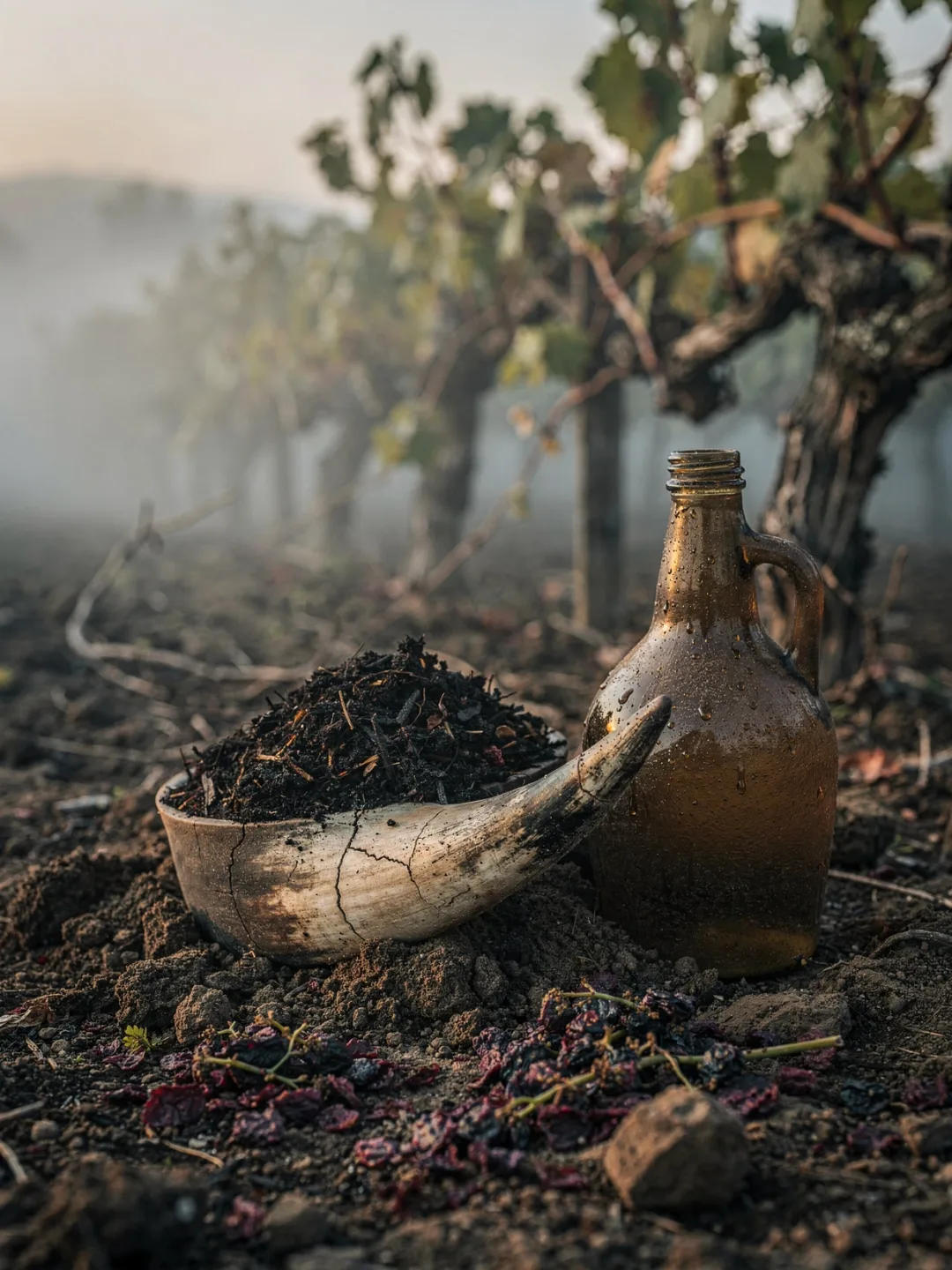
Biodynamic viticulture builds on the rules of organic farming but reaches further back, to the 1920s. That's when the Austrian philosopher Rudolf Steiner first gave lectures on a holistic, spiritually influenced approach to agriculture. Since then, biodynamic estates have viewed the vineyard as a single, self-contained living organism. In addition to organic methods, they use special preparations, such as fermented compost buried in cow horns, which is dug up again in spring and applied to the fields in highly diluted form.
A particularly controversial part of biodynamics is the alignment of many tasks with the lunar calendar, meaning moon phases and zodiac signs. There is no scientifically recognized proof of effectiveness for this. Biodynamics is usually certified through private seals like Demeter rather than a state regulation. Proponents nonetheless report healthier soils and livelier wines. Critics see it mainly as strict but scientifically unproven additional rules on top of organic farming, without solid evidence of a real difference in the glass.
Natural wine: an attitude without a fixed definition
Unlike organic or biodynamic, natural wine is not a legally protected term but an informal movement. The idea isn't new. Individual winemakers were already working deliberately with as few additives as possible decades ago. However, the term and the scene around it only became popular over the past twenty years, especially among small, independent wineries across Europe, from France and Italy to Germany and Austria.
Natural wine usually means organically grown grapes and spontaneous fermentation with wild yeasts instead of cultured yeast. On top of that comes little to no added sulfur and a refusal to fine or filter, often also a refusal to control temperature during fermentation at all. Clear rules exist for protected designations of origin, such as under EU Regulation 2024/1143. For natural wine, such an official definition and control is completely lacking. That means, in principle, anyone can use the term on a bottle, which critics regularly point out.
Less intervention means more risk
All three approaches share one basic idea. They aim to intervene as little as possible in a natural process, trusting the grape, the yeast and the soil more than the technology in the cellar. The price for this is often less control. Natural wines without sulfur and filtration can appear cloudier, spoil faster, or taste different from bottle to bottle, something that would hardly happen at a conventional estate.
For many winemakers and drinkers, that's exactly the appeal. A wine then honestly shows what a year, a soil and a grape produce with little interference, warts and all. This brings the journey full circle. It began with the carefully pruned vine in winter and ends with the question of how much intervention a wine really needs in the end to be fully itself.