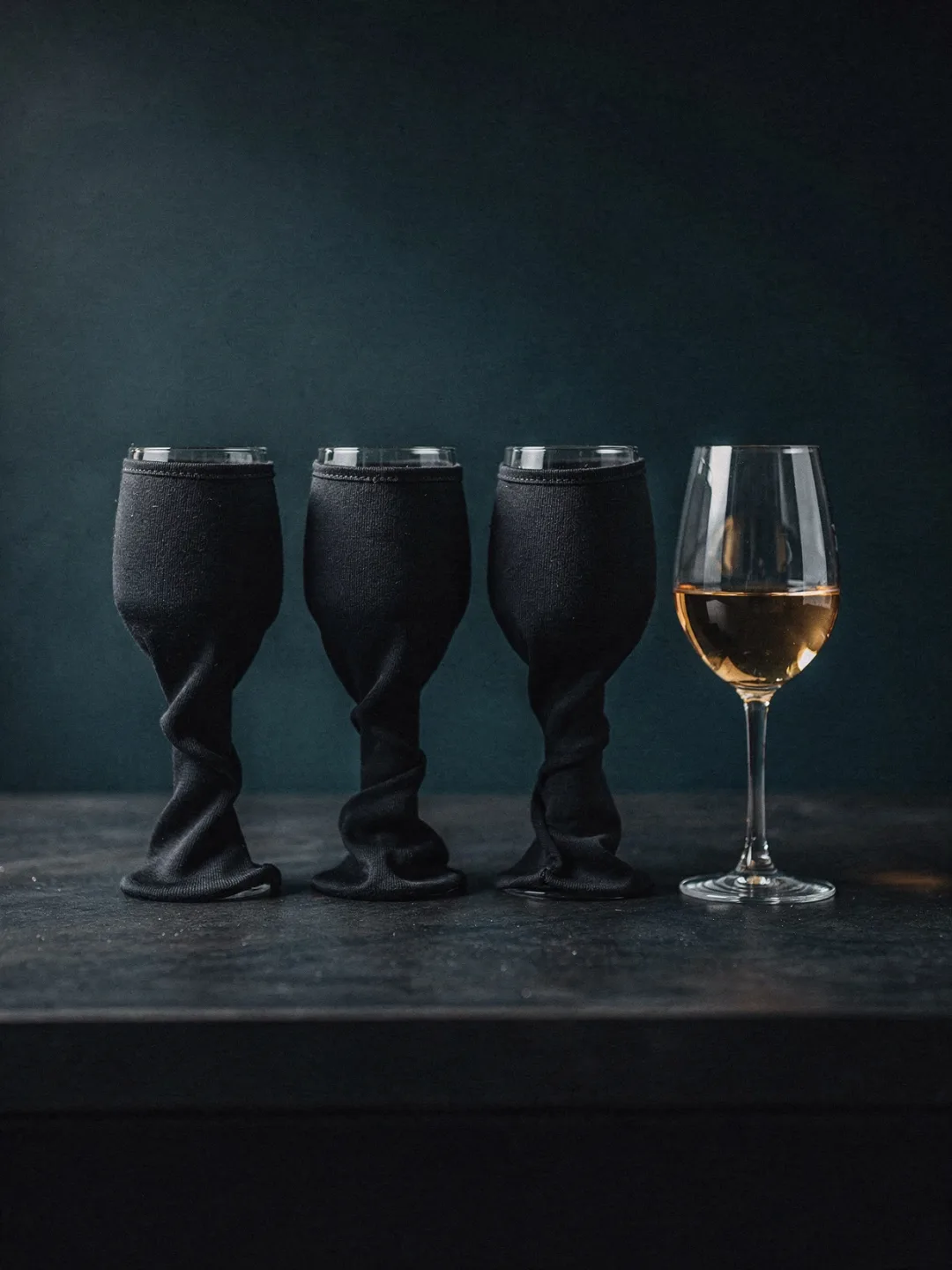
Judgment without a label
Blind tasting
Once you know what's in the glass, you no longer taste with a clear mind. A label, a price, or a well-known name slips in between the wine and your own judgment—and blind tastings were invented for exactly that reason.
Why a label changes the impression
French researcher Frédéric Brochet demonstrated just how strongly a label can bend judgment in 2001, through two simple experiments. In the first, he tinted a white wine red using a flavorless dye and asked fifty-four enology students to describe it. Almost no one caught on to the trick. Nearly everyone used words typically associated with red wine, such as notes of stewed red fruit, even though what was in the glass was an entirely ordinary white wine.
In the second experiment, fifty-seven test subjects were given the same middling Bordeaux twice: once with a label for a simple table wine, and once with the label of a prestigious top estate. They described the supposedly simple bottle as thin and unbalanced, while the very same liquid with the fancier label was called complex and harmonious. The wine hadn't changed once between the two tastings—only what the test subjects knew about it.
The day California beat France
How consequential a genuine blind tasting can be became clear on May 24th, 1976, in Paris. British wine merchant Steven Spurrier had invited French tasters to pit Californian and French white wines, as well as red wines, against each other blind. The occasion was a small celebration marking the two hundredth anniversary of American independence. No one expected a surprising outcome, least of all the French judges themselves.
In the end, Californian wines won in both categories: a Chardonnay from Chateau Montelena and a Cabernet Sauvignon from Stag's Leap Wine Cellars, both from the 1973 vintage. The event went down in wine history as the Judgment of Paris and proved something almost no one had dared say out loud until then: without the label in view, the reputation of an entire wine nation lost its automatic edge.
Single-blind or double-blind
In a single-blind tasting, only the taster doesn't know which wine is in the glass, while the person pouring knows exactly. That's usually more than enough for a casual comparison at home. At competitions and in professional criticism, many organizers go a step further and taste double-blind: even the person pouring no longer knows which glass corresponds to which wine, because a third person has secretly determined the order beforehand.
This extra step prevents preferences from unconsciously creeping in through glances, tone of voice, or the order of pouring. At medal competitions with many hundreds of samples, double-blind tasting has now become standard practice. A single leaked name can otherwise skew the result for an entire category.
Practicing blind tasting without overreaching
Sommelier training includes a particular exercise: systematically deducing a wine's grape variety, origin, and age from its color, aroma, and taste. Pronounced acidity paired with a pale green tinge in the color points to a cooler climate, while a velvety texture with ripe, dark fruit suggests a warmer site. With enough practice, this chain of clues can lead to remarkably accurate guesses.
Still, this exercise isn't a benchmark for everyday enjoyment. When simply enjoying wine at home, no one needs to guess the grape variety or pin down an origin in order to understand and appreciate it. Blind tasting is most worthwhile when a judgment needs to be as independent as possible from price or a famous name. A good example is comparing several similar bottles from your own cellar.
Blind tasting at home, too
A simple version of blind tasting works just as well at your own dinner table, no competition or expert panel required. A second person pours two or three wines into numbered glasses and covers up the bottles. Secretly, they note down which number corresponds to which wine. Only after you've formed your own impression is it revealed which wine was hiding behind which number.
Small rounds like this often reveal more about your own taste than any open tasting would. The cheaper wine suddenly gets a fair shot. Anyone who regularly compares wines this way with friends also learns something fundamental: your own impression can shift surprisingly much over the course of a single evening, depending on the order of tasting and how you're feeling that day.