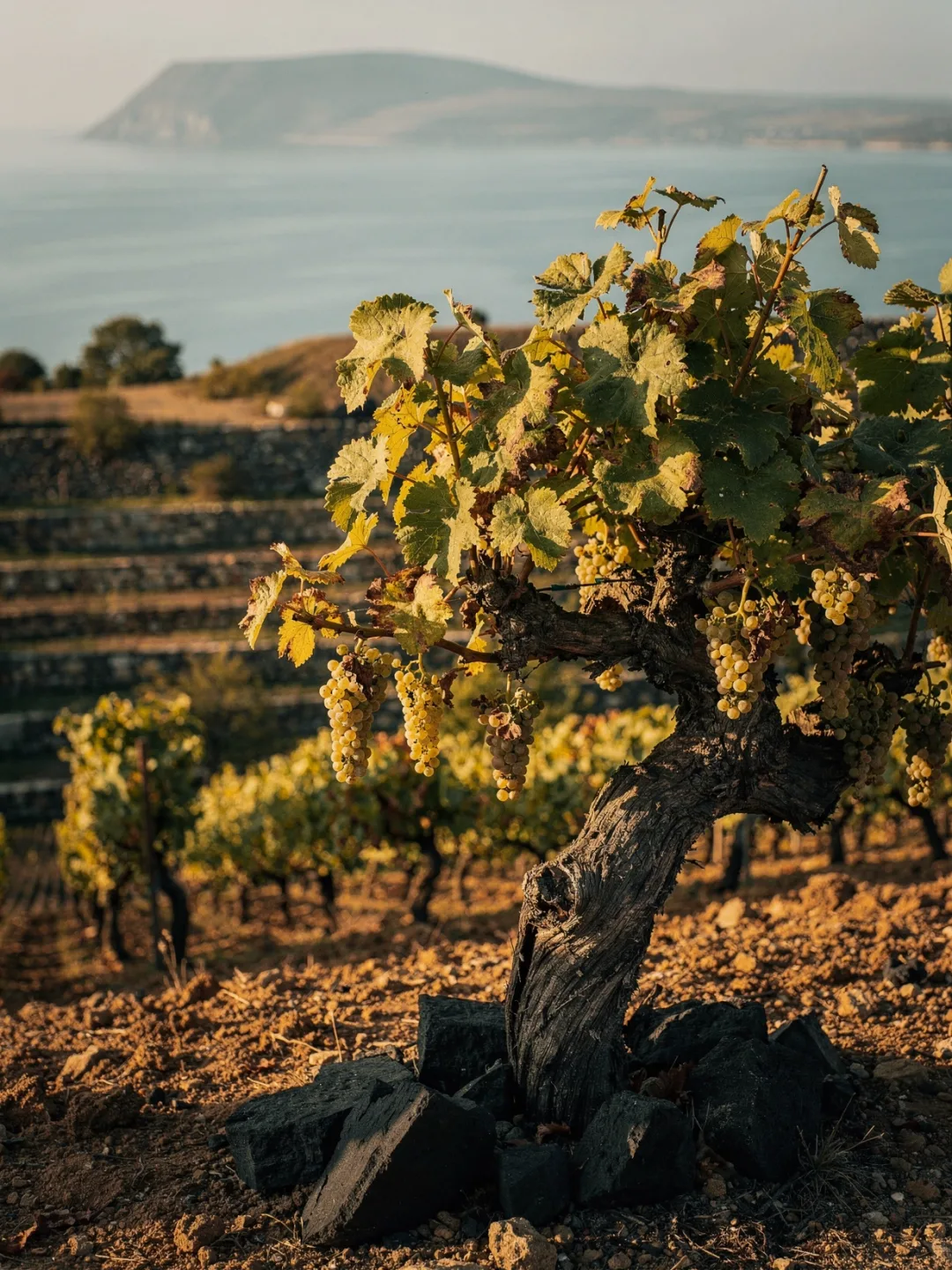
Kéknyelű and its neighbors
Grape Varieties
One grape variety shapes the northern shore of Lake Balaton like no other. Olaszrizling, known in English as Welschriesling, covers more area than any other variety around the lake. It shares nothing with true Riesling but the name, though, and belongs botanically to an entirely different family. Its grapes ripen late and yield full-bodied, often slightly bitter wines.
Alongside it stands Szürkebarát, the 'grey monk.' The variety is a strain of Pinot Gris, also known internationally as Grauburgunder. Monks were already planting it on Badacsony around 1300, and today it produces full-bodied, often golden-yellow wines with low acidity. When the grapes hang on the vine for a long time, they sometimes develop noble rot, a fungus that draws out water and thereby concentrates the aromas.
The true rarity is called Kéknyelű. The variety grows practically nowhere else but on the basalt slopes of Badacsony and blooms exclusively female. Without Budai zöld as a pollinator in the neighboring row, its yield stays minuscule. In the glass, it's unusually powerful for a white wine, almost tannic, with a structure that some tasters would expect from a red.
In the warmer Balatonfüred-Csopak area, a bit east of Badacsony, Furmint mingles with the Olaszrizling in good years — the very same variety that carries the sweet Aszú wines in far-off Tokaj. Here it stays mostly dry, yielding taut, mineral-driven wines.
International varieties have arrived as well. Chardonnay, Sauvignon Blanc, and the crossing Müller-Thurgau now appear in nearly every vineyard around the lake, usually as a second or third variety alongside Olaszrizling. They haven't displaced the old names anywhere, though — the bond with Kéknyelű and Szürkebarát runs too deep for that.