Nyirok & Rhyolite Tuff
Soils
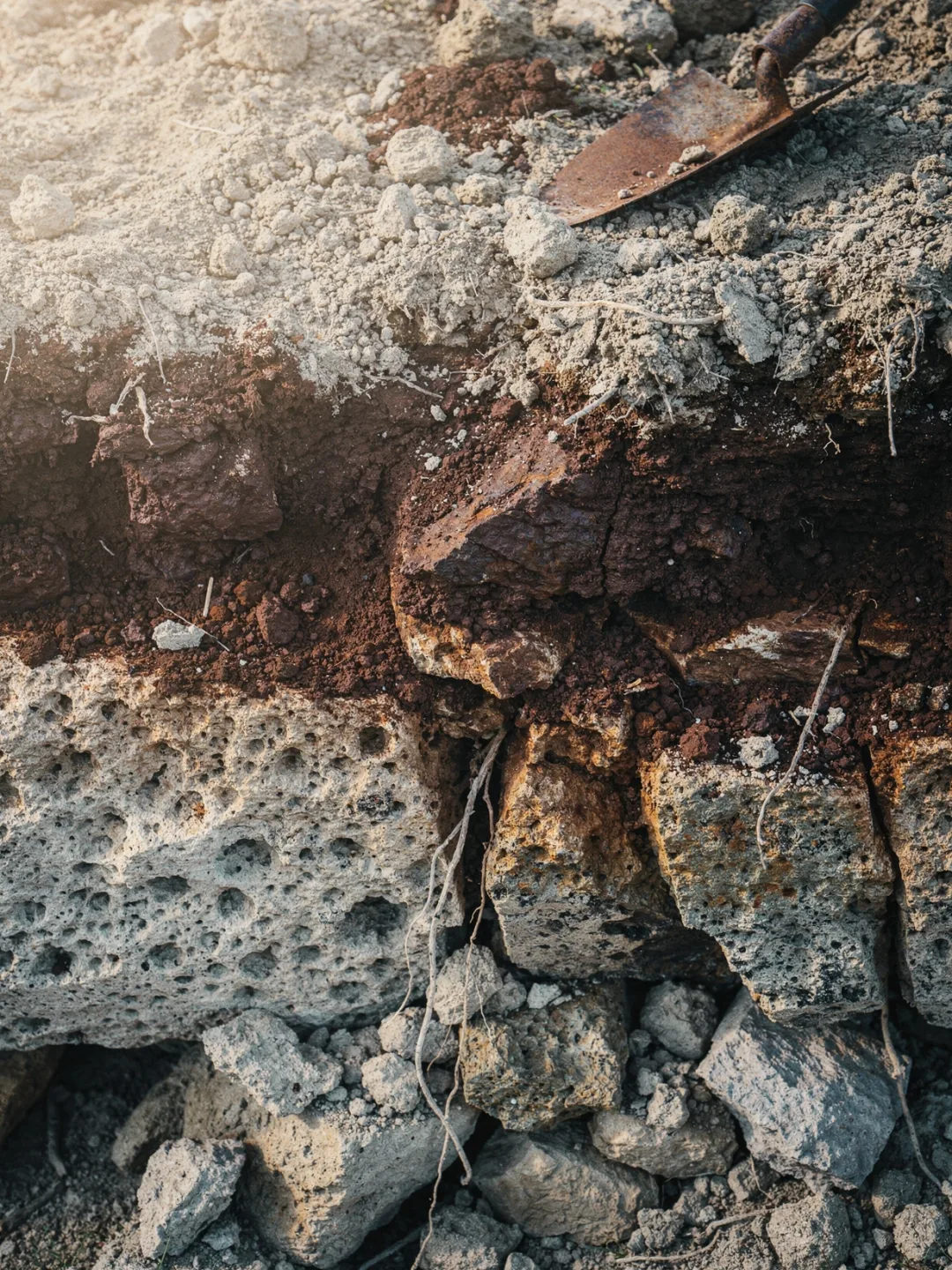
Dig a hole in a vineyard near Mád, and you'll first hit fine, pale dust: loess, blown here by the wind over thousands of years.
Beneath it, the color turns red. This layer is called Nyirok here, a tough, iron-rich clay formed as volcanic rock weathers over millions of years. In Tokaj, this is mainly rhyolite tuff and andesite. Both are remnants of around four hundred extinct volcanoes that built up this landscape twenty million years ago. Nyirok stores water like a sponge and releases it only slowly, exactly what a vine needs during a dry late summer.
Deeper still lies the tuff itself, compacted volcanic ash. It's sometimes soft enough to dig cellars into with bare hands. This is exactly what the famous cellar labyrinths beneath Tokaj and Sárospatak are made of. For a vine root, it's a hard but porous reservoir. Through it, the root works its way down for meters to reach moisture left over from the previous year.
Which soil sits above which differs from site to site, sometimes across just a few hundred meters, and that's why the eighteenth-century classification still holds true today: Nyirok sites produce more powerful, denser wines, while loess sites give more elegant, less concentrated ones.
A misconception persists here too: that the vine absorbs minerals from the volcanic rock and the wine later tastes them. What actually matters is the detour via water: how much a soil holds and how quickly it releases it. That, in turn, determines how deep a root needs to grow.
Fine, pale windblown dust from the last ice age, calcareous and quick-draining in summer.
The root: This is where the fine roots sit. They take up whatever rain arrives and are the first to dry out.