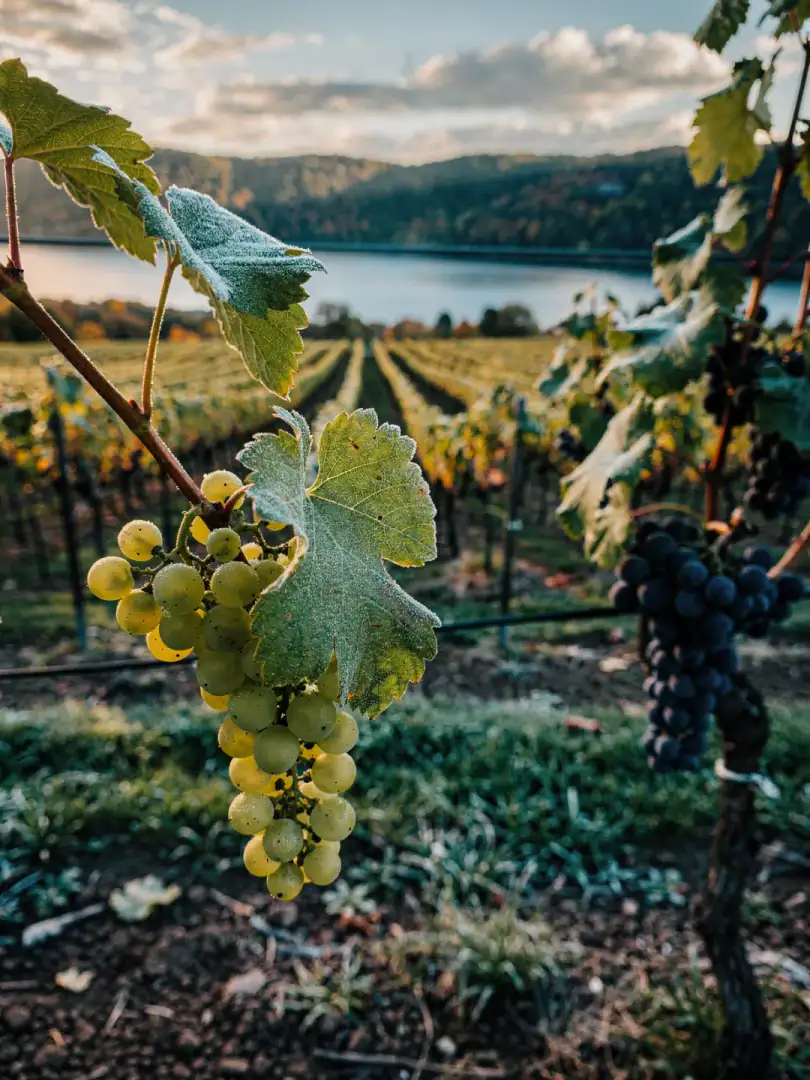
Riesling & Hybrids
Grape Varieties
A single white variety defines the region's image today. Riesling covers roughly 850 acres, more than double the second-place Chardonnay, making it the most widely planted European grape in the Finger Lakes. Cool nights over the water keep its acidity high even once the sugar is long since ripe. The result tastes of green apple and lime, rarely of fruit alone.
Among red varieties, one with Bordeaux roots leads the way. Cabernet Franc has claimed the top spot among red vinifera with about 240 acres, well ahead of Pinot Noir and Cabernet Sauvignon. Its thin skin ripens earlier than that of most other red varieties, which matters greatly in a season that must wrap up in October before the first hard frost arrives. In the glass it shows a lean side. Green bell pepper, red cherry, and a tannin that barely clings to the tongue round it out.
The second half of the story doesn't come from Europe, but from the region's own research garden. At Cornell's station in Geneva, breeders spent decades crossing hardy American vines with more delicate European varieties. Cayuga White, a cross of Schuyler and Seyval Blanc, got both its name and its cold resistance this way. Vignoles, in circulation under that name since 1970, yields wines with acidity sharp enough to keep even high residual sugar tasting fresh. None of these varieties make headlines. Without them, the region wouldn't exist in its current breadth.
At the coldest end of the scale stands Vidal Blanc. Great Western Vineyards pressed the region's first ice wine from it in 1981, using grapes that had frozen right on the vine. Today Riesling and Cabernet Franc are also used for ice wine, but Vidal remains the classic thanks to its thick skin and high acidity. As different as these varieties sound, vinifera makes up only about a fifth of the total vineyard area around the lakes. The rest is Concord and Niagara, grown for juice and grape jelly, not for the bottle.