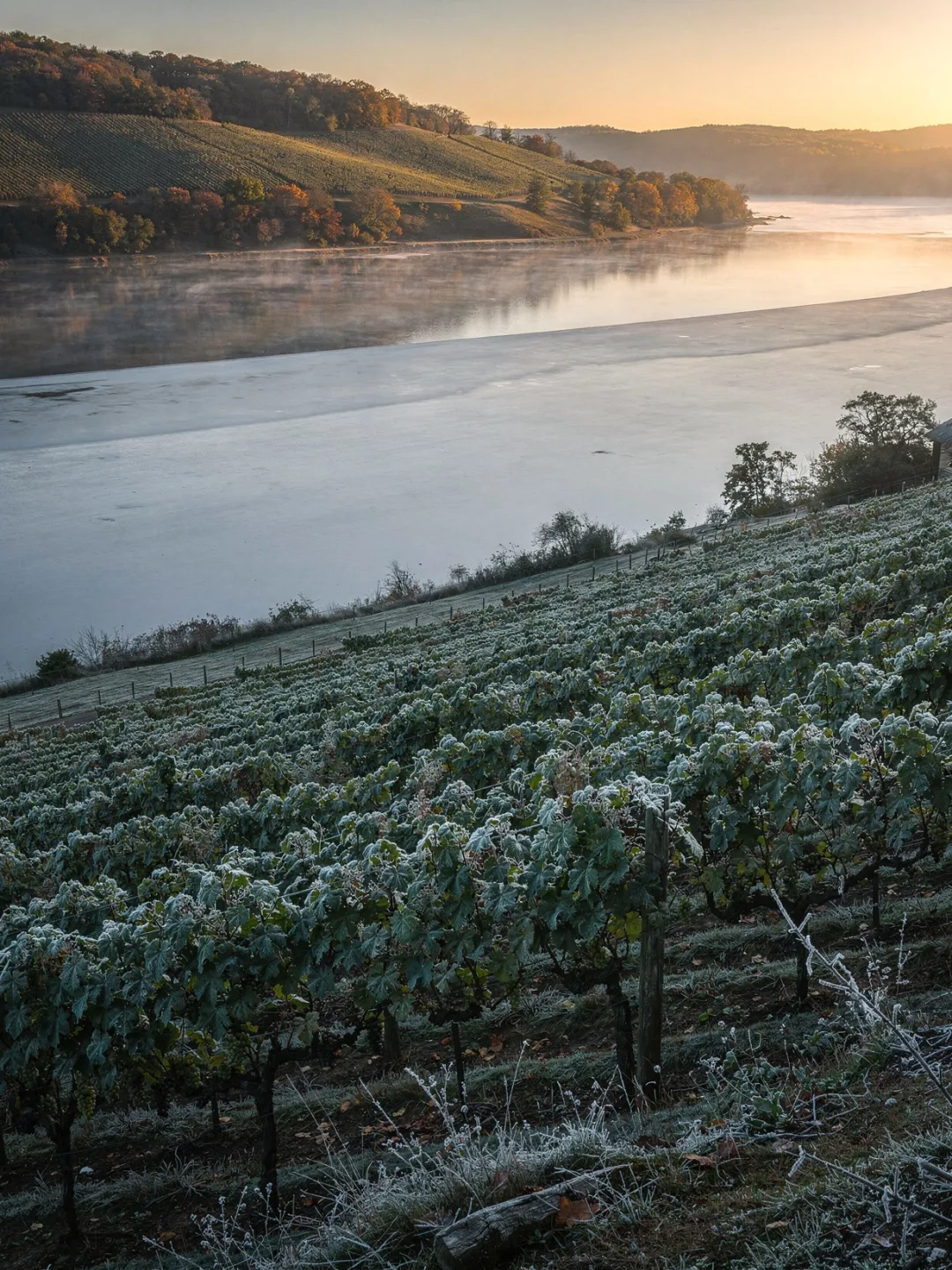
Deep Lakes Warm the Air
Climate
Drive through Central New York in winter and you'll see frozen fields for miles with barely a vine in sight. The Finger Lakes growing season lasts only 190 to 205 days, shorter than in nearly any other well-known wine region in the world. And yet Riesling ripens here reliably. The reason lies not in the air, but in the water below.
Seneca Lake plunges to more than 180 meters at its deepest point and as a result almost never freezes over. Cayuga Lake, a good 60 kilometers long, has a lakebed that actually dips below sea level. Both lakes store enormous amounts of heat from March through August. They then release it back slowly. In spring, the air above the water stays cool as a result, which delays bud break and protects the vines from late frosts. In autumn the opposite happens, as the lakes warm the air along the slopes even as the first frost has long since settled further inland.
Look at a map of the wineries and a pattern jumps out immediately: almost all of them sit on slopes, not down in the valley. Cold air is heavier than warm air and sinks at night. A vineyard planted in the middle of a valley sits exactly where the frost collects. On the southeastern side of Seneca Lake the effect is so pronounced that locals have called the area the Banana Belt for decades. The name has nothing to do with bananas—it refers to the fact that even sensitive varieties rarely suffer frost damage there.
Konstantin Frank didn't choose his land on Keuka Lake by accident. The western shore sits directly across from the lake's deepest point and so benefits from the strongest buffering effect. Without that advantage, his first vinifera planting would hardly have survived its first harsh winter. The same logic still holds today. Where the slopes drop steeply to the water, more Cabernet Franc, Pinot Noir, and Cabernet Sauvignon are now being grown than even ten years ago—varieties once considered too risky for the area.