Fog versus Heat
Climate
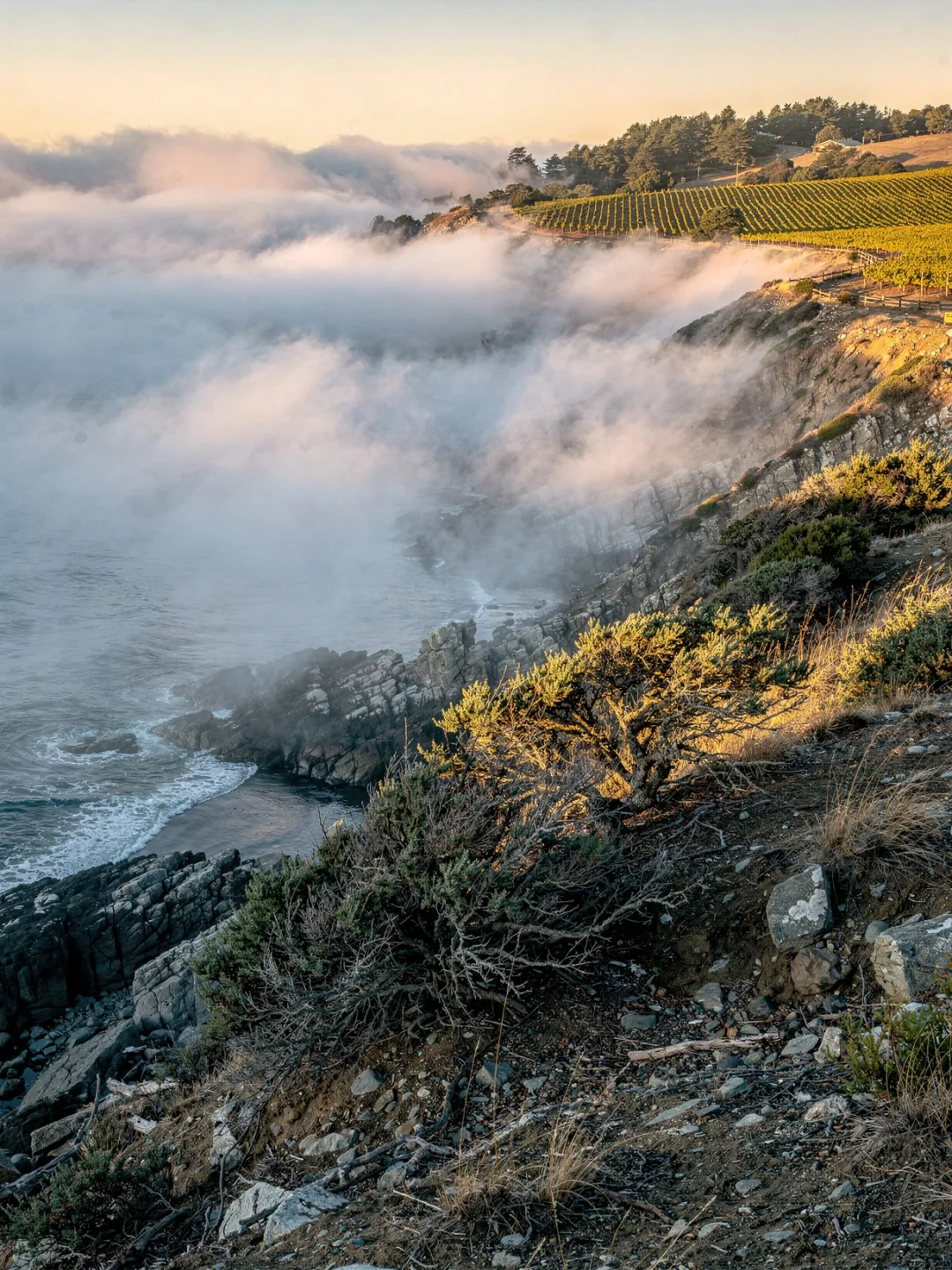
Anyone driving from the coast inland on an August morning passes through several climate zones within an hour. Thick fog often lingers at the coast until noon, while barely ten kilometers away, in the valley, the sun has already been shining for hours. This difference is no accident — it's geography: the Pacific cools the air. Depending on how open a valley lies to the coast, this coolness penetrates inland to varying degrees. Nowhere else in California does the climate shift so dramatically over such a short distance.
The Sonoma Coast AVA, established in 1987, illustrates the problem of drawing too large a boundary. It covers roughly 194,000 hectares, stretching from Carneros to the Mendocino county line. Most of that area lies far from the cooling ocean. Winemakers on the truly cool coast fought for years for their own, smaller zone. Since May 2022, they have one: the West Sonoma Coast AVA lies no more than eight to eleven kilometers from the Pacific and is, on average, about five and a half degrees Celsius cooler than the inland sites. That's a difference you can taste in the glass.
The Russian River itself acts like a funnel for fog. It draws cool ocean air from the open Pacific at Jenner deep into the valley, often lingering well into the afternoon. The eastern side of the county is entirely different: there, the Mayacamas Mountains block the fog almost completely, so places like Alexander Valley stay dry and noticeably warmer in summer. Grapes there ripen earlier, with less acidity and more sugar.
Far to the south lies Los Carneros, an AVA since 1983. For the first time, its boundary doesn't follow a county line but rather wind and fog, and to this day it sits half in Napa, half in Sonoma. San Pablo Bay cools the roughly 15,000-hectare area from the west. On the Sonoma side, additional fog rolls in from the Pacific. That's why Pinot Noir and Chardonnay thrive here, often destined for sparkling wine: cool, breezy, ideal for bubbles.