Gold Rush & Law
Region & History
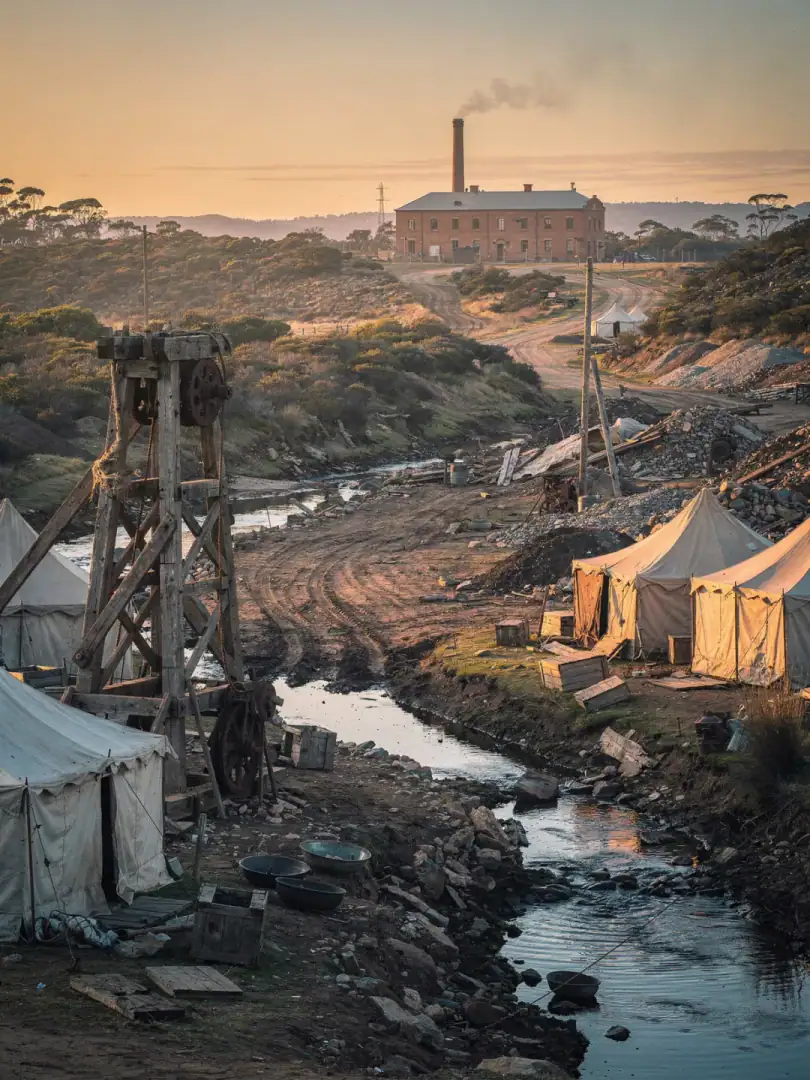
When gold was discovered near Ballarat in 1851, hundreds of thousands of men poured into Victoria. With them came a thirst for something stronger than beer. Scottish and Irish immigrants brought their trade with them, and alongside the claims in the goldfields, the first pot stills appeared. Staying legal, though, meant getting a licence.
In 1862, the Victorian Distillation Act tightened the rules so much that small distillers could barely get a licence at all. Anyone who wanted to stay legal had to think big. John Dunn opened his Warrenheip distillery near Ballarat in 1863, right in the middle of the gold rush money, and kept going until 1930. Hardly anyone else in Victoria lasted that long.
In 1888, the Federal Distillery in Port Melbourne built one of the largest plants on the continent. By 1894, more than a million liters a year were running through its columns, mostly industrial alcohol. The Distillation Act of 1901 then set a nationwide minimum still size of 2,700 liters, an impossible sum for any small distillery. For decades after that, Victoria remained the domain of big companies. In 1930, the Distillers Company of Edinburgh opened the Corio distillery near Geelong, producing blended whisky there until it closed in 1980.
That Victoria has small distilleries again today is thanks to a Tasmanian. In 1990, Bill Lark convinced the government to scrap the 1901 minimum still size. Only after that could the mainland distill again without having to build a corporation first.
David Baker was the first to make use of the new freedom on the mainland. In 1999, he founded the Bakery Hill Distillery in Bayswater, east of Melbourne, still today the longest continuously operating whisky distillery on the Australian mainland. Two more distilleries followed in 2004, at opposite ends of the continent. Cameron Syme opened the Great Southern Distilling Company with its Limeburners brand in Albany, Western Australia. David Vitale started in Melbourne with what would later become known as Starward. In 2014, Archie Rose in Sydney brought a third city into the picture, the first new distillery there in over 160 years.
Four distilleries, three states, one shared starting point. A single law had blocked, for a century, what can now be tasted throughout Victoria today.