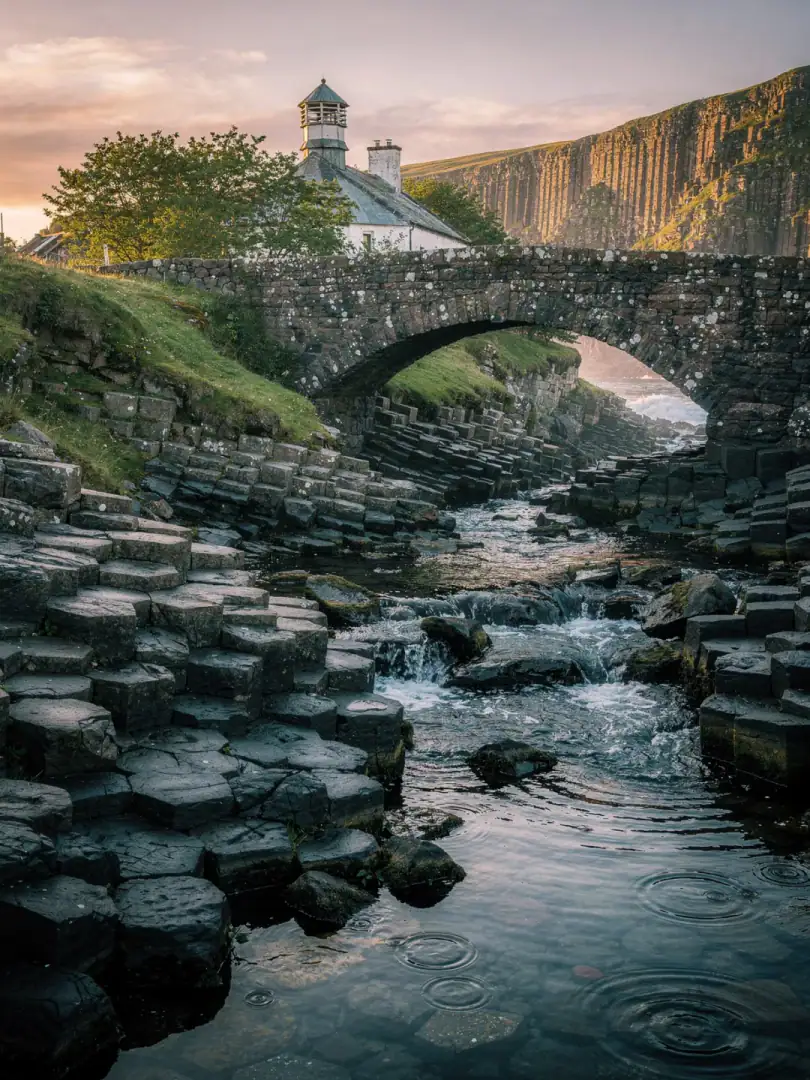
A Rill Through Basalt
Water & Climate
Standing by the water in Bushmills, you're not looking at the River Bush itself. You're looking at one of its tributaries, the narrow stream called St Columb's Rill. This stream has supplied the distillery for centuries. The water flows down from the Antrim Plateau, through soils resting on one of Europe's strangest rock formations.
Around 50 to 60 million years ago, lava erupted here from long fissures. It cooled into straight, mostly hexagonal columns. This rock formation can be seen just a few kilometers away at the steep coastline, known as Giant's Causeway. Beneath the entire region, the basalt lies like a dark lid. Any water that seeps through it loses its hardness and becomes soft.
Further south, in Ballynahinch, Hinch draws its water from Silent Valley. There lie the drumlin hills of County Down, a completely different landscape from the basalt coast in the north. Instead of sharp-edged cliffs, there are gentle, rounded hills, but just as much soft rainwater.
Along the north coast, the Atlantic dictates the climate. It's damp and rarely extreme, with mild winters and cool summers. For the casks in the warehouse, this means steady conditions throughout the year. The dramatic temperature swings that make whisky mature faster elsewhere, but also evaporate faster, are barely felt here.
Along the Causeway Coast, rain falls more as the norm than the exception. It's often fine drizzle rather than brief downpours. This steady moisture keeps the soils above the basalt saturated year-round. As a result, springs like the Rill don't run dry even in dry summers.