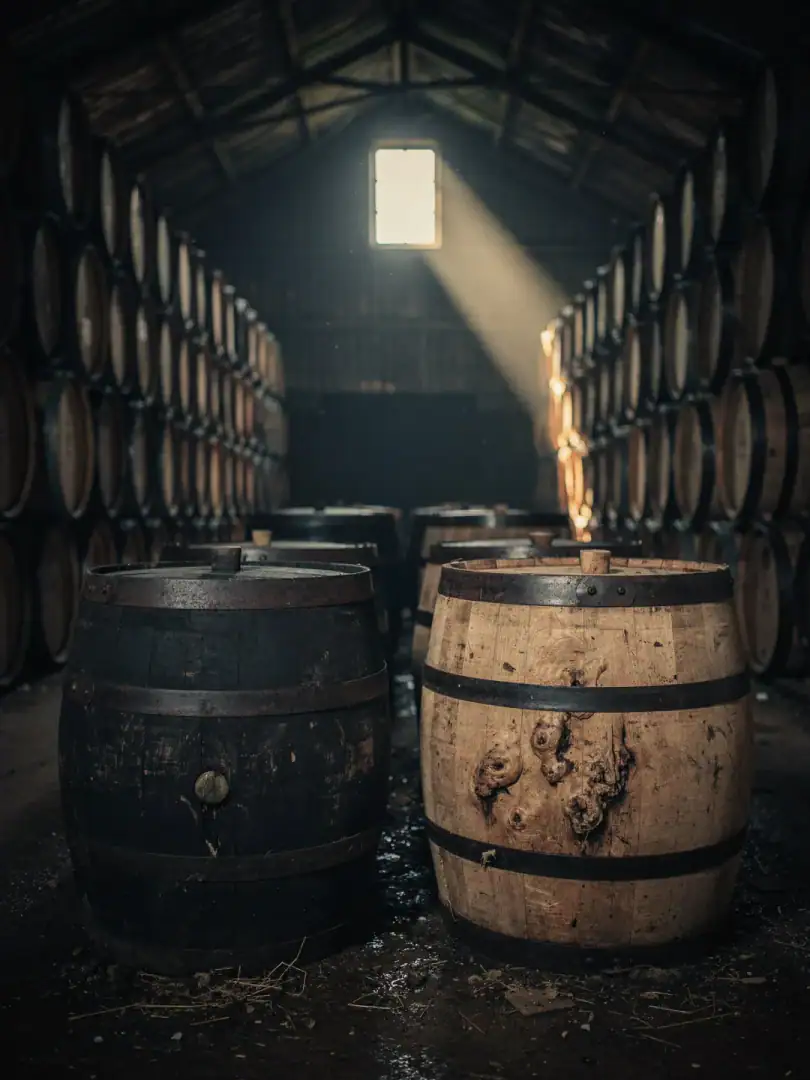
Mizunara and sherry
Cask & Maturation
Three types of wood define Yamazaki's warehouses: American white oak from used bourbon casks, European oak from Spanish sherry casks, and a third found almost nowhere else, Mizunara made from Japanese oak.
Mizunara grows mainly on Hokkaido, slowly and with many branches, which makes the wood porous and hard to bend. Coopers took a long time to learn how to build truly watertight casks from it. Early attempts simply leaked. That's why Mizunara casks remain considerably more expensive than American or European oak to this day.
The effort pays off in the glass: Mizunara imparts a note of sandalwood and incense that no other cask type delivers. Because the wood is so porous, it also interacts more strongly with the warehouse air than denser oak does.
The warehouses stand at the foot of Mount Tennozan, in the same humid air that already shapes the mash. For the casks, this means a faster cycle of expansion and contraction than in a cooler climate. The whisky loses more volume to the air as a result, the so-called angel's share.
For the standard bottlings, Suntory combines all three cask types. For special editions like the Yamazaki Mizunara release, however, the whisky matures exclusively in Japanese oak, so its character comes through undisturbed.
No other element varies as much in Yamazaki's whisky as the cask. The range spans from the sweet caramel of bourbon oak to the resinous, incense-like note of Mizunara. That is ultimately what makes the difference between a simple whisky and a layered one.