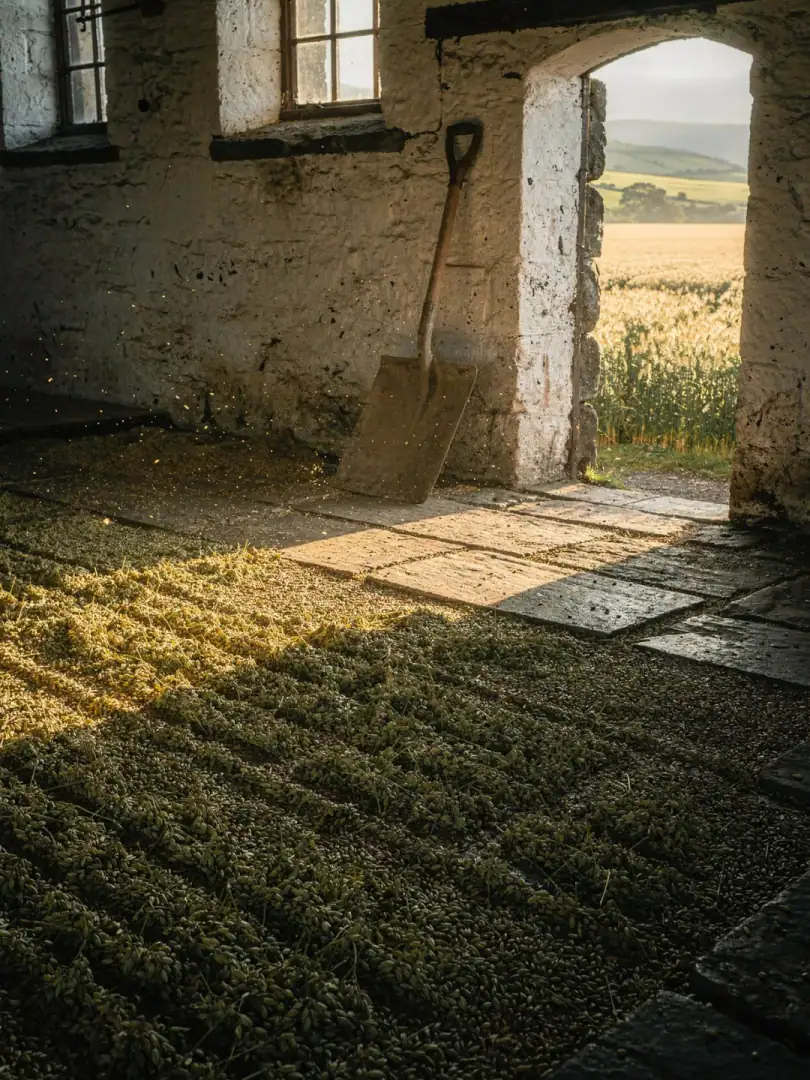
Its Own Malting Floor
Grain
Under the Scotch Whisky Regulations of 2009, Single Malt Scotch Whisky may only be made from malted barley, water and yeast. Other grains are off limits for this category. That sets Scotland apart from Kentucky, where Bourbon needs at least 51 percent corn. In Campbeltown, this Scottish rule shows itself especially clearly. Springbank is one of the last distilleries in the country still malting part of its own barley.
On its own malting floor, the damp barley is turned by hand several times a day. This lets it germinate evenly, without hot spots forming. After about a week, it moves to the kiln for drying. Elsewhere, this work has long since been taken over by large commercial maltings using machines. In Campbeltown, it's still part of the distillery's daily rhythm.
From the very same barley, Springbank produces three completely different whiskies: the eponymous Springbank, the unpeated Hazelburn, and the heavily peated Longrow. The difference doesn't lie in the grain. It lies in the kiln and in the number of distillation runs that follow later.
Glen Scotia and Kilkerran, by contrast, source their malted barley from maltings on the Scottish mainland, as most distilleries in the country do. The grain typically comes from fields in the east of Scotland, where the soil suits barley growing far better than on the windy, rain-soaked Kintyre peninsula.
So in a single town, two paths run side by side. At Springbank, it's the old, slow handwork on the malting floor. At the other two distilleries, it's the modern practice of buying in from specialist maltings. Both paths lead to whisky under the same law, only the road to the finished malt differs.