Smoke from the Moor
Malt & Peat
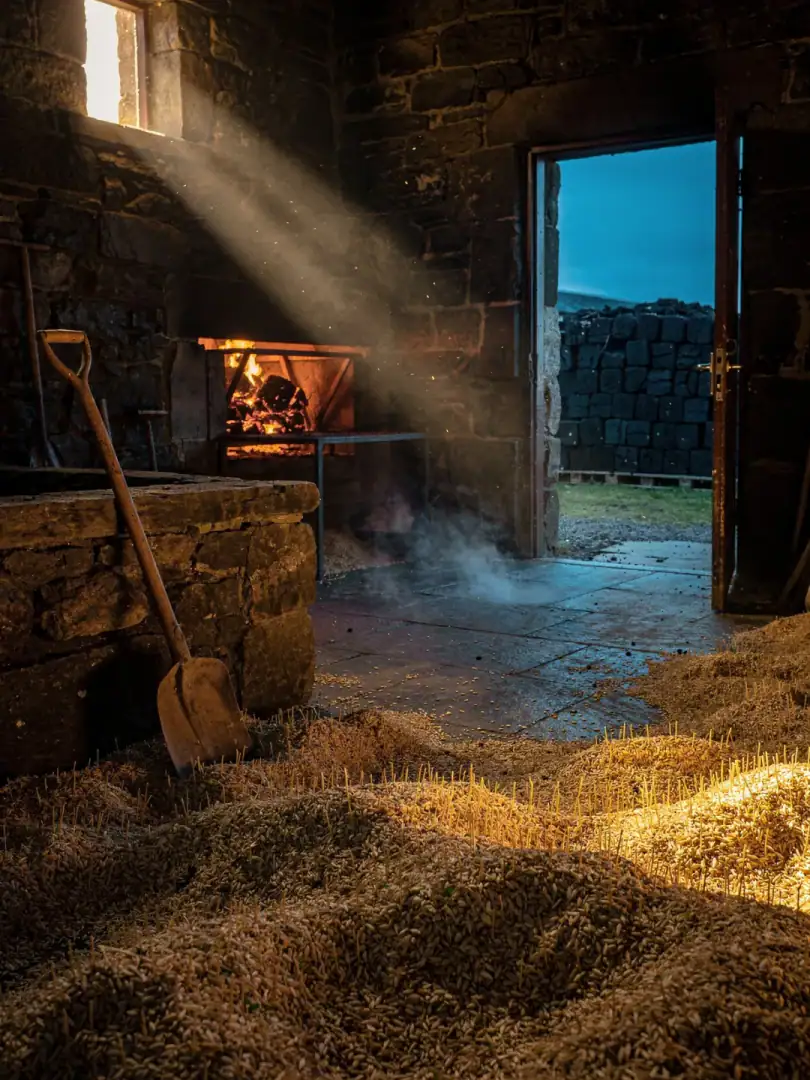
Almost every distillery on Islay burns peat to dry its malt. It's cut straight from the island's own moors. Once, this was pure necessity, since coal was expensive and hard to ship in; today it's craft carried out on purpose. The smoke drifts through the damp, germinated grain and leaves behind phenols, the flavour compounds you later taste as smoke, iodine, or soot.
Distilleries measure the strength of this in ppm, phenol parts per million. Ardbeg takes it furthest at 50 to 55 ppm. Lagavulin, Laphroaig, and Caol Ila sit around 35 ppm, Bowmore at roughly 25 ppm. Bunnahabhain and Bruichladdich, by contrast, distil with barely any peat at all, usually under 3 ppm, their malt arriving unsmoked from the mainland.
Most of the malt comes from Port Ellen Maltings, an industrial malting facility in the harbour town of the same name. It has supplied nearly the whole island since the 1970s, using peat cut from Castlehill Moor. Kilchoman takes a different path. The island's smallest distillery still malts part of its barley by hand, on its own malting floor. The ppm levels there vary between roughly 20 and 50, depending on the batch.
On the malting floor, the wet, germinated barley is turned so it doesn't clump and dries evenly. Only afterward does it go into the kiln, where peat smoke rises up through the bed of grain from below. How long and how densely it's smoked plays a part too. The result can be a whisky like Bowmore, mild and rounded, or one like Ardbeg, sharp and smoky.
Sphagnum moss and heather, still green and barely compressed.
The root: Too young to cut; this is where tomorrow's peat is only just beginning to form.