Storm, Salt, Spring
Water & Climate
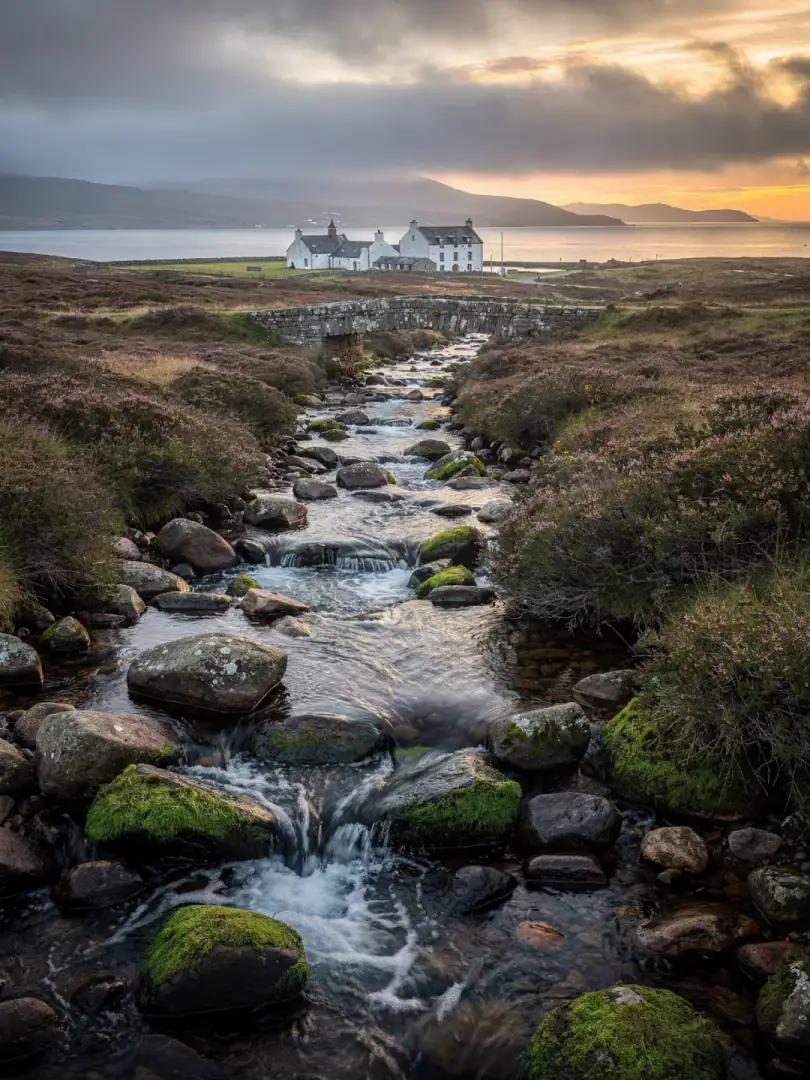
Kilbride Stream is the name of the burn that supplies Laphroaig with water. It's a peat-stained trickle running over moor and heath before reaching the distillery. Every distillery on the island has its own source. Bruichladdich, for instance, draws mashing water from its own loch, cools with a stream, and bottles with spring water from Octomore. That makes three different waters for three different steps.
Bowmore sits right on Loch Indaal, a sea loch that cuts deep into the island. The village and its distillery practically grow out of the water. The distillery's first warehouse, Number One, even lies below sea level, its outer wall bordering directly on the loch. Walking through those warehouses, you almost hear the water more than you see it.
Beneath the peaty turf, the bedrock shifts from limestone to schist, depending on which part of the island you're on. Water seeping through limestone picks up minerals and becomes harder. Water from peat and schist, by contrast, stays softer and darker in colour. That makes a real difference to the flavour, even if few drinkers consciously pick it out.
The climate is mild and damp, with constant wind off the Atlantic and storms that carry salty spray miles inland. This very climate means less whisky evaporates on Islay than elsewhere in Scotland. At Bowmore, the annual loss, the so-called angel's share, sits at only about 1 to 1.5 percent. Other warehouses across the country lose closer to 2 percent. What does evaporate smells of the sea, or so say the distillery workers who walk past it every day.