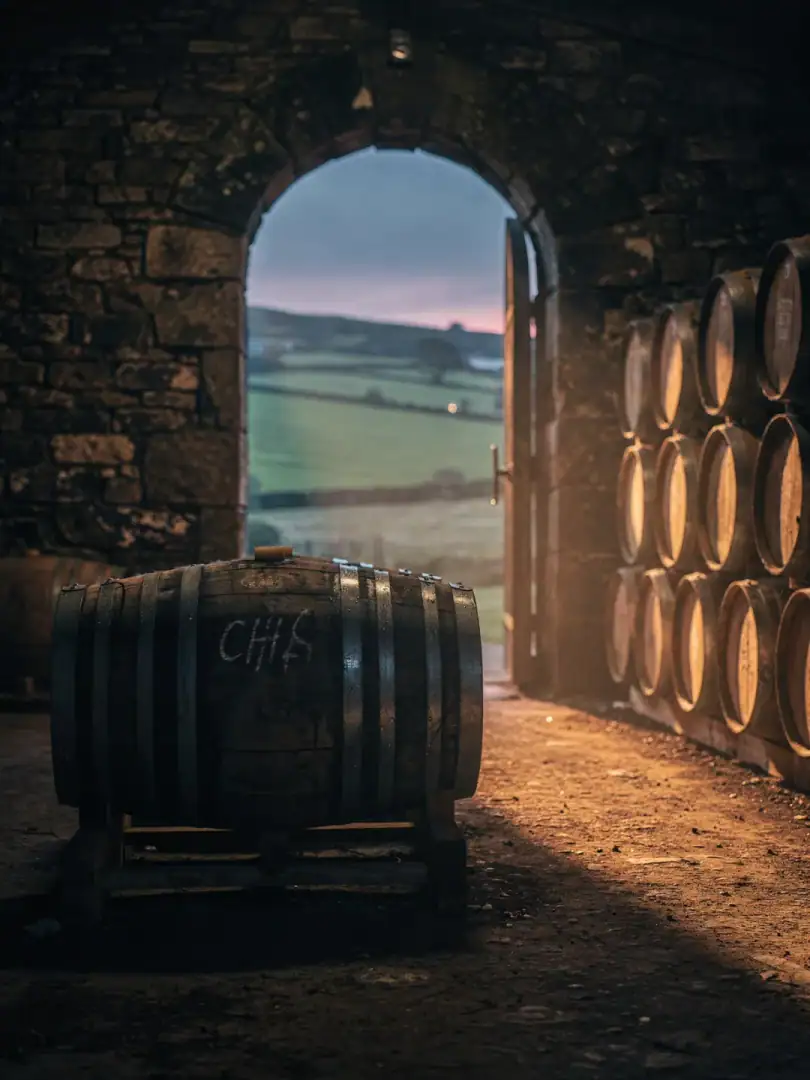
A Mild Ageing Climate
Cask & Maturation
Bourbon casks made of American white oak dominate the region's warehouses, most having already held Kentucky bourbon before crossing the Atlantic. Sherry casks remain the exception rather than the rule.
The Lowlands' mild, maritime climate affects maturation differently than the harsher weather of the Highlands or Islay. Without extreme temperature swings between summer and winter, the cask works more calmly. The angel's share, the annual evaporation loss, therefore proceeds more evenly, without the sharp swings a warehouse right on the open sea would experience.
Auchentoshan's warehouses sit in the shadow of the Kilpatrick Hills northwest of Glasgow, close to the city yet surrounded by greenery. Bladnoch's casks mature in Galloway, where the Gulf Stream's influence from the Solway Firth brings comparatively mild winters.
Some of the new Lowland distilleries mature their whisky right in the city. Port of Leith, in Edinburgh's old harbour district, was built as a vertical distillery. Clydeside, on the Glasgow riverside, matures its whisky just steps from the water, where ships were once built.
This stands in contrast to the traditional, rural warehouses of Glenkinchie and Bladnoch. It shows just how differently maturation can look within the same region today.
Cask selection, too, is changing with the new distilleries. Where Auchentoshan, Glenkinchie, and Bladnoch long relied almost exclusively on bourbon wood, younger houses like Lindores Abbey and Daftmill experiment more openly with different cask sizes. In the end, the basic rule still holds: a mild climate matures whisky more slowly and evenly than would ever be possible on an exposed island.