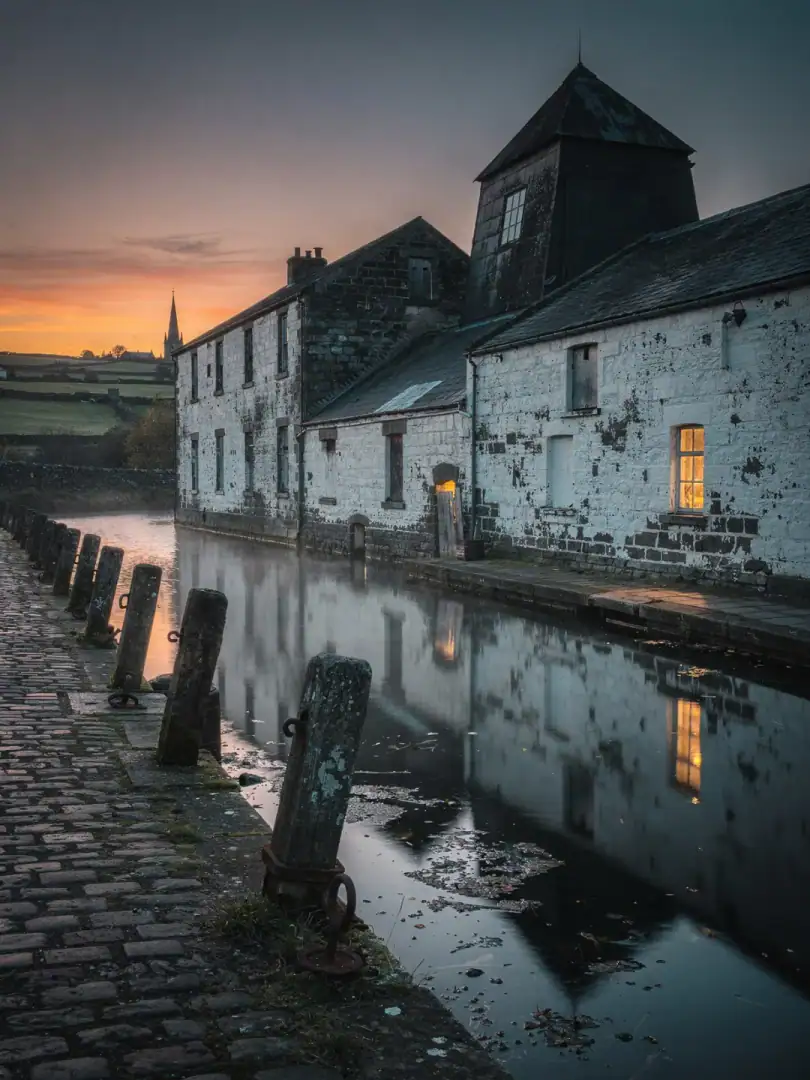
Cornfield & Collapse
Region & History
Between Greenock on the Firth of Clyde and Dundee on the North Sea runs an invisible border, the Highland Line. Everything south of it counts as the Lowlands, as officially defined by the Scotch Whisky Regulations 2009. Unlike the mountain regions to the north, this border is a pure administrative matter, not a watershed, not a mountain range. Just a line on paper that nonetheless decides which label a distillery is allowed to carry.
Auchentoshan near Clydebank was licensed in 1823, Bladnoch on the river of the same name founded in 1817 by brothers John and Thomas McClelland. Glenkinchie followed in 1837 in fertile East Lothian. Three names that survived what nearly destroyed the rest of the region: the twentieth century, with its taxes, wars, and waves of consolidation.
By around 1990, hardly anything remained of what had once been a dense landscape of distilleries. Rosebank in Falkirk closed for good in 1993, and to this day remains one of the most missed names in the industry. Bladnoch fared little better: Northern Irish entrepreneur Raymond Armstrong rescued the site from ruin in 1994. It wasn't until 2000 that spirit ran from the still again, only for the distillery to fall silent once more in 2009, and go into liquidation in 2014.
In the end, only Auchentoshan and Glenkinchie remained as continuously operating malt distilleries, two against the rest of Scotland. Anyone writing about the Lowlands in the nineties often meant the same thing: soon there'll be none left at all.
Since 2010, the picture has turned around: three active malt distilleries have become more than twenty. Daftmill and Kingsbarns opened in Fife, joined in 2016 by InchDairnie and Lindores Abbey. Clydeside followed in 2017 on the Glasgow riverside, and the Borders Distillery in Hawick in 2018. Rosebank, too, is currently being revived, and more than a dozen further projects are under construction or in planning.