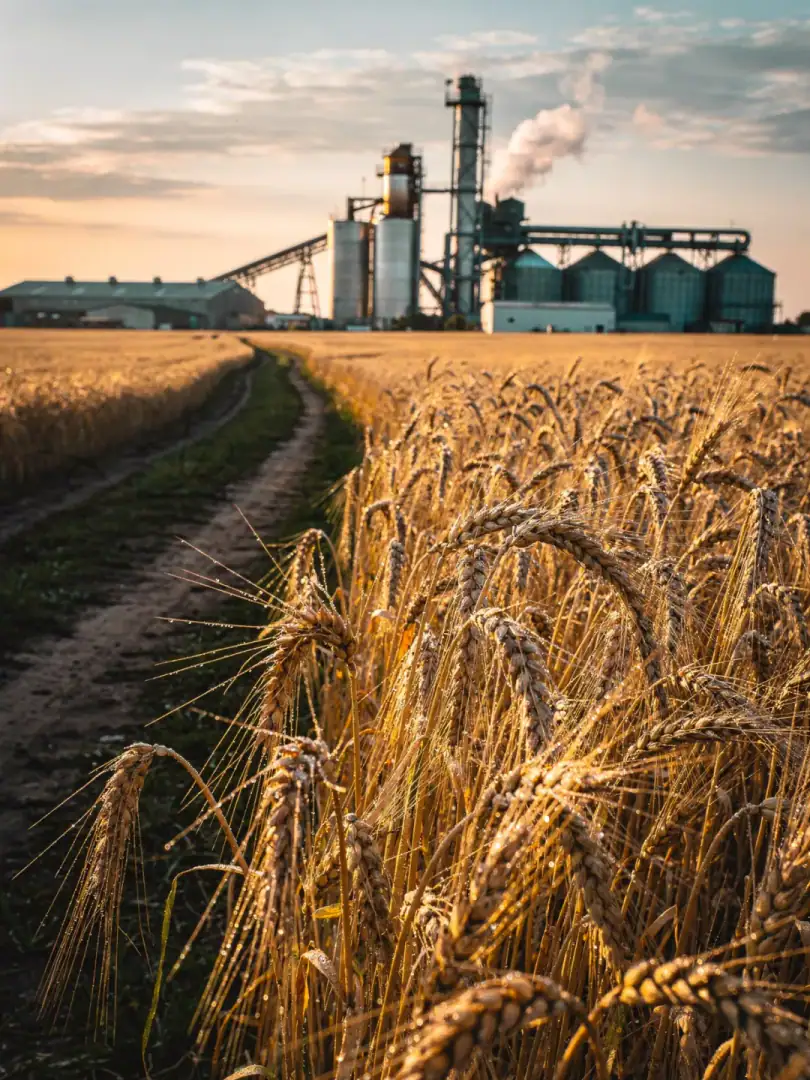
Granary and Giant
Grain
East Lothian and the Scottish Borders have for centuries been counted among the most fertile grain-growing areas of Scotland. Mild climate, deep soils, plenty of sun for the barley fields. This same barley has always supplied the raw material for two very different styles of whisky from the region, often produced just a few kilometres apart.
One is single malt from the pot still, as distilled by Glenkinchie and Auchentoshan. The other is grain whisky from the column still. This is precisely where the Lowlands' true strength lies: no other region in Scotland produces anywhere near as much of it.
Cameronbridge in Fife was founded in 1824. From 1830 onward, it was one of the first distilleries to use Robert Stein's column still method. Today, three column stills run there with a capacity of around 136 million litres a year, more than any malt distillery in the region could ever hope to achieve.
North British in Edinburgh is Scotland's second-largest grain distillery. Strathclyde in Glasgow was founded in 1927 by gin producers Seager Evans. Girvan on the Ayrshire coast was built by William Grant & Sons in 1963, and it's still where the Single Grain Blackbarrel is made.
This grain-whisky weight is the reason the Lowlands supply more whisky for blends than any other region. Without the column stills of Cameronbridge, North British, Strathclyde, and Girvan, most well-known blended whiskies wouldn't exist in their current form.
The Scotch Whisky Regulations 2009 therefore draw a clear line between two categories. Single malt must come from malted barley and a pot still, while single grain permits other cereals and the column still. In the Lowlands, both worlds often lie no more than an hour's drive apart.