The First Alcohol
Fermentation & Yeast
Only once yeast meets the cooled wort does alcohol actually begin to form. What looks, in huge wooden or stainless steel vessels, like simple beer brewing already sets the course for the flavor to come.
The Washback: The Vessel Where It All Bubbles Up
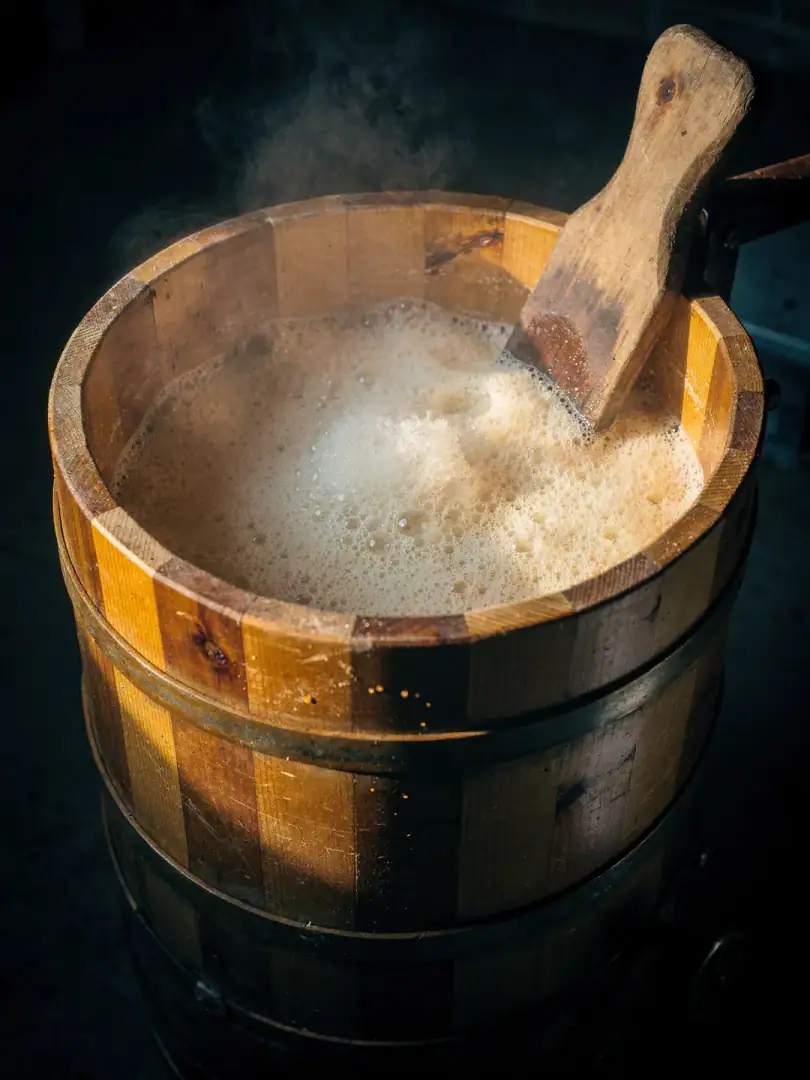
The cooled wort flows into the washback, a tall, open vessel made of wood or stainless steel holding tens of thousands of liters. As soon as yeast is added, it gets to work immediately, breaking down the dissolved sugar into alcohol and carbon dioxide. The washback is only filled to about three-quarters capacity, leaving enough headroom for the foam to rise.
Within a few hours, the liquid visibly foams up, sometimes so vigorously that without intervention it would spill over the rim. That's why some distilleries use rotating switchers with blunt blades that sweep through the surface and mechanically knock the foam back down.
Wooden washbacks made of Oregon pine are considered more traditional among connoisseurs. The reason lies in their seams, where lactic acid bacteria survive even after thorough cleaning and never fully disappear, contributing extra flavors to the fermentation. Stainless steel washbacks, by contrast, are easier to clean and control for temperature. Many distilleries therefore run both materials side by side in the same plant, depending on which whisky style is needed at the time.
Which Yeast Gets Used
Most distilleries use specialized distiller's yeast strains of Saccharomyces cerevisiae. These strains are bred for high alcohol yield, not for the delicate flavors that matter in brewing beer. Some add a small proportion of brewer's yeast as well, since this combination produces fruitier by-products than distiller's yeast alone.
The exact recipes and blending ratios are among a distillery's most closely guarded secrets. The base strains themselves, however, differ little between many houses. Within 48 to 96 hours, the yeast converts the wort into a cloudy, beer-sour liquid called wash. Its alcohol content afterward sits at around 7 to 9 percent.
Fermenting longer than usual costs more, since it keeps the washback tied up and unable to be refilled. In return, longer fermentation tends to yield more fruity esters. Every distillery has to weigh whether the extra waiting time is worth it for the character they're after.
Why Fermentation Time Shapes Flavor
A short fermentation of around 48 hours produces a wash that's more grainy and malty. The yeast mainly generates alcohol here, leaving little time for secondary reactions. A long fermentation of 60 or even 90 hours, on the other hand, lets lactic acid bacteria become active, generating additional fruit esters and floral notes.
Some distilleries, particularly in Speyside, deliberately go for long fermentation times because their house style aims for apple and pear flavors. Others keep fermentation short and prefer to let the following distillation do the work of shaping flavor. Neither approach is wrong, they simply lead to markedly different new-make characters.
Temperature as a Quiet Regulator
Temperature inside the washback also affects how fermentation unfolds. Yeast works faster in warmer conditions, but this also produces more unwanted by-products such as higher alcohols. Many washbacks are therefore fitted with cooling coils or jackets that prevent the temperature from climbing too high during the most intense phase of fermentation. Depending on the distillery and season, washbacks typically run between 20 and 33 degrees.
Without this control, fermentation could run out of hand and produce an unbalanced, harsh wash, one that even the later distillation could barely salvage. Balancing speed against cleanliness in fermentation remains one of the most underrated levers in the entire production process.
From Wash to Pot Still
At the end of fermentation stands a cloudy, lightly foaming liquid. In flavor, it strongly resembles a rough, unhopped beer and is barely drinkable on its own. Yet this wash is exactly the raw material the pot still needs, since without alcohol in the starting liquid, there would be nothing left to distill.
The wash is now pumped into the first pot still, where heat rather than yeast takes over the rest of the work. How that still is shaped, and what metal it's made from, plays a major role in determining how the finished spirit ultimately smells and tastes.