How vapor becomes liquid
Worm tubs vs. condensers
Hot alcohol vapor emerges from the head of the still and still needs to be cooled and liquefied. Two techniques share this job, with markedly different results.
The worm tub: the old school
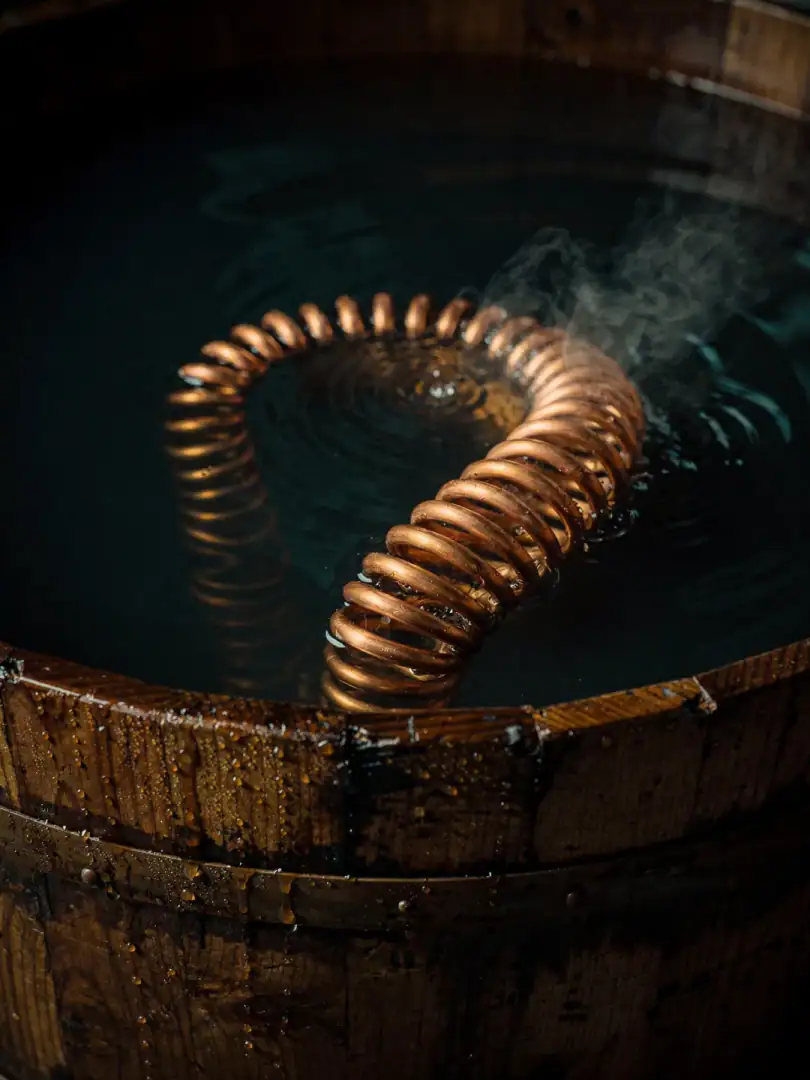
A worm tub is a long, spiral-coiled copper tube. It sits in a large, open vat of cold water. The hot vapor travels through these coils, releasing its heat into the surrounding water and condensing into liquid alcohol before exiting at the bottom of the tub.
This technique is considerably older than modern alternatives. Today it's used by only a handful of distilleries, such as Dalwhinnie, Craigellachie, or Mortlach. The reason for its survival isn't nostalgia alone. There's a noticeable difference in the taste of the finished new make.
Less copper contact, more weight
In a worm tub, the vapor hits a lower temperature relatively quickly and condenses within a narrow coil. Overall, it has less contact surface with copper than in modern setups. That means fewer sulfur compounds get filtered out. As a result, the new make turns out heavier, meatier, and sometimes slightly sulfury.
Exactly this rustic, robust character is what distilleries like Mortlach are aiming for. It's part of their house style. But running a Worm Tub also means more maintenance work. The narrow copper coils are harder to clean than a modern tube bundle.
The Shell-and-Tube Condenser as the Modern Standard
Most distilleries today rely on what's called a shell-and-tube condenser. This is an upright cylinder containing a bundle of many thin copper pipes. Cold water flows around these pipes from the outside. The alcohol vapor passes through them, coming into contact with copper over a considerably larger total surface area.
This design is easier to clean and offers more precise control. It also requires less floor space than an open water trough. What's more, it tends to produce a lighter, cleaner spirit. More sulfur compounds are captured by the copper before the vapor even turns liquid.
A Shift That Took Decades
The transition from open Worm Tubs to enclosed shell-and-tube condensers began at many Scottish distilleries in the second half of the 20th century. Demand for whisky grew sharply during this period, and many distilleries expanded or completely rebuilt their equipment. A modern condenser fit more easily into larger, more efficient production than an open water trough in the yard.
Not every distillery made this switch at the same pace. Some houses replaced only one of their two stills and kept the Worm Tub on the other, often for reasons of space or to change their house style only gradually. Only in hindsight did it become clear how strongly this single technical decision could shape the character of a New Make across generations. To this day, some Master Blenders select their cask fillings specifically based on this technical trait of the source distillery.
Why Some Distilleries Stick with the Old Ways
Switching from a Worm Tub to a modern condenser would noticeably change the character of the New Make, usually toward something lighter and less distinctive. Distilleries have built their house style over decades. Many shy away from this step, even when it would make more economic sense.
The choice between the two technologies is therefore less a question of old versus new. It's a deliberate stylistic decision. Anyone who loves heavy, sulfury, robust whiskies often owes that character to a Worm Tub, one that has stood unchanged in the distillery yard for generations.
Cooling Water as an Underrated Factor
Both systems require large volumes of cold water, usually drawn from a nearby river or loch, which is returned noticeably warmer after condensation. This is why so many Scottish distilleries have historically been sited along streams and rivers: the water is needed for the mash, but explicitly also for the necessary cooling capacity.
In summer, this becomes scarcer, since warmer river water cools less efficiently, and some distilleries must temporarily scale back production to keep the water temperature at the cooling outlet and return within legally permitted limits. This seasonal constraint affects Worm Tubs and modern condensers alike, though a compact condenser is often somewhat more economical by comparison.