The Raw Spirit Before the Cask
New Make & Cask-Filling Strength
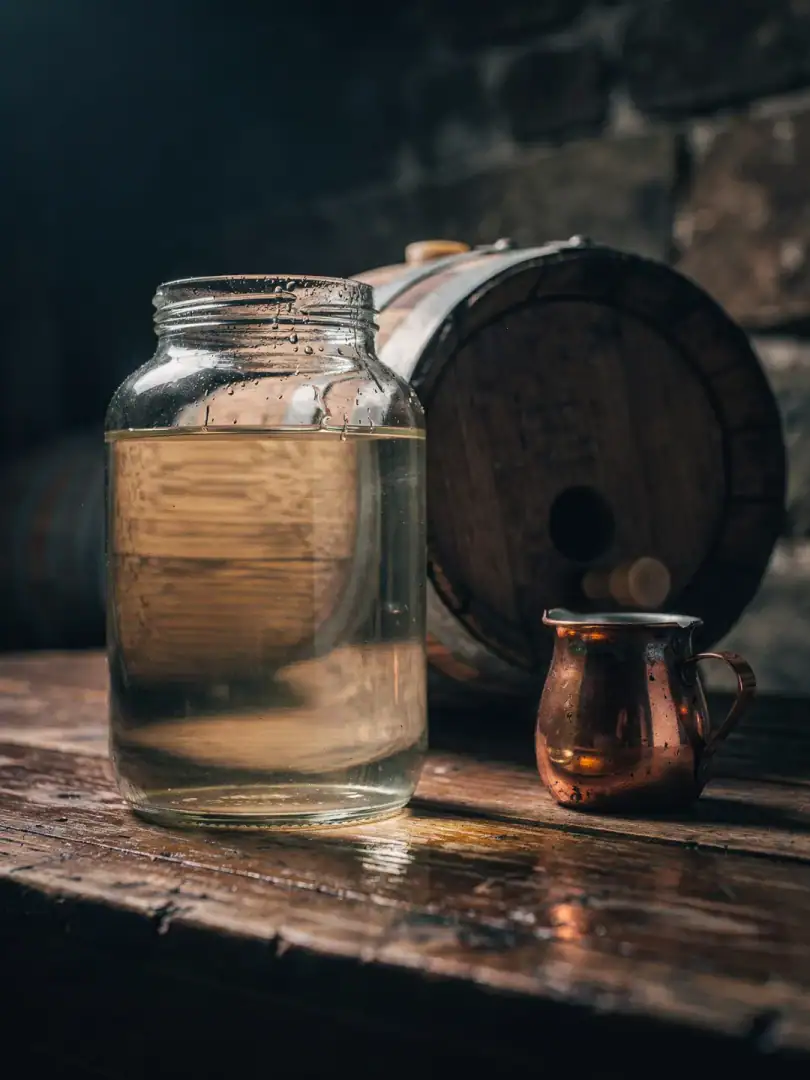
At the end of distillation stands a colorless, high-proof raw spirit: the New Make. Before it's allowed into the cask, it's brought down to the correct strength with water.
New Make: Whisky That Isn't Quite Whisky Yet
Coming straight from the Spirit Still, New Make Spirit has an alcohol content of roughly 68 to 72 percent in the case of Scotch malt whisky. It's as clear as water and, flavor-wise, still far removed from a finished whisky. Legally, it may not be called whisky in any country. Only the mandatory minimum maturation in wooden casks turns it into one.
Even so, the New Make already reveals a great deal about the eventual spirit. Experienced distillers smell and taste it straight from the Spirit Safe. This tells them whether fermentation, still shape, and the cut have come together as planned. Sometimes it becomes immediately clear that the next batch needs some adjustment.
Many Names for the Same Raw Spirit
Depending on the country, this unaged raw spirit goes by a different name. In Scotland, it's called New Make or New Make Spirit. In the US, distillers often call it White Dog, sometimes also White Lightning, a term that originally comes from informal moonshining. In every case, it refers to the same thing: clear, unaged alcohol straight from the still, before the cask has even touched it.
Some American distilleries now sell their White Dog openly in bottles, often as a limited special release alongside their aged bourbon. This is legally possible because White Dog doesn't have to be sold as whiskey, but can simply be labeled as a spirit. In Scotland, by contrast, New Make almost never officially leaves the distillery, since the Scotch Whisky Regulations 2009 require a minimum of three years of cask maturation for anything called Scotch.
Why Water Is Added Before the Cask
At over 68 percent alcohol, the new make would be too strong for barrel maturation. Wood and alcohol interact best at a specific concentration. That's why the raw spirit is diluted with water before being filled into casks. In Scotland, the target is usually around 63.5 percent, a figure that has become the industry's practical standard over decades.
At this strength, aromatic compounds are extracted most effectively from the oak. Too much water would slow down this extraction. Each distillery can choose its own exact target strength. Most, however, stay close to this established value, since it has proven itself over generations.
How it's regulated in the US
For Bourbon, US law under 27 CFR Part 5 sets a firm upper limit. The raw spirit may come off the still at no more than 80 percent alcohol. Before barreling, it must be diluted to a maximum of 62.5 percent. Only then may it be filled into a new, charred oak barrel, as required by law for Bourbon.
These limits prevent the raw spirit from becoming too neutral and the contact with fresh wood from being too intense. Unlike in Scotland, barrel entry proof for Bourbon isn't simply a matter of style. It's a fixed legal requirement that every distillery must follow.
Different countries, different frameworks
Within the EU, Regulation (EU) 2019/787 on spirit drinks defines the term whisky uniformly: a minimum of three years' maturation in wooden casks and a minimum bottling strength of 40 percent ABV, regardless of the country of production. These thresholds serve as a baseline for all member states, even though individual countries like Scotland impose additional, stricter rules through the Scotch Whisky Regulations 2009.
Clear regulations also exist outside Europe. Ireland's Technical File from 2014 likewise requires at least three years of cask maturation, while Japan's industry standard set by the JSLMA in 2021 established, for the first time, that a spirit may only be called whisky if it was actually distilled in Japan and matured there for at least three years. However, these regulations remain silent on the exact barrel entry strength, which around the world usually remains up to the individual distillery.
The final step before maturation
Once the new make has been diluted to its target strength, it's filled into casks and moved to the warehouse. From this moment on, wood, time, and climate take over. Everything that has happened up to this point, malting, mashing, fermentation, distillation, and cutting, becomes the foundation locked inside that single cask.
How strongly this foundation still comes through in the finished whisky depends heavily on the type of cask and the length of maturation. That, however, is a different stage of the journey, because from here on, it's no longer about distilling but about maturing.