How often it's distilled
Double vs. triple
Two runs through the still are enough for most Scotch distilleries. Some go a third route and distill a third time, which makes the spirit noticeably lighter and cleaner.
The Scottish standard: double distillation
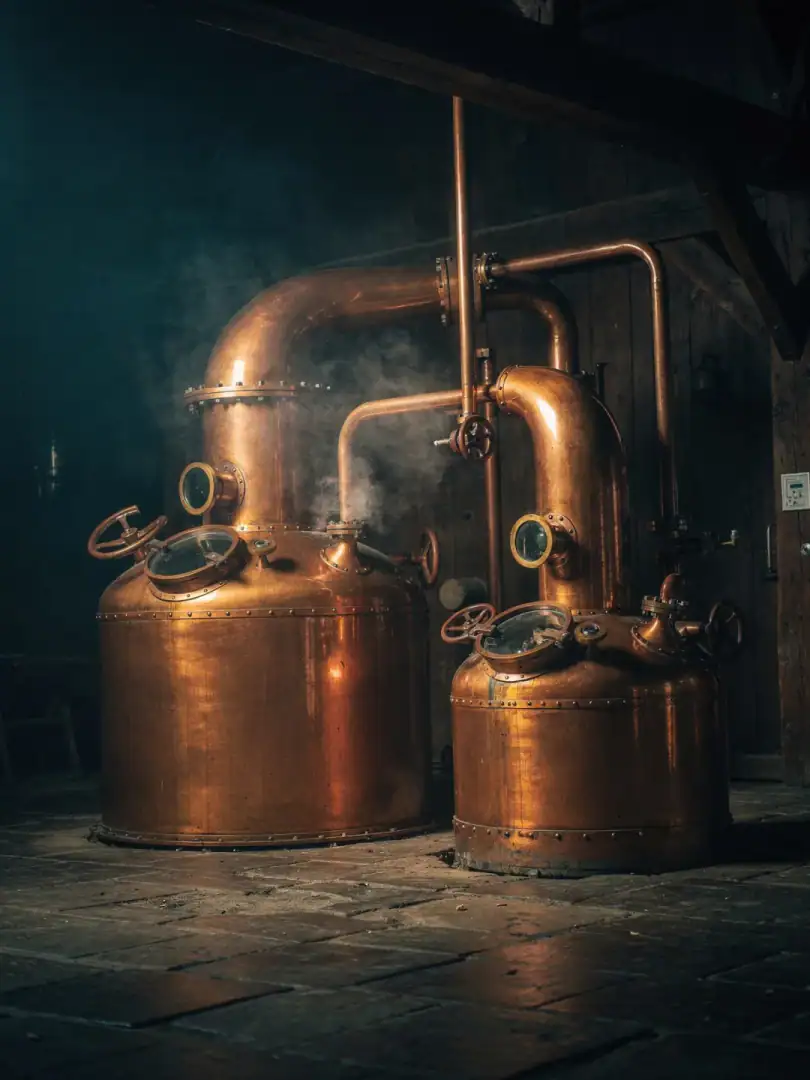
The vast majority of Scottish malt distilleries distill twice. The wash from fermentation first runs through the wash still, where a rough separation of water and alcohol takes place. The result is the so-called low wines, at around 20 to 25 percent alcohol.
These then run into the spirit still, where the actual fine-tuning happens. After this second run, the new make typically sits between 68 and 72 percent alcohol.
Two runs are considered sufficient in Scotland. They remove enough unwanted compounds while still preserving the character of the barley, the yeast, and the still shape in the spirit. It's exactly this balance that makes double distillation so widespread, and most Scottish distilleries have stuck with this exact process since their founding.
The third run: more purity, less weight
A few distilleries commit to triple distillation, Auchentoshan in the Scottish Lowlands foremost among them. After the wash still and spirit still, a third, often smaller still follows there. It pushes the alcohol content further, past 80 percent, and strips away even more heavy compounds.
The result is a particularly light, creamy, and mellow new make with few rough edges. Anyone who likes this style gives up some of the rustic, oily heaviness in return. Double-distilled whisky often carries that heaviness. Both approaches are technically demanding, just aimed at different goals.
The third run costs extra time, energy, and manpower, since every additional distillation needs its own monitoring at the spirit safe. Distilleries that take on this effort do so deliberately as part of their brand identity, not out of economic necessity.
Ireland as the home of triple distillation
Triple distillation is traditionally seen mainly as an Irish hallmark. Historically, this dates back to a time when Irish distilleries wanted to produce particularly pure spirits suitable for export. To this day, many Irish distilleries work with three runs. Not all of them do, though, since double-distilled bottlings exist in Ireland too.
The often-repeated claim that Irish whiskey is fundamentally smoother than Scotch because it's always triple distilled is therefore only half the truth. Actual distilling practice varies from distillery to distillery, regardless of which side of the Irish Sea it stands on.
The number of runs isn't legally mandated
Neither the Scotch Whisky Regulations 2009 nor the EU Spirit Drinks Regulation (EU) 2019/787 dictate how many times a distillery must distill its wash. Both frameworks only require a minimum period of cask maturation and a minimum bottling strength of 40 percent ABV. Whether a distillery distills twice, three times, two-and-a-half times, or four times remains purely a house decision, not a legal requirement. Only the individual production steps before and after are subject to fixed rules in some places, not the number of runs itself.
The special case: two-and-a-half times
A particularly distinctive process is run by Springbank in Campbeltown, which produces three different whiskies at a single site using different distilling techniques for each. The namesake Springbank malt is distilled two-and-a-half times: part of the low wines from the wash still passes through an additional, third partial run before everything combines and runs into the spirit still.
At the same site, Longrow is made, double distilled and heavily peated, along with Hazelburn, fully triple distilled and unpeated. All three whiskies come from the same barley and the same stills, yet differ fundamentally in character purely through peat use and number of runs. This shows just how strongly this single variable shapes the finished whisky.
The far edge: quadruple distillation
At the very extreme of the scale sits quadruple distillation. Bruichladdich on Islay introduced X4 Quadrupled, a distillate that runs through the same stills four times and ends up above 90 percent alcohol. That's considerably more than the usual new make at 68 to 72 percent.
A result at this level is barely suitable as a classic malt whisky in the conventional sense, since at such high purity the grain loses almost all its character. Such experiments do show, though, where the technical limit of pot still distillation lies. They also show how strongly each additional run pushes the spirit toward neutrality, and how little of it still recalls the original grain by the end.