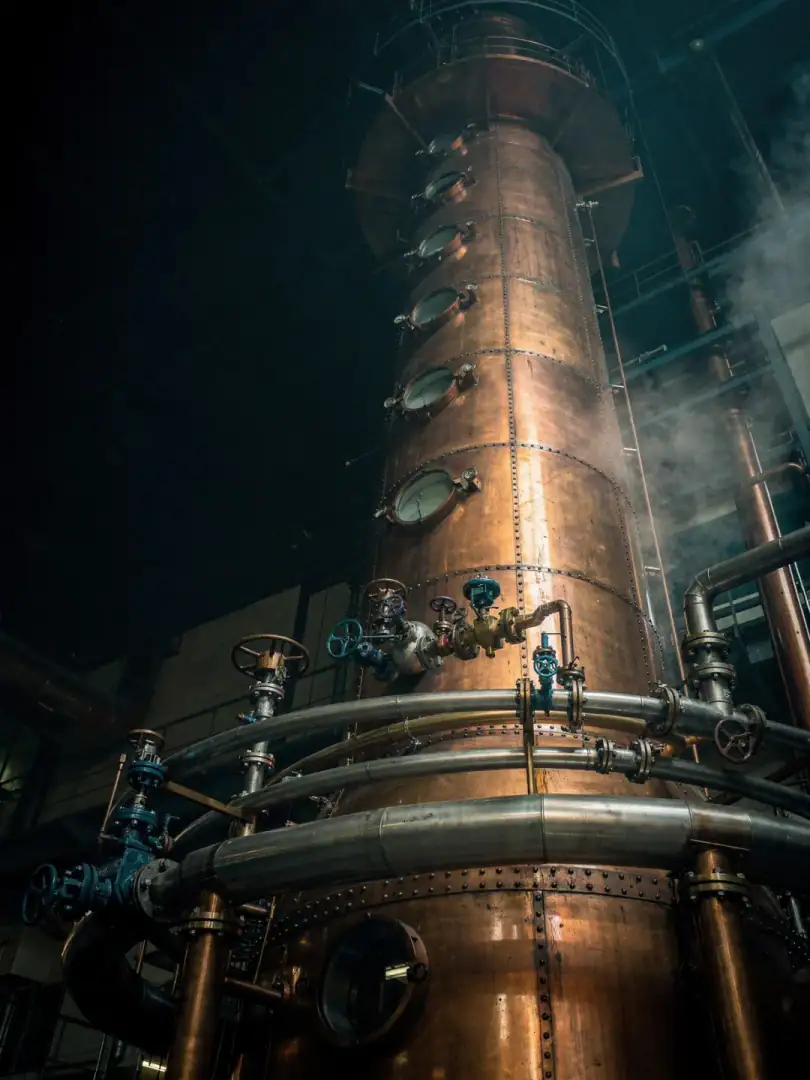
Continuous operation instead of batches
Column still
Alongside the classic pot still there's an entirely different design: the column still, also called a Coffey still. It runs continuously and delivers a light base spirit rather than a characterful malt.
From Robert Stein to Aeneas Coffey
The first practical column still was developed by the Scotsman Robert Stein in the mid-1820s. The Irishman Aeneas Coffey improved on this design and had it patented in 1830. That's why the design is still often called a Coffey still today, even though Coffey wasn't its sole inventor.
Unlike a pot still, a column still runs continuously. A pot still must be emptied and refilled after every run. Wash flows continuously into the top of the column still, and alcohol is drawn off continuously at the bottom, as long as there's a supply of wash coming in.
Two columns working together
A column still usually consists of two tall columns divided by perforated plates. In the first, called the analyzer, rising steam meets descending wash. The alcohol gradually dissolves out and evaporates.
The second column is called the rectifier. It refines this vapor further, separating alcohol by boiling point into different purity levels. The vapor passes through many perforated plates along the way. The effect resembles many successive small distillations, just without ever needing to empty a kettle anywhere. That makes the setup efficient, though also notably more expensive to acquire than a simple pot still.
What column stills are used for
In Scotland, this design mainly produces grain whisky. Wheat or corn usually replaces malted barley here. The grain whisky is later blended with malt whiskies to make blended Scotch.
In the US, bourbon and rye are also mostly made using column stills. A second pass often follows in a smaller doubler or thumper for fine-tuning. Under US law, set out in 27 CFR Part 5, bourbon may come off the still at no more than 80 percent alcohol. This limit prevents the alcohol from becoming so pure that virtually none of the grain character remains.
Why the column doesn't run to its maximum
A column still could theoretically purify alcohol to nearly 96 percent, the point at which water and ethanol form an azeotrope and can barely be separated further. That's exactly what stills producing neutral grain alcohol for vodka or gin do. Anyone making whisky deliberately halts this process earlier, well before the column reaches its technical maximum.
The closer the alcohol content gets to this maximum, the more so-called congeners disappear, those flavor compounds that give the grain its character. An overly pure grain whisky would contribute little more than raw alcohol to a blend. That's why every distillery sets a lower target strength for its column still, often well below the technically possible maximum. In doing so, it deliberately accepts a somewhat lower yield, because grain character matters more to it than the last few percentage points of purity.
Light base spirit instead of heavy character
Column stills are optimized for high purity. As a result, they deliver a noticeably more neutral alcohol than a pot still. That's not a drawback, it's the purpose of the design. Grain whisky is meant to carry the malt components in a blend, not overshadow them. Bourbon is meant to still taste distinctly of corn despite its high purity.
Pot stills and column stills aren't mutually exclusive in many countries. They complement each other. Scottish blends need both designs. American distilleries use the column still almost exclusively. Most of the character development then follows later, during cask maturation.
Hybrid stills between the two designs
Some smaller, newer distilleries now use hybrid stills, where a rectifying column sits directly atop a classic pot still. This allows switching as needed: with the column disengaged, a classic, characterful pot-still spirit results; with the column engaged, a purer, more neutral spirit comes from the same setup.
This is attractive for small craft distilleries, since a single still combines the flexibility of a column still with the character of a pot still, without needing to acquire two separate setups. In Scotland, this design remains rare, because the Scotch Whisky Regulations 2009 explicitly require pot stills for malt whisky.