More Grain Allowed
Single Grain Whisky
Single Grain sounds like a supporting act, but it's a distinct style with a long history. Like Single Malt, this whisky comes from just one distillery, yet the mash may include corn or wheat alongside barley.
What sets Single Grain apart from Single Malt
The difference lies in the grain and the still. Single Malt uses exclusively malted barley. Single Grain, by contrast, may add unmalted corn or wheat grain. It's usually distilled in a different, continuously running still rather than the classic pot still.
The result is generally lighter and milder than a Single Malt. It lacks the pronounced roasted and nutty notes. Some Single Grains, however, mature surprisingly long and gain depth as a result.
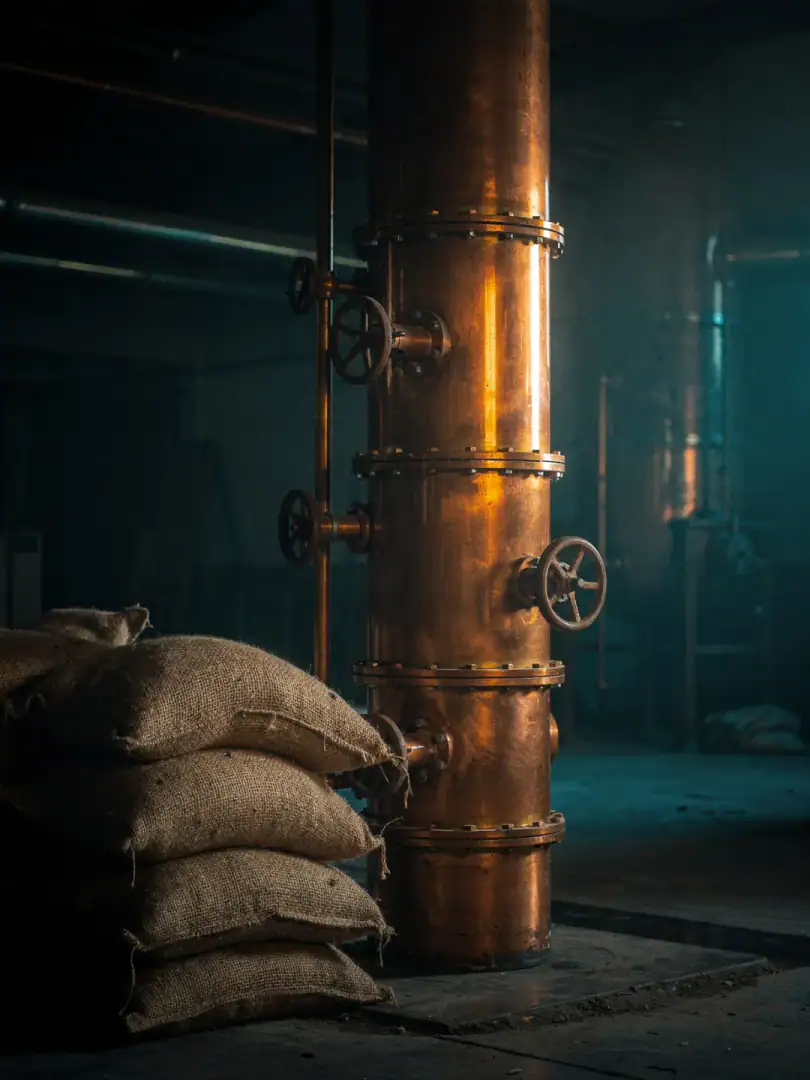
The continuously operating still, known as a Coffey Still or Column Still, allows round-the-clock operation, while a classic pot still must be refilled after every run. This difference in technique explains why Single Grain is generally much cheaper to produce than a Single Malt from the same region. Large distilleries use exactly this efficiency to reliably supply the huge quantities needed for blends worldwide.
Corn and wheat in the grain mix
Because Single Grain permits several types of grain, the recipe varies more from distillery to distillery than with Single Malt. A typical mash contains a large proportion of corn or wheat. Only a small amount of malted barley is added, providing the necessary enzymes.
This grain mix is reminiscent of American whiskeys. Even so, origin and maturation still follow the rules of the respective country, such as the Scottish rules for a Scotch Single Grain.
Some distilleries even use wheat as their main grain, since it's more readily available than corn in certain regions of Scotland, where corn must be imported. The exact choice depends heavily on local supply chains and long-standing contracts with farmers. Other distilleries switch between corn and wheat depending on the harvest year, whenever prices or availability shift significantly.
Why Single Grain was long reserved for blends only
For decades, almost all Single Grain ended up in Blended Whiskies. There, it rounds off the more robust malts and stretches them further. Distilleries often produced it in large quantities without it ever being bottled under its own name.
This background role explains why Single Grain remains unfamiliar to many drinkers even today. Yet it accounts for a substantial share of global whisky output.
Because single grain was rarely sold under its own name, it remained almost invisible to the wider public for decades, even though it made up a large share of Scotch production by volume. This perception only shifted noticeably as interest in niche styles grew. Tasting panels and specialist retailers began featuring individual grain bottlings on purpose, rather than mentioning them only as blend components.
Standalone bottlings today
In recent years, more and more distilleries have started releasing their single grain neat, often with long cask ageing. Fans appreciate its mild, slightly sweet character. It stands apart pleasantly from the intensity of some single malts.
Anyone who tries single grain discovers a quieter side of whisky, one that was long overlooked in the shadow of better-known malts.
Independent bottlers are driving this development: they buy individual casks directly from grain distilleries and release them under their own label, often with precise details on vintage and cask type. For collectors, such bottlings offer a rare chance to try distilleries that seldom release their own bottles under their own name at all.
An example of change in the whisky market
Some Scottish grain distilleries are now releasing casks thirty or forty years old under their own name. Such releases show just how soft and complex single grain can become after long maturation. Prices are often lower than for comparably aged single malts, since demand is still smaller.
This shift follows a broader trend: drinkers today actively seek out unfamiliar styles. Single grain benefits from this, having long stood in the shadows and now being rediscovered. Curious beginners would do well to explore these quieter bottlings.
When it comes to cask selection, some bottlers are also breaking new ground, experimentally maturing single grain in red wine casks or other unusual wood types. Such experiments would be rarer with a strictly traditional single malt, and show just how much freedom this style now offers. For curious drinkers, this opens up a range of unexpected flavours within a single whisky style.