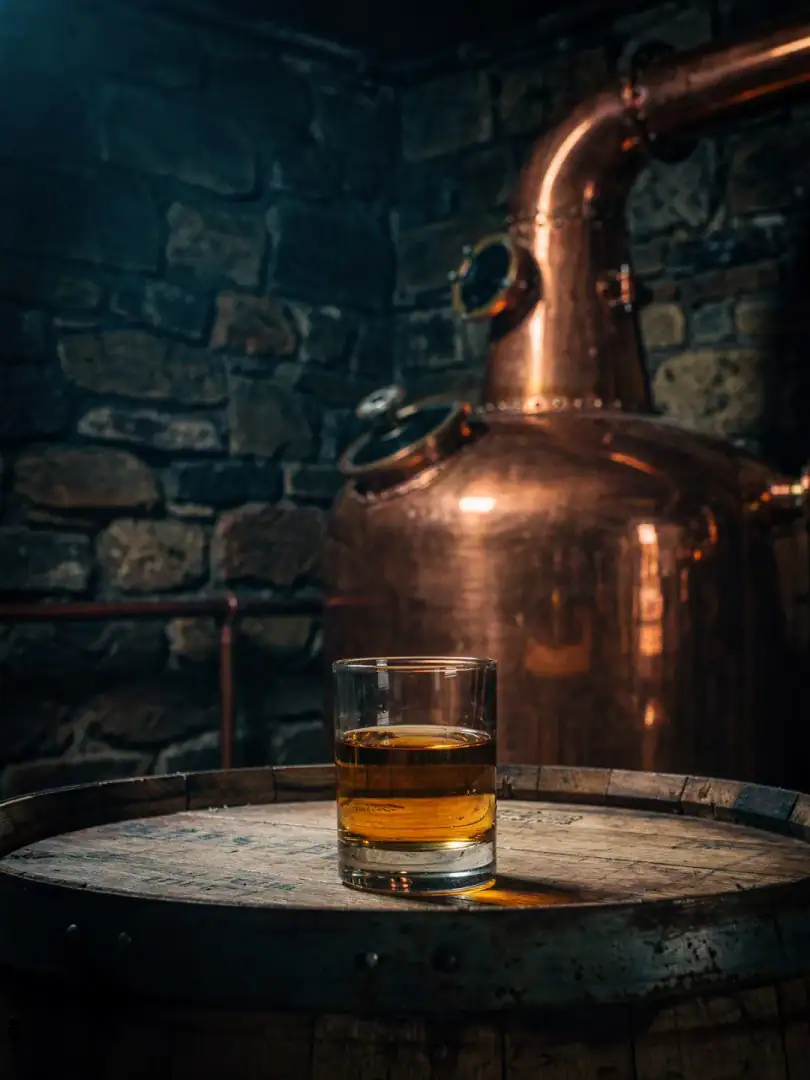
Malt, One Distillery
Single Malt Whisky
Single Malt stands for origin from a single distillery and for pure barley. The name promises no particular flavor, but rather a method of production: one grain, one place, many casks from different vintages that are ultimately blended into one bottling.
What the word Single actually means
Single doesn't refer to a single cask, but to a single distillery. A Single Malt may come from many casks of the same house and still carry the name. What matters is only that not a single drop from another distillery is added.
This rule is set out by the Scotch Whisky Regulations 2009 for Scotland. Other countries with their own Single Malt tradition, such as Ireland or Japan, follow similar principles. The focus everywhere lies on origin, not on any particular number of casks.
This clarification matters because many newcomers mistakenly equate Single with a single cask. In fact, most distilleries blend numerous casks from different vintages and warehouse locations for a single bottling, to ensure a consistent house style, without violating the one-distillery rule.
Malt as the only grain
A true Single Malt is made exclusively from malted barley. No corn, no wheat, no unmalted grain may enter the mash. This restriction to a single grain makes a distillery's signature style more clearly recognizable than in whiskies made with a grain mix.
Precisely because the grain always stays the same, water, yeast, still shape, and cask choice determine the difference between two distilleries. A Single Malt is therefore a good starting point for comparing distillery styles directly against each other.
This restriction is strictly enforced: even if a small proportion of unmalted grain were added, the bottle could no longer be sold as Single Malt and would have to be declared under a different category. In Scotland, this is monitored through official oversight that traces every bottling.
Why Single Malt can taste so different
Two Single Malts from the same region can taste completely different. Every distillery makes its own decisions: how long it ferments, how it distills, which casks it uses. The only common denominator is the method, not the flavor.
This very range is what makes Single Malt so interesting for many newcomers. Taste ten different bottlings and you learn ten different signatures. Yet the same basic rule applies everywhere: one distillery, one grain.
Even within a single distillery, bottlings from different years can differ noticeably, since climate, raw materials, and small technical adjustments shift over time. This very unpredictability is what makes the master distiller's job so demanding, and the finished whisky so interesting to collectors.
Where Single Malt calls home
Scotland made Single Malt famous. But Japan, Ireland, India, Taiwan, and Germany have long been producing their own Single Malts as well. Each country brings its own climate and water sources into play, even though the basic rule remains similar everywhere.
The term itself isn't legally protected in many countries the way it is in Scotland. It's always worth checking the country of origin and the distillery before buying a bottle.
In Germany, for instance, an increasing number of dedicated Single Malt distilleries have emerged since the 2000s, experimenting with local barley and regional climate. Their whiskies often differ markedly from Scottish originals, because warmer summers speed up cask maturation and let flavors develop faster.
Age and cask statements as a first orientation
Many Single Malt labels carry an age statement such as twelve or eighteen years. This always refers to the youngest cask in the blend, not the average. A Single Malt without an age statement isn't automatically inferior; it's often deliberately assembled from several different vintages.
Anyone buying their first Single Malt is best guided by region and age rather than price alone. Both pieces of information reveal far more about the expected style than any bottle shape.
Beyond age, it's also worth checking the cask strength and whether a whisky has been filtered. Single Malts bottled undiluted or unfiltered often state this explicitly on the label, aimed at drinkers who want to experience the original character as unaltered as possible.