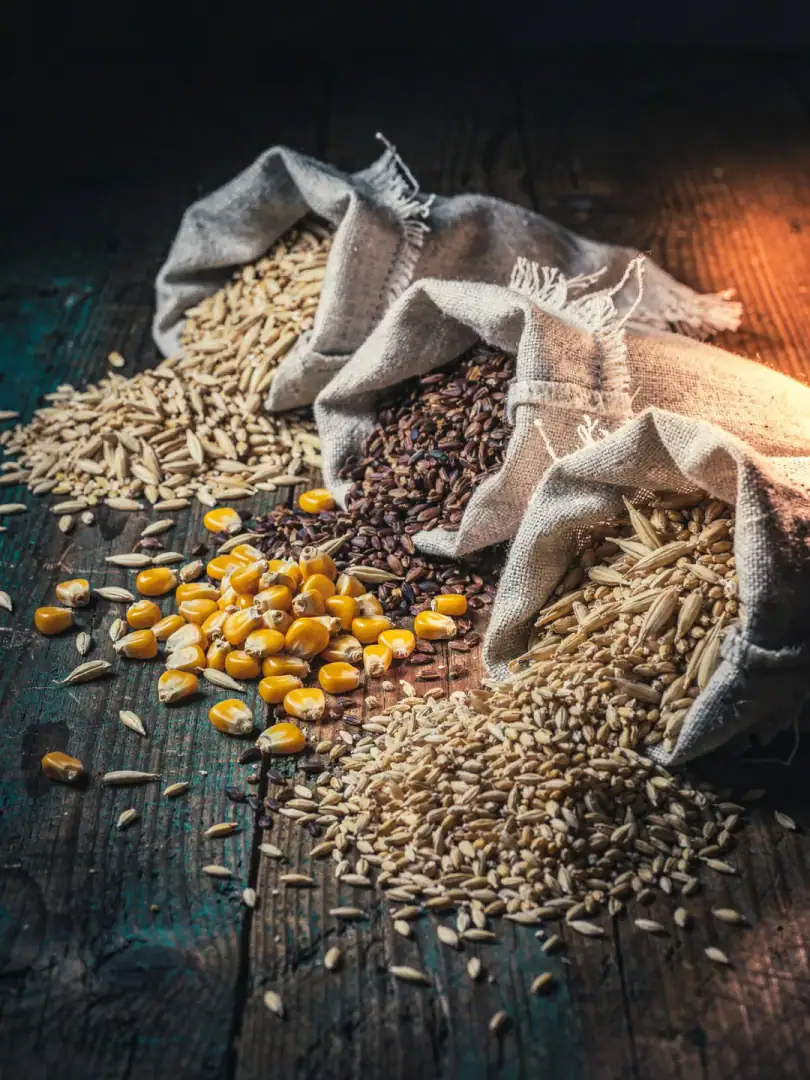
Four Types of Grain
Which Grain Is Inside?
Every whisky begins as a grain mash. Barley, corn, rye, and wheat each bring different flavors, from nutty to sweet to spicy. Which grain a country favors shapes a whisky's character more than any cask maturation that follows.
Barley as the foundation of many styles
Barley is the oldest whisky grain and the basis of Scotch. Malted, meaning sprouted and then dried again, it supplies the enzymes that later convert other grains into sugar too. Its flavor is considered nutty, bready, and lightly sweet. This base note accompanies almost every Scotch whisky.
In Scotland and Ireland, barley remains the most important grain to this day. Many new distilleries outside these countries also start out with barley. In doing so, they draw on centuries-old recipes before striking out on their own path.
Before mashing, the barley is soaked in water for several days so it begins to germinate at all. Only this germination process releases the enzymes that other grain types later depend on. Without this step, even the finest barley would be practically worthless for whisky production.
Corn brings sweetness to Bourbon
Corn delivers more sugar than any other common whisky grain, giving a rounded, almost caramel-like base note. In the USA, a whiskey must contain at least 51 percent corn to be called Bourbon. The rest is usually barley, rye, or wheat. This blend ultimately determines the character of the bottle.
Because corn contains so much sugar, mashes with a high corn content ferment vigorously and quickly. This explains why Bourbon often tastes sweeter and rounder than a pure barley whisky from Scotland. Anyone who tastes both side by side notices the difference immediately.
Because corn grows as a cob rather than an ear, it must be additionally ground and cooked before mashing so its starch becomes accessible at all. This extra effort pays off, since no other common whisky grain delivers such reliably high alcohol yields.
Rye provides spice and bite
Rye brings pepper, herbs, and a slight sharpness. It differs markedly from corn and barley in this respect. Even a small proportion of rye in a mash noticeably changes the flavor, because the grain is so intensely aromatic.
Rye has a long tradition in the USA and Canada. In Scandinavia and Germany, it's currently experiencing a small revival. A whisky with a high rye content rarely tastes mild; instead, it's often complex and edgy.
Rye swells more strongly than other grains when cooked and can pose technical challenges for distilleries, for instance when the mash turns thick and becomes harder to stir. Many distilleries deliberately accept this extra effort, since the spicy aroma can't be achieved any other way.
Wheat for mild, soft whiskies
Wheat contributes little flavor of its own and thus acts almost like a neutral carrier for other ingredients. Whiskies with a high wheat content often taste soft, round, and lightly sweet. They lack the bite of rye and the pronounced nuttiness of barley.
Some American distilleries deliberately use wheat instead of rye and call the result Wheated Bourbon. In Germany too, where wheat grows abundantly, the grain is gaining importance among young craft distilleries.
Because wheat is softer than barley or rye, it's easier to process in the mill, but ferments more delicately and requires more attention in the distillery. That effort pays off in a whisky that glides especially smoothly across the tongue.
Why distilleries rarely use a single grain alone
Very few whiskies are made from just one grain. Distilleries usually blend two or three types to balance sweetness, spice, and texture. Only malted barley reliably supplies the enzymes that convert unmalted corn or rye grain into sugar as well. Without a portion of barley, fermentation would barely work.
That's why barley shows up even in recipes that are actually known for their corn or rye flavor, such as Bourbon or Rye. It remains the quiet building block in the background. The stations that follow show how these four grains become entirely different whisky styles.
Even within a single style, the exact blending ratio varies considerably from distillery to distillery, often following a closely guarded recipe. This recipe, known as the mash bill, helps determine how a whisky later matures in the cask and what character it ultimately shows.