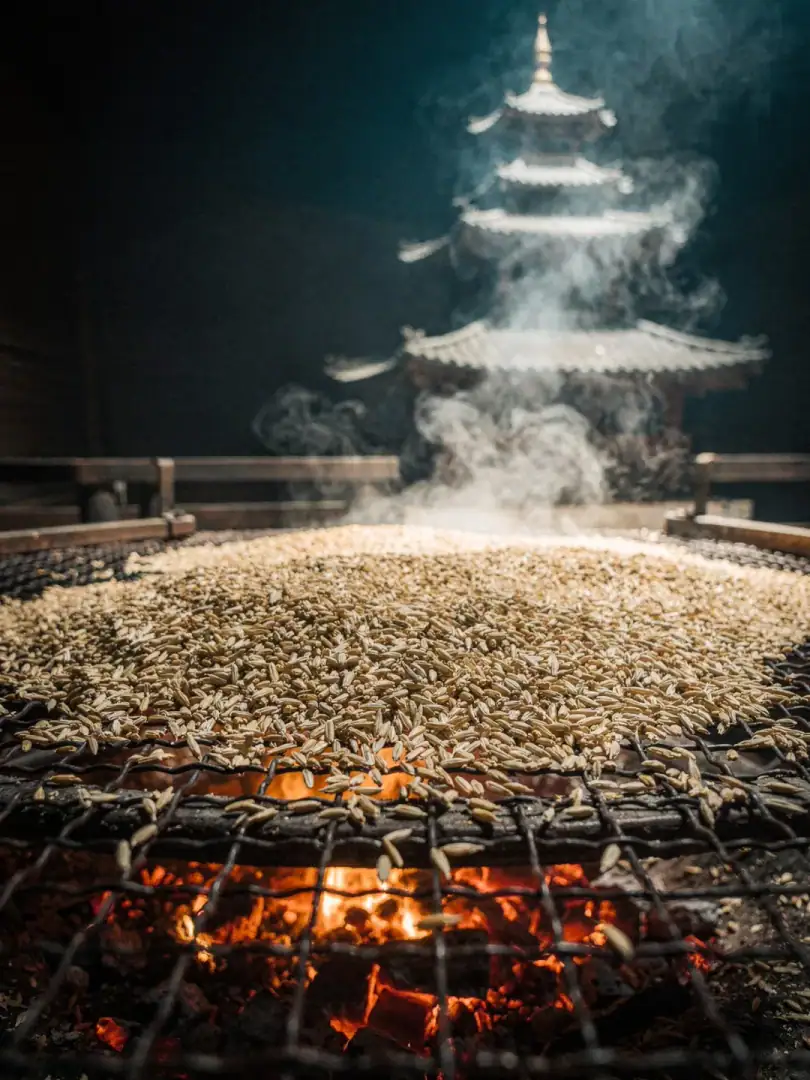
Malt Meets Fire
Kilning & Smoke
Between peat cutting and the glass lies the kiln: an oven in which moist, germinated malt is dried. If peat smoke is drawn through the malt during this process, its aroma settles onto every single grain, long before the mash is even made.
Why Malt Is Kilned at All
Before barley becomes whisky, it must germinate. During germination, the grain forms enzymes that will later convert starch into fermentable sugar. To stop the grain from growing into a plant and to preserve these enzymes, the germination process is halted with heat: the moist malt goes into the kiln and is dried.
Without any smoke at all, using just hot air, you get unpeated malt, the type used by most whiskies worldwide. Only when smoke, rather than pure heat, is passed through the malt do we speak of peated malt, the raw material for smoky whisky.
How Smoke Gets Into the Malt
Traditionally, the moist malt lies on a perforated floor above a hearth in which peat smolders. The smoke rises up through the malt and back down through a roof with the characteristic pagoda shape, an architectural style still seen at many Scottish distilleries today, even though there's often no active kiln behind it anymore.
Hardly any distillery malts its own malt these days; most buy it already smoked from specialized maltings. These maltings control the smoking duration and intensity precisely to hit a specific strength, often according to the distillery's own specification. Only a few houses, such as Balvenie or Laphroaig, still operate their own small floor maltings alongside buying in malt.
Why Duration and Timing Matter
How long smoke is drawn through the malt largely determines how peaty the resulting whisky will be. Short smoking times produce a lightly peated malt, hours of smoldering an extremely peaty one. Between these extremes lies a wide range that distilleries use deliberately to shape their house style.
Smoke that hits still very moist malt early in the drying process settles differently than smoke that hits nearly dry grain at the end. Maltings deliberately use this timing window to shape aromas that only reappear years later in the finished whisky.
Old Kilns, New Technology
The classic floor malting with its pagoda roof is rarely active today, since it produces little malt per day compared to industrial facilities. Most distilleries have outsourced this step to large maltings that work with drums and automated kilns, but which still follow the same principle of passing smoke through moist malt.
A few houses stick with the old method, not out of pure nostalgia but because it lets them control smoke levels precisely for small batches. Balvenie, for instance, still malts part of its own barley and later blends it with bought-in malt for the finished whisky.
How to Recognize Peated Malt
Even raw, unmashed malt reveals whether it's been peated. Unpeated malt smells sweetly of grain and honey, while peated malt carries a distinct, sometimes biting smoky smell reminiscent of a dying campfire. Distillery staff can usually tell roughly the ppm range of a malt just from the smell of a sack, even before it's mashed.
Maltings normally supply peated malt with a precise specification that records not just the ppm value but also moisture, enzymatic power and grain quality. Distilleries often order several batches with different smoke levels at once, so they can later blend them in-house for different bottlings, rather than committing to a single fixed smoke strength.
Smoke That Stays in the Whisky
Once drawn into the malt, peat smoke never fully disappears again. It survives mashing, fermentation and distillation, though heavily diminished. Even after decades in the cask, a trace of it remains noticeable. It's exactly this persistence that makes peated malt so reliably plannable for distilleries.
Some production styles deliberately use only a portion of peated malt, blending it with unpeated malt. This produces a whisky with light smoke in the background rather than full force up front. This blending technique allows for fine gradations between mild and intense, all without needing a separate still setup for two distinct styles.